Trains and Mergers
Phases, rust, train export, the Merger Round, forced train purchases, bankruptcy and the end.
Train phases and rust
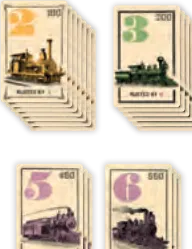
The trains form one stack, cheapest on top. Whenever a train is bought from the stack or exported, check two things at once (rulebook p. 16):
- Phase change: the first train of a new colour — green, purple or grey — starts that phase. New tiles become available to the next company, new train limits apply at once (a company over the limit puts a train of its choice in the bank pool), and the range of starting prices widens.
- Rust: the first 4-train rusts all 2-trains, the first 6-train all 3-trains, the first 7/∞-train all 4-trains. Rusted trains leave the game immediately.
| Train | Stops | Price | Rusted by | Train limit Minor / Major | Starting prices |
|---|---|---|---|---|---|
| 2 (yellow) | 2 | 100 | 4 | 2 / – | 60–90 |
| 3 (green) | 3 | 200 | 6 | 2 / 4 | 60–110 |
| 4 (green) | 4 | 300 | 7/∞ | 2 / 3 | 60–110 |
| 5 (purple) | 5 | 450 | Permanent | 1 / 2 | 60–135 |
| 6 (purple) | 6 | 550 | Permanent | 1 / 2 | 60–135 |
| 7 (grey) | 7 | 750 | Permanent | 1 / 2 | 60–135 |
| ∞ (grey) | Any | 1,000, or 800 + a trade-in | Permanent | 1 / 2 | 60–135 |
The limit column applies after that train has been bought or exported. 7 and ∞ are the two sides of the same grey cards: once grey trains are on top you choose which side to buy. Their supply is meant to be unlimited — use exported or rusted cards if you run out.
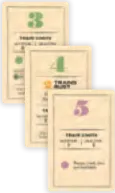
Optional reminder cards can go under the first 3-, 4- and 5-train to remind everyone what happens.
 Resourceful Company keeps rusted trains for one more run; they do not count
against its limit and cannot be sold or traded in (companies).
Exporting trains
After the Merger Round (or straight after OR2 before green), the top train of the stack is exported — removed from the game (rulebook p. 19):
- Exporting a 2-train removes all remaining 2-trains, so the first 3-train is next.
- Any other export removes one train.
- An export counts like a purchase: the first 4-, 6- or 7/∞-train exported rusts trains, and the first green, purple or grey train exported changes the phase.
- If that export starts the green phase, there is no Merger Round now; go to the Stock Round.
Then, unless this was the last cycle, advance the cycle counter and move the round marker to the Stock Round. [Solo] There is no export in solo (Solo). [Landmarks] With the Metropolitan, exported trains go to it (Metropolitan).
Mergers
After both Operating Rounds, if the first green train has been bought or exported, there is a Merger Round (rulebook p. 18):
- In descending share price, each Minor’s president may propose a merger with another Minor it can trace a route to (to at least one of its hubs), or pass.
- Both presidents must agree (often it is the same player). A refused proposal cannot be repeated this Merger Round.
- The new president is whoever owns the most shares of the two Minors; on a tie, the president of the Minor that comes first in operating order. They choose an available Major Corporation.
- Shares: every Minor share becomes a Corporation share where it lies. The new president takes the Corporation’s president’s certificate; the other Minor’s president’s certificate becomes two single shares.
- Charter: place the two Minor charters side by side and the Corporation charter on top. The Corporation keeps both Minors’ abilities.
- Stock price = the average of the two Minors, rounded down. Put the Corporation’s tokens on the stock track and earnings chart and remove the Minors’ tokens.
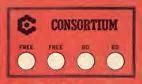
- Hubs: replace each Minor hub on the map with a Corporation hub. If both were on one tile, keep one there and put the other back on the charter on a FREE spot. Two more hubs go on the two rightmost charter spots; a spare hub returns to the box.
- Treasuries and trains combine. Over the train limit, the president puts one train in the bank.
- Return the Minors’ tokens and certificates to the box.
[Landmarks] Merger Mania! adds a second Merger Round, and Hostile Mergers (base variant) put mergers to a share vote (Events, variants).
Forced train purchase and bankruptcy
A company that owns no train must buy one before its turn ends. If its treasury cannot pay for a train from the stack or the bank pool, and no deal with another company is made (rulebook p. 17):
- The company buys the cheapest train between the bank pool and the stack (a grey one must be a 7).
- It spends all its treasury first (its own shares do not count).
- The president adds personal cash.
- Still short? The president sells shares one at a time until there is enough or nothing more can be sold. All prices drop afterwards, one step per company sold.
- The president may not sell shares of the operating company that would hand over its presidency, nor push its bank pool above 50%.
If even that is not enough, the president is bankrupt.
Bankruptcy and the end
- A bankruptcy usually ends the game at once. If the others want to go on: every company the bankrupt player presides over leaves the game; its trains go to the bank pool and its hubs leave the map; the other players cash in their shares of those companies at their last price (simultaneously, no price drop); then remove their tokens and continue.
- Normal end: after the 4th cycle (Short) or 6th (Long), each player adds cash + the value of all shares they own. Company treasuries do not count. Highest total wins; on a tie, the president of the company that would operate first wins.
- [Landmarks] Metropolitan shares count like any others (Metropolitan).