The Companies
The twelve Minor Companies and their abilities, and the six Major Corporations they merge into.
Minor companies
Every Minor Company bends one rule. Its ability is printed on its charter and wins over the normal rules whenever the two disagree (rulebook p. 12). When Minors merge, the Major Corporation keeps the abilities of both — so a Major can have two (rulebook p. 18). Four Minors are left out of the Short Game: Adaptive, Bridging, Overnight and Spacious (rulebook p. 6).
| Logo | Company | In short | Short Game |
|---|---|---|---|
 | Adaptive | Chooses its home when it launches | No |
 | Agricultural | A yellow tile after its upgrade | Yes |
 | Bridging | Bridges over water | No |
 | Eastern Mining | Two-stop mine home tile | Yes |
 | Expansive | A second hub for 40 | Yes |
 | Express | +1 stop with a single train | Yes |
 | Northern Port | Two-city port home tile | Yes |
 | Overnight | Runs through full cities | No |
 | Resourceful | Rusted trains run once more | Yes |
 | Spacious | One extra train slot | No |
 | Suburban | Two suburbs worth +10 | Yes |
 | Tunneling | Earns 60 per mountain | Yes |
[Landmarks] The expansion adds four more Minors — Circus, Coupling, Manufacturing and Twin Cities (New Companies).
Adaptive Company
Has no printed home. Its first president picks the home while launching it in the
Stock Round: any empty spot in a basic city — not a 
 city
and not a spot reserved for another Minor — with or without a track tile already there.
Agricultural Company
After laying its one upgrade, it may also lay a yellow tile.
Bridging Company
Owns five bridge tiles (two straight, two gentle curves, one sharp curve). It may lay
them on water hexes instead of normal yellow tiles; bridges are never upgraded. Its other track
may also run into the edge of a water hex.
Eastern Mining Company
Its home is the tile, with its own set of upgrades. The mine tile
holds two stops linked by track, so it gives a 2-stop route from the first turn. Each upgrade may
be turned so the new leg goes clockwise or anticlockwise; what must stay is the connection to each
existing hex side. Any company may upgrade it.
Expansive Company
Has an extra hub token. During an Operating Round it may place it for 40 from
its treasury, under the normal hub rules. If it is still on the charter when Expansive merges, it is
swapped for a token of the new Corporation and stays on the 40 space.
Express Company
While it owns exactly one train, that train counts one extra stop. Mark it with
the  marker.
Northern Port Company
Its home is the tile, with its own upgrades; any company may upgrade
it. One train cannot run to both halves of the port tile.
Overnight Company
May pass through cities full of other companies’ hubs. A skipped city is part of
the route but is not a stop and earns nothing, and the route still may not visit any city twice.
The ability also counts when checking whether Overnight can reach a tile to lay or upgrade, a Minor
to merge with and, once merged, a city spot for a new hub.
Resourceful Company
When its trains rust, they stay for one more run and are then discarded.
Rusted trains take no train slot, cannot be sold to another company and cannot be traded in for an
∞-train.
Spacious Company
Always has one train slot more than the current limit — the Minor limit while it is
a Minor, the Major limit once merged.
Suburban Company
Has two  suburb tokens. At any moment of its Operating Round it
may place one or both on reachable basic cities where it has no hub (one per tile). Every train
of this company whose route includes a suburb city earns +10 there. Suburbs never move.
Tunneling Company
Each time it lays track on a  mountain, it first pays the 40, then
receives 60 into its treasury — a net gain of 20 per mountain, paid after each tile.
Major corporations
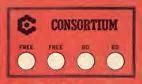
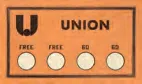
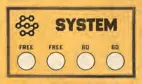
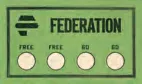
There are six Major Corporations; each charter has two identities (one per side), so pick either when the merger forms it. A Corporation has 10 shares (president’s certificate + 8 singles), pays 10% of the revenue per share, and keeps the abilities of both Minors it was made from (rulebook pp. 3, 18).
| Charter | Corporation |
|---|---|
 | Consortium |
 | Union |
 | System |
 | International |
 | Federation |
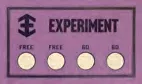 | Experiment |
Each charter shows one identity here. Its hub row has two FREE spaces and two at 60: the merged Minors’ hubs and spares fill them as described under mergers, and the Corporation pays the printed cost when it places one (placing hubs).
[Landmarks] Two more Corporations (Authority and League) join the base ones, and in the purple and grey phases a Minor may launch straight as a Major (Direct-to-Major).