Teach the Game
A script to read aloud when teaching Railways of the Lost Atlas.
How you win
“We are investors in a world nobody has mapped yet. We build the map together, then put our own money into small railway companies that lay track, run trains and pay us dividends. Later the small companies merge into big corporations. After four cycles — six in the Long Game — whoever has the most money plus share value is the richest investor and wins.”
- What you need: personal cash and shares that are worth a lot at the end.
- How you get it: launch Minor Companies, help them earn revenue, take dividends, buy shares of companies whose price will rise — yours or other players’.
- The core loop: in the Stock Round you invest; in the two Operating Rounds the companies you preside over build track, run trains and pay out. Rising revenue pushes share prices up.
Your money and company money never mix: you spend yours in Stock Rounds, a company spends its treasury in Operating Rounds (details).
The board
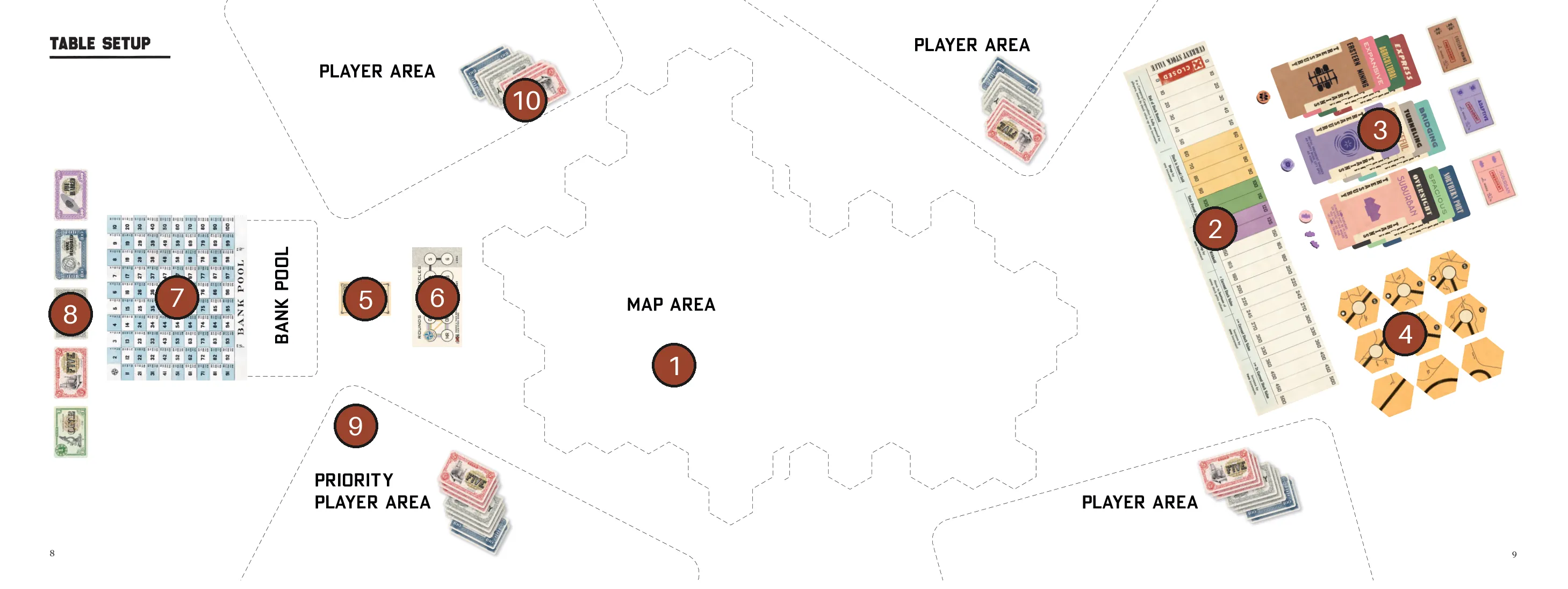
- The map — built from tri-hex tiles at the start of every game.
- Stock track — each company’s share price; it also sets the operating order.
- Company charters — Minor Companies in a launch matrix, Major Corporations waiting for mergers.
- Track tiles — yellow first, green, purple and grey upgrades as phases open.
- Train stack — cheapest on top; buying new kinds of train changes the phase.
- Round and cycle tracker — where we are in the game.
- Earnings chart and bank pool — dividends per share, and shares sold back to the bank.
- Money cards — the bank.
- Priority marker — who starts the next Stock Round.
- Player areas — your cash and certificates.
A cycle
- Stock Round — from the priority player, each turn: start a Minor auction, or sell shares and/or buy one share, or pass. Ends when everyone passes in a row. Stock Rounds
- Operating Round 1 — companies act from highest share price down: leadoff train (new Minors), issue/redeem a share, lay track, place a hub, run trains, pay out or withhold, buy trains. Operating Rounds
- Operating Round 2 — the same again.
- Merger Round — once the first green train is gone, connected Minors may merge into Major Corporations. Mergers
- Export a train — the top train leaves the game; that can rust trains or change the phase. Exporting trains
How the game ends
- After 4 cycles (Short Game) or 6 cycles (Long Game) — the game ends after the export step of the last cycle.
- Score = your cash + the value of every share you own at its final price. Company treasuries do not count.
- Tie: the president of the company that would operate first wins.
- A bankruptcy usually ends the game at once; the table may instead remove that player and go on. Game end
Ways to score
| Source | How and when |
|---|---|
| Cash | Counts at face value at the end. You get it from dividends and share sales. |
| Shares | Each share counts at its company’s final stock price (a president’s certificate is 2 shares). |
| Dividends | Paid each time a company pays out: 20% of the revenue per Minor share, 10% per Major share. |
| Stock price rises | Pay-outs at or above the share price, and fully owned companies at the end of a Stock Round. |
| Losses | Withholding, issuing shares, sales and earning nothing drop the price; a price of 0 dissolves the company and its shares become worthless. |
| Forced train purchase | Your own cash and shares can be spent to buy a train for a company you preside over. |
What each resource is for
| Resource | Why you need it | How you get it | How you use it |
|---|---|---|---|
| Your cash | Buying shares and winning auctions; it is also score | Starting capital, dividends, share sales | Bid for Minors, buy shares, cover forced train purchases |
| Company treasury | Pays for the company’s trains, hubs and mountains | The winning bid, shares sold from its treasury, withheld revenue, dividends on its own shares | Spend in Operating Rounds only |
| Shares | Dividends, control and final score | Auctions, buying from a treasury or the bank pool, mergers | Most shares = president; sell for cash |
| Trains | No train, no revenue — and every company must own one | Buy from the stack, the bank pool or another company | Run one route each, up to their number of stops |
| Track tiles | Routes between your hub and valuable cities | The shared supply, by phase | 2 yellow tiles or 1 upgrade per turn |
Hub tokens  | A route must touch one of your hubs; full cities block others | Home hub at launch; Majors and Expansive pay for more | Place one per turn in a reachable open city spot |
| Company abilities | Each Minor bends one rule; a Major keeps all of its Minors’ abilities | Launch or merge that company | See the companies |
Teaching tips
- Teach on the introductory map in the Short Game, or a Micro Game, before building random maps.
- Hammer the two wallets: your cash and each company’s treasury are separate.
- Play one auction, one full company turn and one train purchase slowly, then let the table go.
- Point at the train stack every round: the next train to buy or export is what rusts trains and moves the game on.
- [Landmarks] Add the expansion only once everyone knows a normal game; start with the Landmarks module (Landmarks).
Rehearse a company turn
Before the first Operating Round, put the company’s treasury apart from your personal money. Ask: ‘Can issuing a share pay for this turn’s leadoff train?’ No: the leadoff purchase comes first, then issuing or redeeming a share. Announce each step before moving on.
For a route exercise, give a company two trains but only one usable track route. Run one train on that route; the other can run a Local route at its hub city. Each train runs its own route: do not count a Local stop as extra revenue on the first train’s route.