Landmarks of the Lost Atlas
The expansion: four modules, and the Landmark tiles — what each one does on a route.
Short tag: [Landmarks]
What it adds
Landmarks of the Lost Atlas adds four modules you can use alone or in any combination, plus a few small variants (Landmarks rulebook p. 1):
| Module | What it does | Difficulty | Game length |
|---|---|---|---|
| Landmarks | Special map tiles that change routes, revenue and stock | Lower | May grow |
| Metropolitan Transit Department | A neutral Corporation that shareholders steer | Higher | Longer |
| Events | A rule change for each cycle | Lower | May grow |
| New Minors and Majors | Four Minors with new abilities, two more Majors | Same | Same |
The variants — crowded maps, randomized Minors in the Long Game, Direct-to-Major launches and a 6–7 player mode — are on New Companies and Variants.
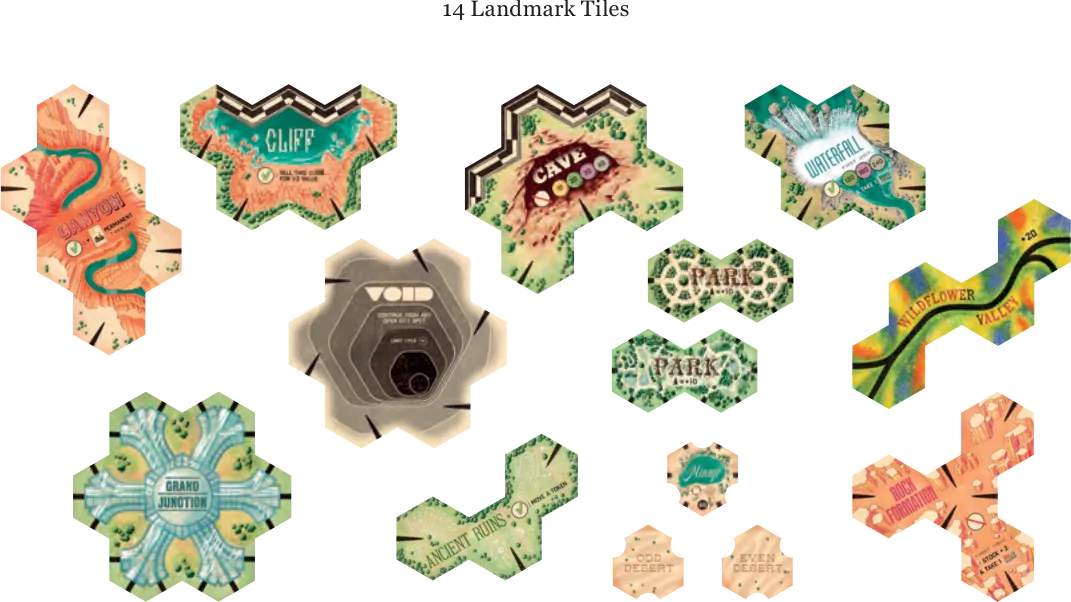
Components: 14 Landmark tiles and 11 Landmark project tiles, 12 Rock Formation and 12 Waterfall mini-postcards, 4 blank markers for the Ancient Ruins, 16 Park markers, the Metropolitan board, hubs and certificates, 14 event cards, 4 Minors and 2 Majors with their tiles and tokens, 5 partner charters, extra map tiles, trains, hubs, Distant Destination cards and player aids. Every piece is pictured in Cards & Components.
Setup changes
Before shuffling the map stack, add random Landmark project tiles — on top of any other project tiles (p. 4):
| Game | Landmark project tiles |
|---|---|
| Micro | 1 |
| Short | 2 |
| Long | 3 |
| 6–7 players | 3 |
| Solo | 2 (solo) |
- When one is flipped, the player places its Landmark tile(s) under the normal map rules and returns the project tile to the box. Mirage and Parks need only two shared edges instead of three; the Mirage’s three single hexes (Mirage, Odd Desert, Even Desert) are placed separately by the same player.
- If a Landmark cannot be placed, shuffle its project tile back into the remaining stack and draw again.
- A tile placed against a Landmark must also share at least one edge with a non-Landmark hex (blank, mountain, water, Distant Destination or city).
Setting up the other modules: Metropolitan, Events, New Minors and Majors. The setup checklist has a switch for the expansion.
Seeding the map stack
Landmarks, Distant Destinations and Capitals can arrive at awkward moments. The booklet passes on three playtester methods (p. 13):
- Kidder method (no Landmark too early or too late): set aside eight non-Landmark tiles, shuffle the Landmarks into the rest, then put four of the eight under the stack and four on top.
- Spanish method (Landmarks first): shuffle the Landmarks into 12 set-aside non-Landmark tiles and put that pile on top.
- Walker method (even spread): make small mixed piles (a Distant Destination, a Landmark, a Capital project tile, a few homes, some terrain), shuffle each and stack them.
New and changed rules
Landmark basics
- For laying track, a Landmark hex counts as blank: track may run into its edge, but no track tile is ever placed on a Landmark (p. 4).
- Where printed track ends inside a Landmark, a route may start or end there but not pass through.
 marks a Landmark that counts as a stop;
 one that does not.
- Landmarks that earn revenue are not cities, even when they count as a stop.
The Landmarks
| Picture | Description |
|---|---|
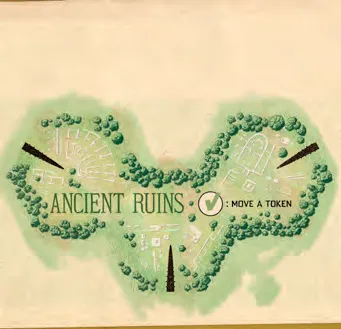 | Ancient Ruins . No revenue. After revenue is worked out, the company that ran there may move one of its own hubs to another available spot reachable by track from the old spot. It cannot move an opponent’s hub (FAQ). |
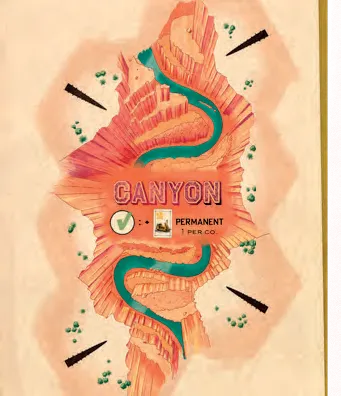 | Canyon . Nothing until the first 4-train is bought or exported. Then, after revenue is paid, the company takes a free rusted 2-train: permanent, takes a slot, cannot be sold or traded in, and may be discarded at any time. One per company, though a merged company may keep both. |
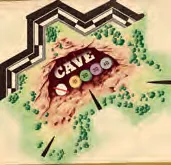 | Cave . Adds revenue that grows with the phase (printed on the tile). It must be at the start or end of the route. |
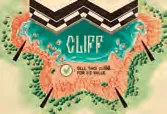 | Cliff . Once per company per Operating Round, after routes are set and before revenue is paid, sell the train that ran there for half its printed price into the treasury; Resourceful cannot sell a rusted train. Several routes may visit the Cliff, but the company sells only one train there; the sold card returns to the bank pool and may be bought later (FAQ, FAQ). With Coupling, if an uncoupled half ran there sell that whole train card; if two trains are coupled, sell only one of their cards (FAQ). |
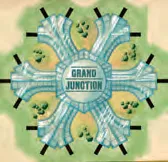 | Grand Junction . Every track section connects to every other. A section can be used only once per route, but several routes — even the same train more than once — may pass through. |
 | Mirage (+ Deserts) . Once per company per Operating Round, one route may count it as a 60 stop. After the Run Trains step, it swaps with Odd Desert after an odd train total or Even Desert after an even total; infinity is even. The Mirage is the route’s end, not a pass-through hex (FAQ). |
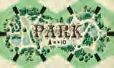 | Park . Trains never enter it. Each adjacent city tile (not a Distant Destination) with track running into the Park earns +10; mark it with a  tree. Tree markers tally which nearby cities could earn a Park bonus; move one onto each city when it connects (FAQ). |
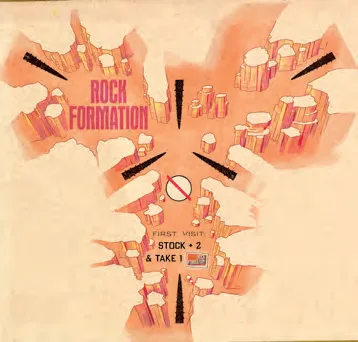 | Rock Formation . A company without a Rock Formation postcard that includes it in a route moves its share price up two steps after revenue is worked out, then takes a postcard. A postcard blocks future use; Rock Formation must be at the route’s start or end (FAQ). |
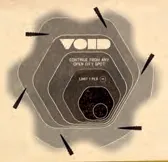 | Void . Once per Operating Round a train may enter and continue from any unblocked city spot under the normal route rules. The city where it emerges counts as a stop; a hub reached through the Void must still connect to it by track (FAQ, FAQ). It is never used for track laying, hub placement or mergers. |
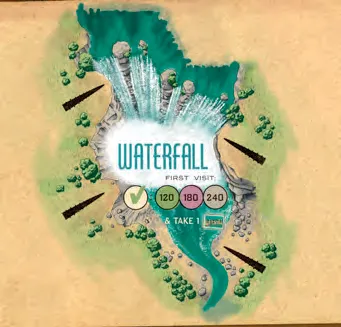 | Waterfall . A company without a Waterfall postcard adds revenue by phase — 120, 180 or 240 as printed on the tile — and takes a postcard; with a postcard it cannot use it again. |
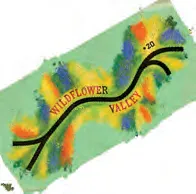 | Wildflower Valley . Adds 20 to a route only when it has at least one stop before and one after the Valley. |
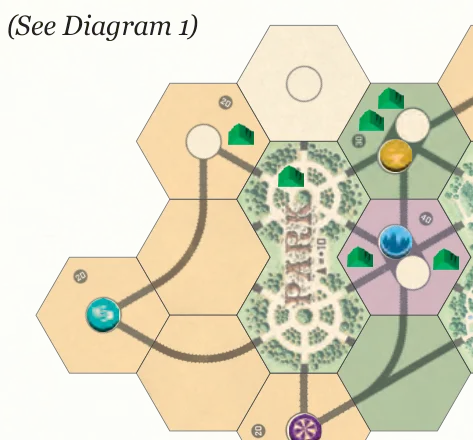
- Parks and the special homes: the isolated stop on the
 Eastern Mining
tile can never connect to a Park; each half of the
 Northern Port tile needs
its own connection.
- Postcards after a merger: a Corporation keeps one Rock Formation and one Waterfall postcard; return any extras.
Scoring changes
The final score is unchanged: cash plus shares. Landmarks change it indirectly — extra revenue (Cave, Mirage, Park, Waterfall, Wildflower Valley), a two-step price jump (Rock Formation), and train cash (Cliff, Canyon). Metropolitan shares count like any other share.
Earlier playtest booklet (WIP)
An earlier 16-page Landmarks playtest booklet is a prototype snapshot, kept here for reference. Play the published rules above; use these differences only with the prototype components.
| Topic | Playtest booklet | Published rules |
|---|---|---|
| Metropolitan certificates | Four per player | Three per player |
| Metropolitan trains | Always a limit of two; its trains never rust | Minor train limit; excess trains are discarded |
| Void | Up to twice per Operating Round | Once per Operating Round |
| Event deck | 16 cards, including Corporate Greed and Prices Slashed! | 14 cards, without those two |
| Coupling Company | Only couples trains | Also uncouples one train into two |
| Direct-to-Major launch | Not in the booklet | Allowed in the purple and grey phases |
The two playtest-only events: Corporate Greed — a company may skip laying track to take 40 into its treasury; Prices Slashed! — redeeming a share costs half its price.