New Companies and Variants
Landmarks module: four new Minors, two new Majors, Direct-to-Major launches, map variants and the 6–7 player mode.
Short tag: [Landmarks]
New minor companies
Four new Minors, each with its home tile (Landmarks rulebook pp. 10–11).
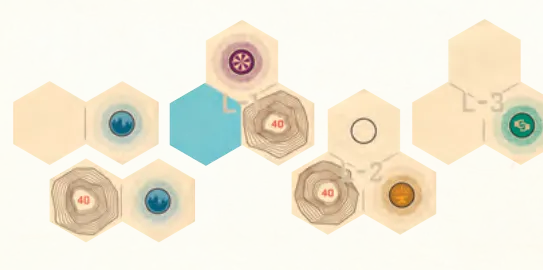
Setup: either pick a set of Minors for your mode, or use a randomized-Minors variant (Short, Long). The number of Minors in play:
| Game | Minors |
|---|---|
| 2-player Micro | 4 |
| 3-player Micro | 6 |
| Short | 8 |
| Long | 12 |
Circus Company
 Once per Operating Round, in the Run Trains step, it may count one city or Distant
Destination twice — using two of the train’s stops. The route must still obey every route rule.
Coupling Company
 Chosen afresh each Operating Round, in the Run Trains step:
- Uncouple: owning exactly one numbered train (not ∞), it may run it as two trains of 2 or more that add up to it — a 7 as 2 + 5 or 3 + 4.
- Couple: owning several trains, it may join some of them to run as one train of their total;
mark each link with a
 coupling marker. Two 2-trains and a 3-train can run as
a 5 plus a 2.
- Every train card still takes a slot. For abilities that count trains (such as Express), coupled trains count as one train and an uncoupled one as two.
Manufacturing Company
 On launch it pays 50 from its treasury to the bank and takes the
Manufacturing 2-train; it may not buy a leadoff train. That train is permanent and takes a slot,
is worth nothing and cannot be bought, sold or traded in. Its owner may discard it during its
Operating Round, removing it from the game.
Twin Cities Company
 Its home is two two-hex tiles, brought in by the Twin Cities project tile
(which also stands for its home in randomized setups). Each tile needs three shared edges as usual.
At launch both homes get a hub; either or both may be used for track and routes. To merge, one of
its hubs must connect to the partner. Merged with Expansive, the Corporation needs eight hubs — the
expansion includes the extra Major hubs.
New major corporations
| Charter | Corporation |
|---|---|
 | Authority |
 | League |
Add them to the base Majors; nothing else changes.
Launching direct-to-major
In the purple and grey phases, the winner of a Minor auction may launch it as a Major Corporation (p. 12):
- Choose an available Minor and turn it into a free Corporation with a blank partner charter.
- It has eight shares in its treasury, one home hub, two hubs at 60 (no free ones) and that Minor’s one ability.
- It may buy a leadoff train in its first Operating Round if it can afford one.
- Its shares cannot be sold until it has operated once.
Map variants
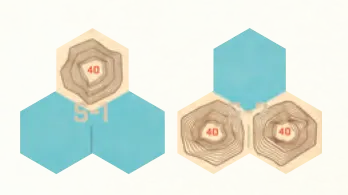
Special tiles S-1 and S-2
Swap two terrain tiles (not homes, projects or Distant Destinations — random or agreed) for the two special tiles S-1 and S-2.
New Distant Destination revenues
Three more revenue cards; best used with the Different Distant Destinations variant, one card per Distant Destination tile.
Crowded map
Short or Long: swap four terrain tiles for four extra Minor home tiles. After building the map, deal the 12 (Short) or 16 (Long) Minor charters in three or four columns of four.
Long Game with randomized Minors
Shuffle all 16 Minor home tiles (tile 21 stands for Adaptive, the project tile for Twin Cities) and remove four unseen; set up as normal with only the Minors on the map.
Six and seven players
- Shuffle all map tiles — S-1 and S-2, every Minor home tile and the Twin Cities project tile — with the Capital project tiles.
- With Landmarks, add 3 Landmark project tiles; with Events, stack 2 New City Herald cards under 3 Town Chronicle cards.
- Put the trains marked for 4+ players (the base game’s extra 3- and 6-train) and for 6+ players (the expansion’s three train cards: a 4-train and two 2-trains) into the train stack.
- Starting capital: 265 each with six players, 225 each with seven.
- Play five cycles.
- Recommended: Hostile Mergers and Direct-to-Major.
The setup checklist covers 1–5 players; use this list for six or seven.