Operating Rounds
The company turn — leadoff train, shares, track, hubs, routes, dividends and buying trains.
Operating sequence
Each cycle has two Operating Rounds. In each, every company and corporation takes one turn, in descending share price; companies at the same price go from the top of the column down (rulebook p. 12). The president decides everything and pays from the company’s treasury. If a company ability contradicts a rule, the ability wins.
A company’s turn, in this order:
- Leadoff train — a new Minor’s first turn only, optional.
- Issue or redeem one share — optional.
- Lay track — optional.
- Place a hub token — optional.
- Run trains.
- Pay out or withhold.
- Buy trains — required if the company owns none.
- Flip its stock token; the next company acts.
When every company has acted, advance the round marker.
Leadoff train
In its first Operating Round, a new Minor may buy one train from the top of the train stack or from the bank pool, at its printed price, from its treasury. It runs this turn. It cannot come from another company, and the president may not help pay.
Issue or redeem a share
- Issue: move one share from the company’s treasury to the bank pool; the company receives the current price from the bank and its price drops one step.
- Redeem: buy one share back from the bank pool into the treasury at the current price; the price does not change.
Only one share, and only in this step.
Track and hubs
Laying track
A company may lay up to two yellow tiles, or upgrade one tile (rulebook p. 13):
- Yellow tiles and non-city upgrades must be placed so the company can trace a route through some of the new track; a city upgrade must be on a tile the company can trace a route into.
- No track may run into the edge of a water hex, a blank side of a Distant Destination, a border hex or the map edge.
- Yellow tiles go only on empty land: not on water, Distant Destinations, border hexes or hexes that already have track.
- Tiles never create or remove a city (cities often gain spots).
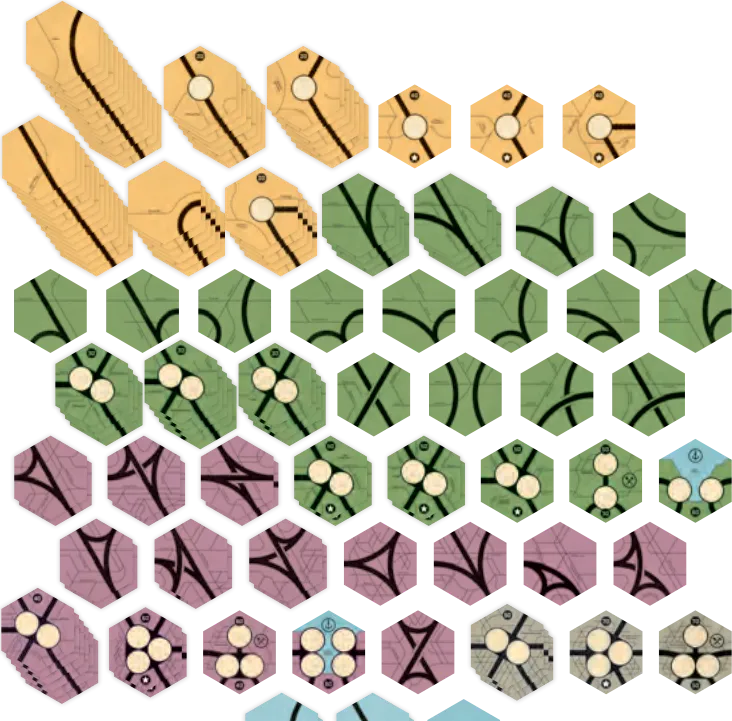
- An upgrade replaces a tile of the previous colour (yellow → green → purple → grey) and keeps every existing track connection; the old tile returns to the supply. Only the colours of the current phase are available.
- Tiles with a

 symbol upgrade only into tiles with the same
symbol.
- Pay any printed cost from the treasury — a
 mountain costs 40.
- Tiles are limited; when a kind runs out it is gone.
- Hubs stay put when their city is upgraded.
- A printed home of an unlaunched Minor stays reserved: when that tile is laid, put the Minor’s token next to the spot. At least one spot must stay free for it, and routes may pass through it.
 Eastern Mining and
 Northern Port start on special mine
and port tiles with their own upgrades; any company may upgrade them. The mine upgrades may be
turned so the new leg goes either way, as long as existing connections stay.
Placing hubs
A Major Corporation (or  Expansive Company) may place one available hub token:
pay the cost printed under it on the charter and put it in any open, unreserved city spot it can
trace a route to. Never two hubs of one company on the same tile. A Minor’s only hub is its free home
hub.
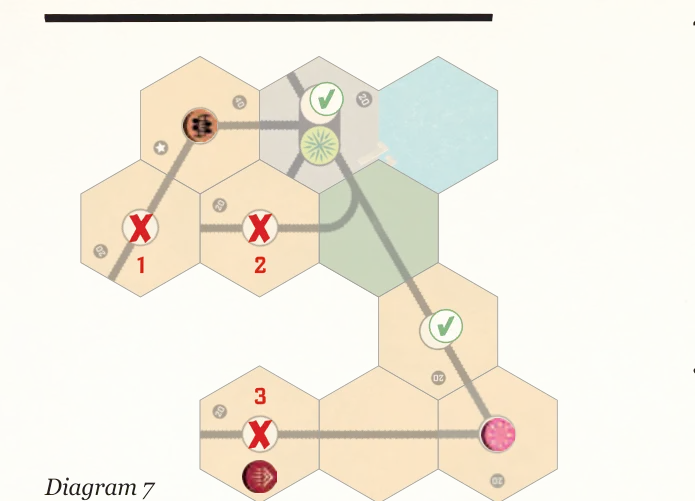
Diagram 7: Expansive may use either checked spot. The crosses are illegal because (1) another company’s full city blocks the way, (2) no route reaches it, (3) the spot is reserved for an unlaunched Minor.
Tracing a route
Whenever a rule says a company must be able to trace a route (track, hubs, mergers), trace it like
a train with no stop limit: from one of its hubs, through no full city, using no track twice. Only
 Overnight may skip full cities.
Routes and revenue
Each train runs one route (rulebook p. 14):
- A route is a continuous line of track that includes a city spot with one of the company’s hubs and uses no piece of track twice.
- A train counts up to its number of stops (2, 3, 4…). It may stop short, but may not skip a stop to reach farther. An ∞-train counts any number of stops.
- The company’s trains never share track; they may cross at cities and on some green and purple tiles.
- A route may not pass through a city whose spots are all filled with other companies’ hubs; it may start or end there.
- A
 Distant Destination is always an end of a route, never passed through.
- One train counts a city or Distant Destination only once; different trains may each count it.
- One train cannot run to both halves of the port tile. The mine tile is two
linked stops, which one train may both count.
- Fork tracks with a sharp turn cannot be run through the sharp turn; inside a city any turn is fine.
- Local routes: a train may run a single stop — your hub city. Any number of locals may run in the same city. This keeps a badly placed Minor playable.
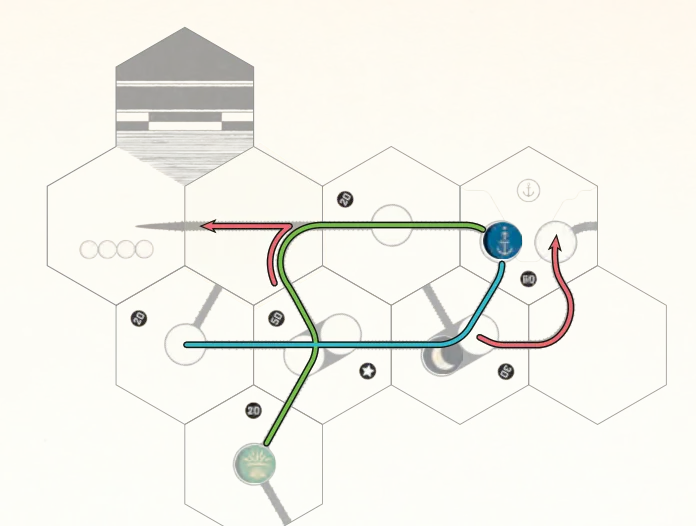
Revenue is the total of the stops: a city is worth its printed number, a Distant Destination the value for the current phase on the revenue card. A company with no train earns 0 and drops one step. You may mark finished routes on the earnings chart while you trace the next one.
Payout or withhold
The president chooses for the whole revenue (rulebook p. 15):
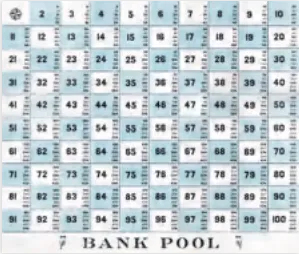
- Pay out: each Minor share gets 20%, each Major share 10%, from the bank — to players and to the company itself for shares in its treasury. Bank-pool shares get nothing. Mark the per-share amount (10% of the revenue) on the Earnings per Share chart.
- Withhold: the company takes all of it into its treasury and drops one step.
| Total payout | Share price |
|---|---|
| More than 0, less than the price | Stays; token moves below the others in its column |
| At least the price, less than double | Up 1 |
| At least double the price | Up 2 |
| Withheld, or 0 | Down 1 |
[Landmarks] The Unions Win! event allows half pay-outs and Record Gains! a triple jump (Events).
Train purchase
Buying trains
If it has fewer trains than the current limit, a company may buy as many trains as it has room and money for:
- the top train of the stack at its price — the ∞-train also for 800 plus trading in any unrusted train;
- any train in the bank pool at its printed price;
- a train from another company, for at least 1, if both presidents agree; the money goes to the selling company.
A company that owns no train must buy one before its turn ends. If its treasury cannot pay, see forced train purchase. Buying the first train of a new kind can rust trains or change the phase at once.