Gameplay
The pieces, the map, the game modes and the shape of a cycle in Railways of the Lost Atlas.
Overview
You play an investor, not a railway. With a small starting capital you launch Minor Companies, become their president and run them: they lay track, place hubs, run trains and earn revenue. From the green phase on, two connected Minors may merge into a Major Corporation. Every game uses a new map built by the players, and the Minors become available in a random order (rulebook p. 1).
The game lasts a fixed number of cycles: 4 in the Short Game, 6 in the Long Game. Your score is your cash plus the value of your shares.
Player money and company money
- In Stock Rounds you act as a player, with your own cash: auctions and share trades.
- In Operating Rounds you act as a president, with the company’s treasury: track, hubs, trains.
- Players cannot pay a company’s costs, and a company cannot pay its president. The one exception is a forced train purchase (rulebook p. 4).
- Control can change hands: whoever owns the most shares of a company is its president. Holding two shares of someone else’s company means it can be dumped on you (presidency).
The components
Minor Company charter
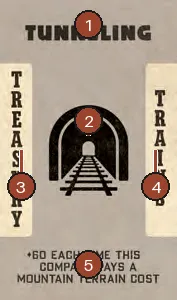
- Name — one of the 12 Minor Companies.
- Logo — also printed on its home hex and its tokens.
- Treasury — the company’s money and the shares still in its treasury go to the left.
- Trains — the company’s train cards go to the right.
- Special ability — the rule this company bends.
Major Corporation charter
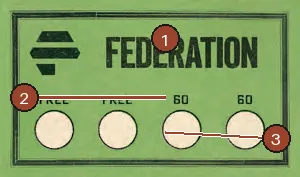
- Name — six Corporations, each with two identities on its two sides.
- Hub token costs — the two left spots are free, the others cost 60.
- Hub tokens — waiting on the charter until placed.
When Minors merge, their charters sit side by side under the Corporation charter (rulebook p. 18).
Stock certificates
| Certificate | What it is |
|---|---|
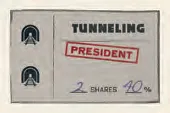 | President’s certificate: counts as 2 shares. Its owner runs the company; only single shares can be sold, and the certificate transfers when another player takes over the presidency (FAQ). |
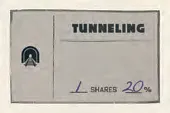 | A single share. A Minor has 5 shares (president’s certificate + 3 singles), each worth 20% of a payout; a Major has 10 (president’s + 8 singles), each 10%. At game end, every Minor share is worth the stock price, and the president’s certificate counts as two shares (FAQ). |
Train cards
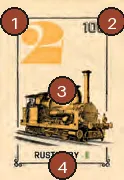
- Number of stops the train may count.
- Price.
- The train — its colour shows the phase it starts.
- Which train rusts it, or Permanent.
Track tiles
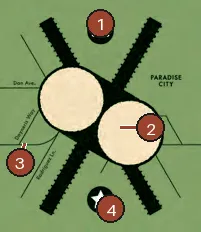
- Revenue of the city.
- City spot — room for one hub token.
- Track entry/exit on a hex side.
- Special symbol —
 capital,
 mine or
 port tiles only upgrade into tiles with the same symbol.
The map
The map is built from tri-hex map tiles (and project tiles) at the start of every game. Map legend (rulebook p. 5):
| Hex | Name | What it means |
|---|---|---|
 | Blank | Open land for track. |
 | Water | No track may run into it — except Bridging. |
 | Basic city | Becomes a city once a city tile is laid; one hub spot or more. |
 | Company home | A Minor’s home; the spot is reserved for it until it launches. |
 | Mountain | Laying track here costs the printed 40. |
 | Distant Destination | Off-map revenue; its value grows with the phase. Routes start or end there. |
 | Border | No map tile may touch it. |
Building the map
- Choose a Distant Destination revenue card and put it where everyone sees it. First game: the 30 / 40 / 70 / 100 card.
- Shuffle the map tiles of your game mode face down.
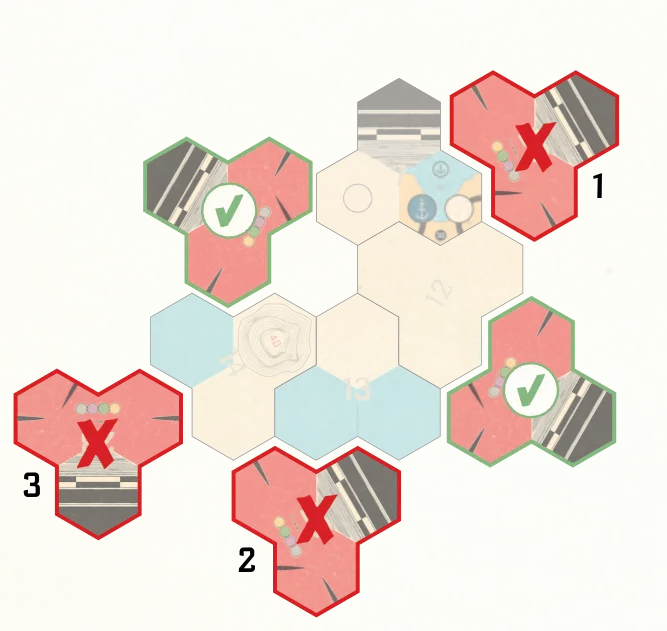
- A random player turns over the top tile and puts it in the middle; then each player clockwise turns over and places the next one.
- A new tile must share at least three edges with tiles already placed, may not touch a black border hex, and lies flat without overlapping. Printed track may point anywhere.
- A project tile (such as a Capital City project) is resolved: place the matching component as it says and return the project tile to the box. If it cannot be placed, it goes to the bottom of the stack and you draw again.
- If no legal placement is possible, everyone agrees to collect the tiles and start over (rare).
- Optionally use the 12 single blank hexes to give late Minor homes room to grow — still never next to a border hex. Centre the map when done.
Instead of a random map you may use the introductory maps sheet, or build any map you like (variants). [Landmarks] The expansion adds Landmark project tiles to the stack (Landmarks setup).
Game modes
| Short Game | Long Game | Micro Game | |
|---|---|---|---|
| Players | 2–4 | 3–5 | 2 or 3 |
| Cycles | 4 | 6 | 4, with no train export |
| Map | Without map tiles 9, 10, 11, 21, 26, one each of 12, 13, 14 and one Capital project tile | All map tiles | One pile of the split map tiles |
| Minors | 8 in two columns — no  Bridging,  Overnight,  Spacious,  Adaptive | All 12 in three columns | The 4 or 6 whose homes are on the map |
| Trains | One of each type removed (not the 7/∞) | All | A fixed small stack |
| Starting cash | 2p 450 · 3p 300 · 4p 275 | 3p 300 · 4p 275 · 5p 220 | 225 each |
With four or more players, add the extra 3-train and 6-train marked for 4+ players; remove them with fewer (rulebook p. 7). Micro Games are explained under variants.
The cycle
A cycle is a Stock Round, two Operating Rounds, a Merger Round and a train export; the round and cycle tracker shows where you are (rulebook p. 19).
- Stock Round — players invest.
- Operating Round 1 — every company acts, highest price first.
- Operating Round 2 — the same again.
- Merger Round — only once the first green train has been bought or exported.
- Export a train — remove the top train of the stack.
- Move the cycle marker on and return the round marker to the Stock Round — or, after the last cycle, end the game.