Metropolitan Transit Department
Landmarks module: a neutral Corporation with no treasury, run by whoever owns its shares.
Short tag: [Landmarks] · Not used in Micro Games or solo.
What it is
The Metropolitan is a neutral Corporation. Nobody is its president: every player who owns its shares helps steer it, to boost their own network or get in someone else’s way. It has no treasury and earns nothing for itself; its costs are taken out of its revenue, and if that runs negative its shareholders pay (Landmarks rulebook pp. 6–7).
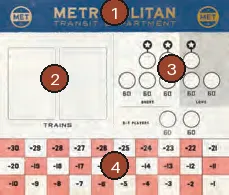
- Name — the Metropolitan Transit Department.
- Trains — the exported trains it receives.
- Hub spaces — marked for the Short Game, the Long Game and 6–7 players; the starred hubs go on Capitals, the others cost 60.
- Negative earnings track — what its track and hubs cost this round.
Setup
After normal setup:
- Put the board above the Earnings per Share chart.
- Place
 Metropolitan hubs on the board’s spaces for your game mode, plus two
spare tokens: one for the earnings chart, one for the stock track.
- Stack 3 Metropolitan certificates per player beside the board — all single shares.
- Nothing goes on the map yet.
Entering play
- Every time a yellow Capital tile is laid, a starred Metropolitan hub goes at once into its empty spot.
- At the start of the first Stock Round after its first hub is placed, its stock price is set to the highest price of any company or Corporation, above all tokens in that column.
Stock Rounds
- Buying a Metropolitan share at its current price is your one purchase for the turn.
- There is no president’s certificate and no limit on how many you may own.
- No sales in the first Stock Round it is available (it has not operated yet).
- A sale drops its price one step. Sold shares go back to the stack beside its board, never to the bank pool.
- If players own every Metropolitan share at the end of a Stock Round, it rises one step with the other fully owned companies.
Operating Rounds
When its turn comes in the operating order:
-
Shareholders act one after another from the player with the priority marker, clockwise:
- 1 share: lay two yellow tiles or one upgrade for it;
- 2 or more shares: that track action and place one hub under the normal rules.
Each player does everything they are allowed before the next starts. Costs (mountains, hubs) are marked on the negative earnings track, which counts per share like the earnings chart: 200 of costs puts the marker on −20.
-
Run trains: the players together find its highest-value route for each train. If tied routes differ in side effects (a Mirage parity, say), the largest shareholder chooses — on a tie, the tied player nearest the priority player clockwise. If no player owns a share, it still runs and its price moves, but nobody is paid.
-
Pay out: move the marker up by the revenue (10% of it per share). If it ends positive, each share collects that amount — 10% of the payout, however many shares are in play — and the price moves as usual.
-
Still negative? Every shareholder pays the amount still shown per share to the bank. A player who cannot pay must sell a Metropolitan share (its price drops a step), and then the price drops one more step for paying nothing. Reset the earnings marker to the first positive space.
The Metropolitan cannot use the Rural Expansion and Unions Win! events, nor the Ancient Ruins, Canyon, Cliff or Rock Formation Landmarks.
Acquiring trains
It never buys trains. Each exported train goes into its train slots instead of leaving the game (an exported 7/∞ becomes a 7). It uses the Minor train limit: when a new train or a phase change puts it over, its lowest train is discarded as if exported.
End of game
Metropolitan shares count at their final price, like any other share.