Teach the Game
A script to teach Orléans at the table — how you win, the boards, a round, the end, every way to score and what each follower and resource is for.
How you win
“We are noble families in medieval France. We fill a bag with followers — farmers, boatmen, craftsmen, traders, knights, scholars and monks — draw a handful each round and put them to work. Eighteen rounds, about ninety minutes. The most victory points wins.”
You score from three things:
- Coins and goods you hold at the end.
- Trading stations and citizens, multiplied by your development status — usually the biggest score.
- [T&I] orders, [Plague] indulgences, [Prosperity] structures when you play with them.
The loop: draw followers, place them to complete places, take the actions — which bring more and better followers, coins, goods, trading stations, citizens and development.
The boards
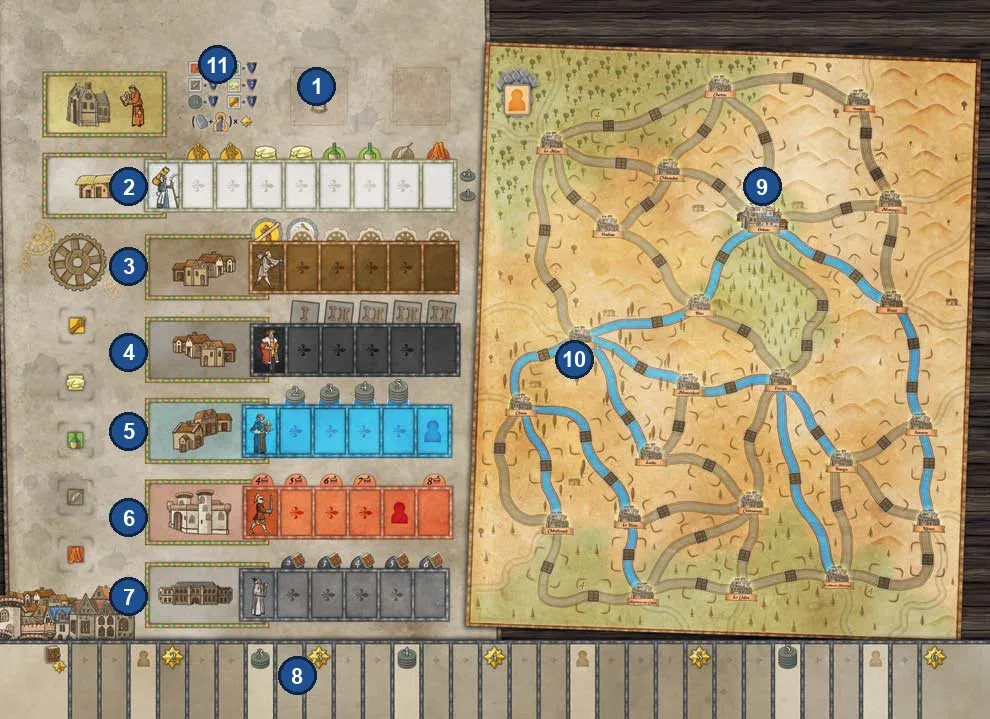
- Follower tracks (left) — one per follower type; each new follower moves your cube and pays a bonus.
- Map (right) — towns joined by roads and waterways with goods on them; your merchant travels here and builds trading stations.
- Development track (bottom) — coins, citizens and the stars of your development status.
- Hour glass space — the stack of 18 events that times the game.
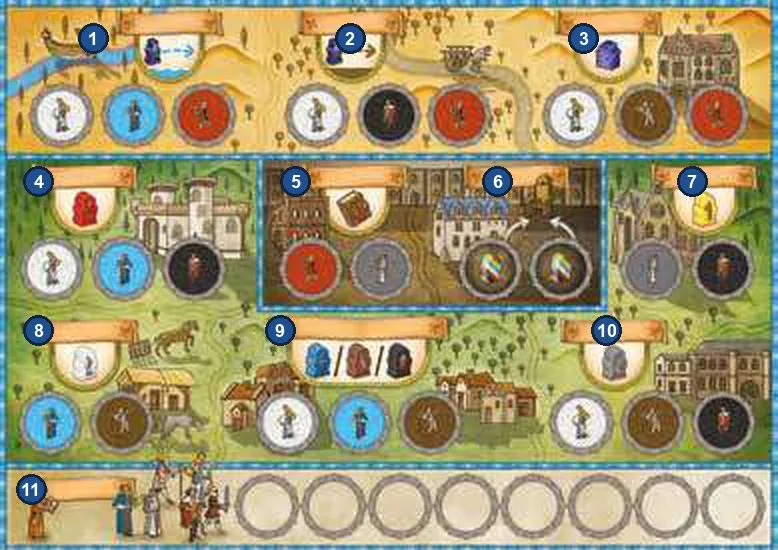
- Player board — ten places you activate with followers, and the market where drawn followers wait.
- Beneficial Deeds board — where the Town Hall sends followers for coins and citizens.
A round
- Hour glass — turn the next event (it happens in step 6). Details
- Census — most farmers +1
 , fewest −1. Census
- Followers — draw as many as your knights track allows onto your market. Followers
- Planning — all at once, place followers on the spaces of the places you want. Planning
- Actions — in turn, one completed place each, until all pass; used followers go back in the bag. Actions
- Event — everyone resolves the event. Events
- Start player — the token passes left.
The places (all of them):
| Place | Gives |
|---|---|
| Farm House |  farmer + a good |
| Village |  boatman (coins),  craftsman (  gear wheel) or  trader (place tile) |
| University |  scholar + development |
| Castle |  knight: draw more followers |
| Monastery |  monk: wild follower |
| Ship / Wagon | Move your  merchant by water / road, take a good |
| Guildhall | Build a  trading station |
| Scriptorium | 1 development point |
| Town Hall | Send followers to the Beneficial Deeds |
How the game ends
After 18 rounds (the last hour glass tile). The player with the most trading stations takes the citizen on the map; then score (Final scoring). A tie goes to the player further along the development track.
Ways to score
| Source | How | When |
|---|---|---|
| Coins | 1 point each | End |
| Goods |  5,  4,  3,  2,  1 | End |
| Trading stations | Each × development status | End |
 Citizens | Each × development status | End |
| Place tiles | Merchant House, Port, Depot, Bakery and others score extra | End |
| [T&I] Orders | Points on each fulfilled card | End |
| [Plague] Indulgences | Points on each fulfilled card; −1 per corpse | End |
| [Prosperity] Structures | Points on each manned structure | End |
| Torture | Whatever you give up is lost | During play |
What each resource is for
| Resource | Why you need it | How you get it | How you use it |
|---|---|---|---|
| Basic followers | Most places need them | Farm House, Village | On action spaces |
| Knights | Draw more each round | Castle | Ship, Wagon, Guildhall, Scriptorium |
| Scholars | Development | University | Monastery, Scriptorium |
| Monks | Wild on any action space | Monastery | Anywhere on your boards |
| Gear wheels | A place needs one follower fewer, for good | Craftsmen, Laboratory | On an action space |
| Coins | Events, points | Boatmen, Income, Trading Day, deeds | Pay events; 1 point each |
| Goods | Points, food for Harvest | Ship and Wagon on the map; Farm House | Harvest, taxes, orders; points |
| Citizens | Multiplied by development | Deeds, track ends, development track | Score at the end |
| Development | The end-game multiplier | University, Scriptorium, deeds | Status 1 to 6 |
Teaching tips
-
Show one place first: “a boatman and a craftsman on the Farm House give you a farmer” explains the whole loop.
-
Stress the multiplier: (stations + citizens) × development status decides most games.
-
Warn that the four coloured personal followers never leave, and that monks are not wild on the deeds.
-
First game: base game only; add the Trade & Intrigue events next.
-
Compare a four-Follower allowance with only three free Market spaces: draw at most three. Knights increase the allowance; Boatmen do not. Practice example.