Course of Play
Orléans round by round: the goal, the game board, the seven phases (hour glass, census, followers, planning, actions, event, start player) and the general rules about followers, bags and supplies.
Goal of the game
You lead a family in medieval France. You recruit followers into your cloth bag, draw some of them each round and place them on the places of your player board to trigger actions. Those actions bring goods, coins, development, trading stations and citizens — and at the end the richest, most developed player wins.
The game lasts 18 rounds (fewer in some scenarios). Each round has the same seven phases.
The game board
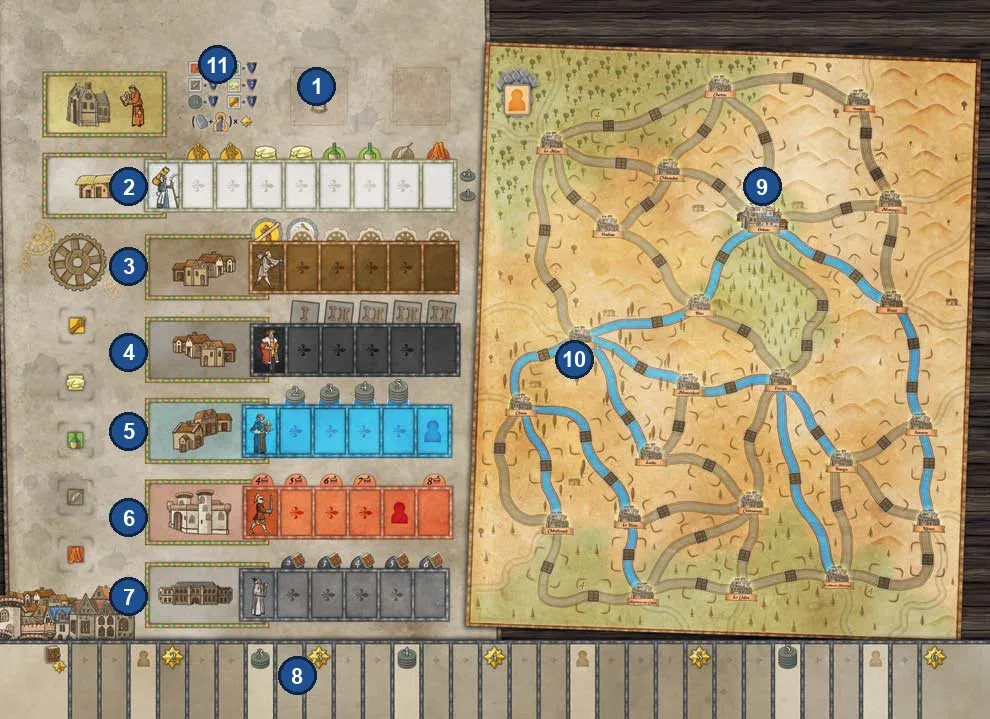
- Hour glass space — the stack of 18 hour glass tiles; it times the game.
- Farmers track — goods for each new farmer; also the census.
- Craftsmen track — a
 gear wheel for each new craftsman.
- Traders track — a place tile for each new trader.
- Boatmen track — coins for each new boatman.
- Knights track — how many followers you draw each round.
- Scholars track — development points for each new scholar.
- Development track — your development status, coins and citizens.
- Orléans — where every merchant starts; each player may build a trading station here.
- Roads and waterways — goods lie on them; ships and wagons move your merchant.
- Goods values — what each good is worth at the end (brocade 5, wool 4, wine 3, cheese 2, grain 1).
Your followers
Every player starts with the same four personal followers in their colour —  farmer,
 boatman,
 craftsman and
 trader — on the market of the
player board, and an empty bag. New followers come from the neutral supply beside the board:
| Follower | Gained at | Track bonus |
|---|---|---|
| Farmer | Farm House | Goods |
| Boatman | Village | Coins |
| Craftsman | Village | Gear wheel |
| Trader | Village | Place tile |
 Knight | Castle | Draw more followers |
 Scholar | University | Development points |
 Monk | Monastery | None — but wild on action spaces |
Your four personal followers are marked: they never leave you. You cannot send them to a Beneficial Deed, lose them to a plague or give them up under torture.
A round
| Phase | What happens |
|---|---|
| 1. Hour glass | The start player reveals the next hour glass tile (this round’s event). |
| 2. Census | Most farmers gains a coin; fewest farmers pays one. |
| 3. Followers | Everyone draws followers from their bag onto their market. |
| 4. Planning | Everyone places followers on action spaces at the same time. |
| 5. Actions | In turn order, one action each, round and round, until all pass. |
| 6. Event | The revealed event happens to everyone. |
| 7. Start player | The token passes to the left. |
Phase 1: Hour glass
The start player turns the top hour glass tile face up. It names the event of the round; every event except Pilgrimage waits until phase 6. The game ends at the end of the round in which the 18th tile is revealed (the events).
Phase 2: Census
Compare positions on the farmers track. The player furthest ahead takes 1  coin; the player
furthest behind pays 1 coin. A tie at the top means nobody gains; a tie at the bottom means nobody pays.
With 2 players the player behind never pays — the leader still gains.
Phase 3: Followers
Draw followers blind from your bag and put them on the free spaces of your market. Your limit is the number your cube shows on the knights track — 4 at the start, up to 8. You may always draw fewer, and you can never draw more than your market has free spaces: followers left there from earlier rounds keep their spaces.
For each follower you choose not to draw, you may move one follower from an action space back to your market. That is the only way to take a placed follower back.
Phase 4: Planning
All players plan at once. Move followers from your market onto the action spaces of the places on your player board and place tiles. A place is activated when every one of its spaces holds a matching follower (or a gear wheel). You may fill a place over several rounds; a half-filled place does nothing until it is complete. Followers you do not place stay on the market.
When you are done, say so; you cannot change your plan afterwards. If anyone wants to see the others’ plans first, plan one by one clockwise from the start player.
Phase 5: Actions
From the start player clockwise, each player performs one activated action or passes. Keep going round the table until everyone has passed; once you pass you are out for the round. After an action, return the followers on it to your bag — gear wheels stay where they are. Activated actions you do not use stay activated for a later round.
Phase 6: Event
Everyone resolves the event on this round’s hour glass tile.
Phase 7: Start player
The start player hands the token to the player on the left.
General rules
- Limited supplies. Followers, gear wheels and goods are limited: when the supply of one runs out, actions that would give it cannot be taken. Events such as Harvest and Plague can return some. Coins are unlimited.
- Looking in your bag. You may count your followers at any time; shake the bag afterwards.
- Empty roads and waterways. You may travel a connection with no good on it; you just gain nothing.
- Placed followers stay put. A follower on an action space cannot move to another space (except by giving up a draw in phase 3, see above).
- Payments go to and come from the general supply.
- Gear wheels depend on the craftsmen track (Technology).
- Ties in timing. When several players resolve something at once, go in turn order from the start player.