Scenario: Prosperity
Prosperity, the competitive Orléans scenario for 2–5 players from the Invasion box: the carpenter, structure cards, hidden goods, a fixed 16-event track and three Beneficial Deeds.
Short tag: [Prosperity]
What it adds
A competitive scenario for 2–5 players by Inka and Markus Brand. A neutral  carpenter
roams the map; whoever moves it to the right town builds a structure, mans it with followers and
scores it at the end. The events follow a fixed track.
| Component | Use |
|---|---|
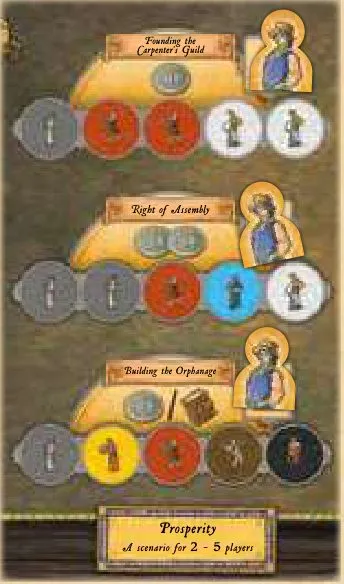 | 16 events and 3 Beneficial Deeds |
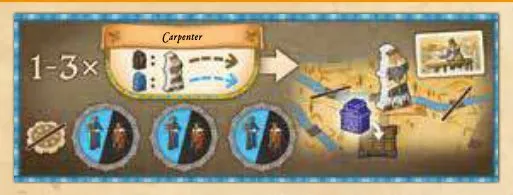 | One per player: the carpenter action FAQ |
| Carpenter | One neutral figure |
| 22 structure cards | Secret building goals; goods tucked underneath can still be collected. FAQ |
| Cover tiles, neutral markers | One each per player |
Setup changes
Set up the base game with these changes:
- Replace the base Beneficial Deeds board with the Prosperity board; a neutral marker on its first event counts the rounds. No hour glass tiles.
- Shuffle the goods and place them face down on the map spaces for your player count; they stay hidden until someone collects them. Turn the leftover goods face up and sort them into the supply.
- Use only these place tiles — I: Brewery, Cheese Factory, Hayrick, Herb Garden, Hospital, Library, Shipping Line, Sacristy, Tailor Shop, Vineyard, Windmill, Winery, Wool Manufacturer; II: Black Market, Cellar, Depot, Gunpowder Tower, Horse Wagon, Laboratory, Office, Pharmacy, School, Stage Coach, Tavern.
- Citizens go only on the boatmen and knights tracks and the 3 Prosperity deeds; the rest form a supply (none on the development track or the map).
- Deal everyone 2 structure cards: keep one, return the other under the pile.
- Put the carpenter in Orléans with the merchants.
- Each player takes a Carpenter extension, covers the Scriptorium with a cover tile and takes a neutral marker to hold completed structures.
The carpenter action
The Carpenter extension counts as a place on your board. In planning put up to 3 traders or boatmen there (monks too; never a gear wheel). When you use it:
- Move the carpenter one connection per follower — a road per trader, a waterway per boatman — using any or all of them now or in later actions. Each follower used returns to your bag. You may also not move.
- If the carpenter stands in the town on your structure card, you may build: lay the card face up and put one of your trading stations on a good on any connection into that town. No good there, no structure. The good under it is locked for the rest of the game.
- After building, draw 2 structure cards, keep one and put the other under the pile.
You may use the carpenter action as often as you can each round.
Structures are not trading stations: place tiles and actions that count trading stations (Office, Trading Day) ignore them.
Manning structures
To score a structure, man it: send the followers it shows next to it with the Town Hall or Gunpowder Tower, and add any coins and goods it asks for (at any time, no action needed). Monks only where the card asks for one; never gear wheels. Nothing placed comes back. Once fully manned, turn the card face down under your neutral marker; its followers return to the supply, its coins and goods leave the game.
Scriptorium
With the cover tile the Scriptorium offers a choice: 1 development point, or a new structure card (draw 2, keep 1, put the other and your old card under the pile). You never hold more than one card.
Prosperity deeds
| Deed | Each follower | Completed |
|---|---|---|
| Founding the Carpenter’s Guild | 1 coin |  Citizen |
| Right of Assembly | 2 coins | Citizen |
| Building the Orphanage | 1 coin or 1 development point | Citizen |
Events
The 16 events follow the order printed on the scenario board.
| Event | Effect |
|---|---|
| Support | Draw a follower, advance on its track with the action, and gain another of that type. |
| Indulgence | Each may buy a monk for 4 coins. |
| Pilgrimage | No monks may be recruited (phase 5). |
| Taxes | Each pays 3 coins (torture if not). |
| Riots | Each returns a knight (market or bag) or pays 5 coins. |
| Bribe | Each may buy a citizen for 4 coins. |
| Plague (×2) | Each loses a follower drawn blind (personal ones are safe). |
| Firestorm | All place tiles turn face down and stop working; gear wheels and non-personal followers on them go to the supply. |
| Mass | At round end, 3 coins per monk on your market. |
| Peregrination | In turn order, each may pay 2 coins to move the merchant (not the carpenter) one connection, taking a good. |
| Restoration | Turn the place tiles hit by Firestorm face up again. |
| Harvest | Return food or pay coins. |
| Pilgrim’s Day | Each may trade a monk plus another non-personal follower from the market for a citizen. |
| Market Day | Each may buy up to 2 goods from the supply at their point value; no selling. |
| Development Tax | Each pays coins equal to development status. |
Game end and scoring
The game ends after 16 rounds. Score as usual, plus the points on your completed structure cards (under your marker). Only real trading stations multiply by development status — structures do not. A face-up, unfinished card scores nothing, but the coins and goods you put beside it still count.