Luna: new astronomers
The four astronomers of the Luna expansion — Isaac Newton, Elizabeth Hevelius, Maria Cunitz and Sophia Brahe — their setup, abilities and personal Book of Comets pages.
Short tag: [Moon]
Luna brings four new astronomers. Like the base four they are played on their ability side in the advanced game (Advanced mode), and they work with or without the Moon: eight characters to choose from in either version.
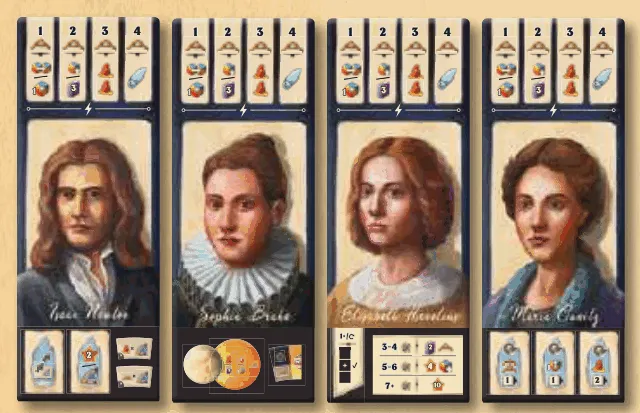
Isaac Newton
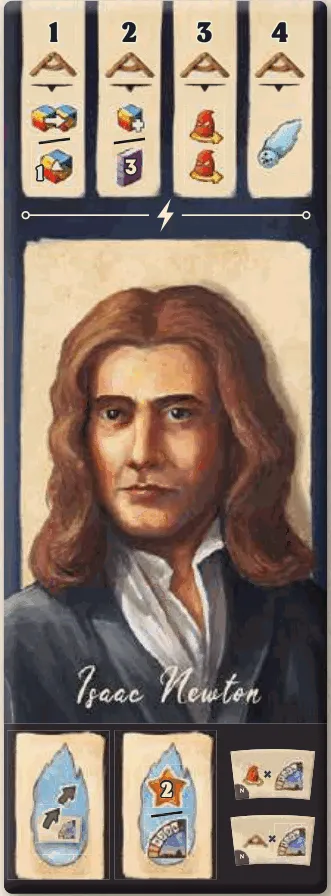
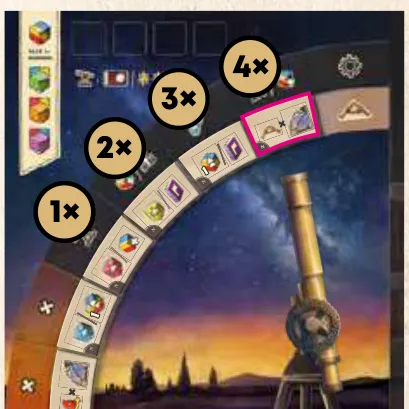
Setup: use Newton’s own six Action tiles (marked N). Put his two special tiles — the primary and secondary mirrors — on the two marked spaces at the bottom of the starry sky, then the other four at random.
Ability: a mirror’s bonus is multiplied by how high it sits: 1× low on the starry sky up to 4× at the top.
| Picture | Mirror tile effect |
|---|---|
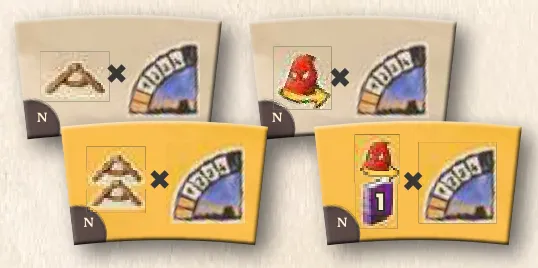 | Basic: choose Quadrants or Persuade equal to the mirror’s position. Upgraded: choose 2 Quadrants or Persuade plus Write 1, each multiplied by its position. |
(Mirror icons read from the rulebook picture.)
Personal comet pages (two):
- move one mirror up to two spaces along the queue (the skipped tiles drop back one space each);
- score 2 × the multiplier of your highest mirror — 8 points if it is at the top.
Elizabeth Hevelius
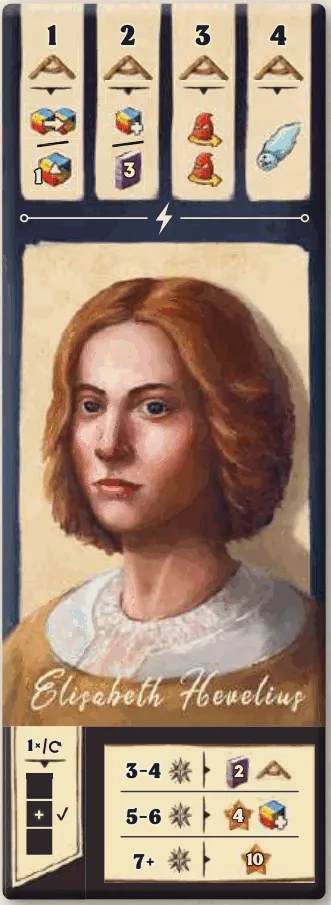
Setup: shuffle her 16 Constellation tiles face down left of your board and turn three face up in a column below the deck: the offer. Leave room to her left for building constellations.
Ability: once per turn, when you carry out the action shown in the bottom-left corner of an offered tile (an exact match: raise yellow dice, upgrade, and so on), take that tile and add it to your constellations. The first tile always starts a new constellation; later tiles may extend one (rotated as you like) or start another. You can’t join two constellations. If you meet no tile’s condition, you may discard any number from the offer instead. Refill the offer to three after taking or discarding.
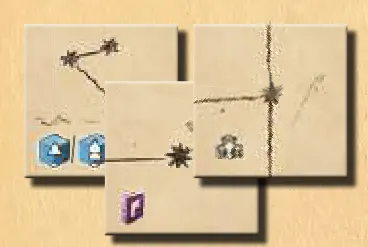
A constellation is complete when no connection is left open. Count its stars:
| Stars | Reward |
|---|---|
| 2 | Nothing |
| 3–4 | Write twice and a  |
| 5–6 | 4  and a die of any colour |
| 7+ | 10 |
Discard completed tiles face down; reshuffle the discards when the deck runs out. Big open constellations can tie up your tiles.
Maria Cunitz
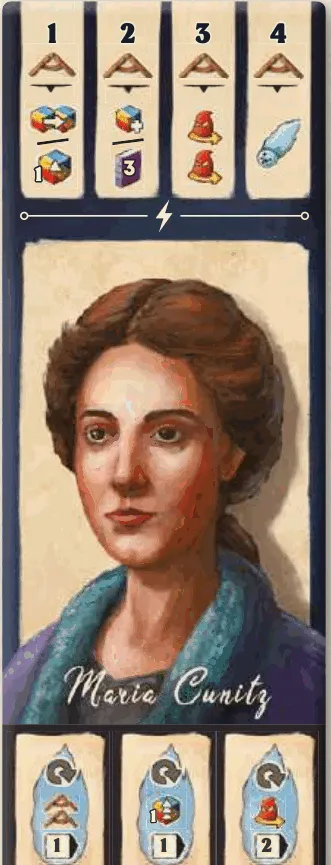
Setup: put the Urania Propitia board right of your player board and fill its six spaces with the six Note tiles at random. The round token goes on the rotating-arrow symbol at the bottom, the square token on the first space of the track. Use Cunitz’s own six Action tiles (marked C).
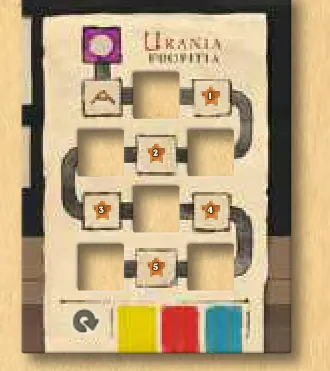
Ability: her tiles add two icons.
- Focus — on every single-colour increase icon: after that half of the tile, you may move the round token onto that colour at the bottom of the board.
- Move — on the right half: move the square token that many spaces along the track.
On a colourless space the square token simply pays its reward. On a coloured Note it pays only if the round token sits on (one of) the Note frame’s colour(s). At the end of the track the square token stays put.
Personal comet pages (three) — each also lets you Focus anywhere:
- 2 and the square token 1 space;
- raise one die by 3 and the square token 1 space;
 once and the square token 2 spaces.
Sophia Brahe
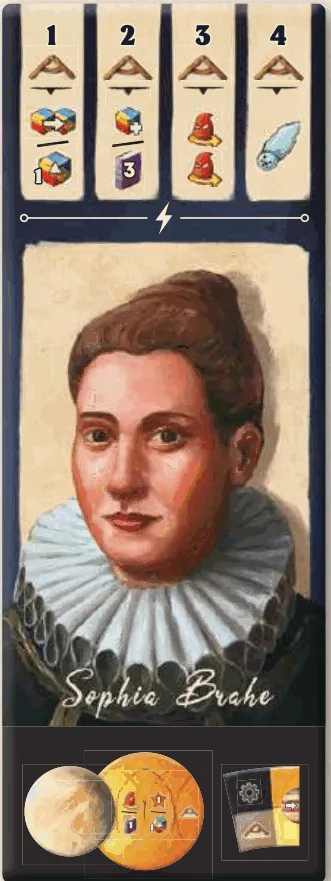
Setup: put her Overlay tile on the Upgrade space of your player board, and her Sun and Venus tokens beside it with Venus covering the Sun.
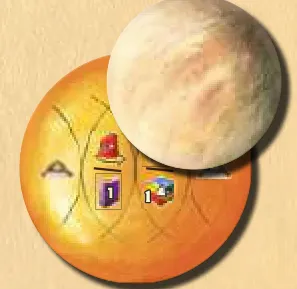
Ability: each time your telescope passes Upgrade and wraps to the bottom, slide Venus one step right across the Sun, uncovering different rewards. Whenever you Observe, you also take every reward visible on the Sun after the action. Once Venus covers only the Sun’s right-hand space, it jumps back to the start the next time you pass Upgrade.
The Sun token’s exact rewards are too small to read in the rulebook: check them against the physical token.