Gameplay and Player Board
Galileo Galilei's player board, the starry sky and its telescope, the three phases of a turn, free actions and the order in which actions resolve.
Overview
Each player is a historical astronomer trying to become the most famous of the age. You score by observing celestial objects on the Discovery cards, writing in your library and lecturing at the university — while keeping the Inquisition at bay. Points go on the track round the game board.
The player who most recently looked at the night sky goes first, then play passes clockwise. The game ends when the Discovery deck runs out (End of the game).
The player board
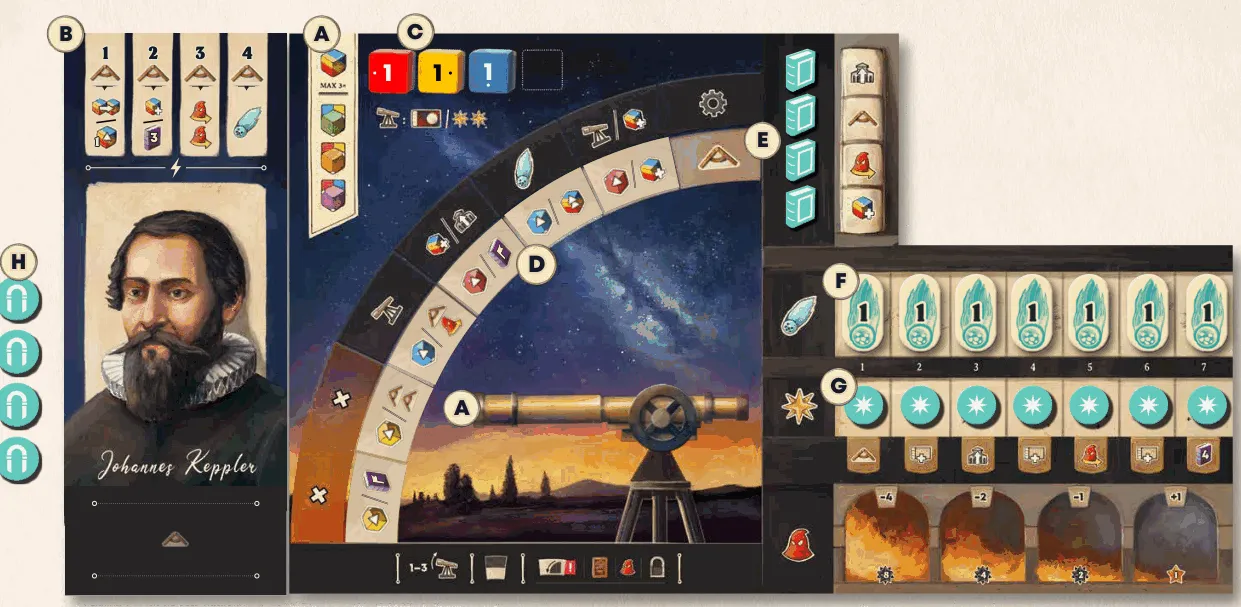
The rulebook’s letters on this picture:
- A — the starry sky and your telescope, which starts on the upper crossed-out space.
- B — your Character Board, with the free actions along the top.
- C — your observation dice: up to four, at most three of a colour.
- D — your six Action tiles on the starry sky.
- E — your four Book tokens, left of the library rows.
- F — seven Comet tokens.
- G — seven Constellation tokens, with the reward printed under each.
- H — your Achievement tokens.
Below the constellations is the cellar, where Inquisitors arrive (The cellar).
Before the first game
Stick the four stickers on the white circles of each player board, fold it so it holds together, and rivet the telescope on so it turns smoothly.
The starry sky
The starry sky is the arc of spaces your telescope points at. The two lowest spaces are crossed out: Action tiles wait there, but the telescope never stops on them once the game starts. Above them are four spaces with a printed fixed action and an Action tile, and at the top the Upgrade space, which has no tile.
| Fixed action (dark) | Choice |
|---|---|
 Observe | Observe |
 /  Gain a die or Lecture | Gain a die or Lecture |
 Spot a comet | Spot a comet |
| / Observe or gain a die | Either one |
 Upgrade | Upgrade — and a  instead of a moving action |
A space split by a slash lets you pick one of its two options.
A turn
A turn has three phases: movement, actions, cleanup.
Movement
Move the telescope 1 to 3 spaces forward, towards the top. It never moves backwards. If it passes the Upgrade space with steps left, it wraps to the lowest space that isn’t crossed out (the Observe space) and carries on.
Actions
On the space you point at you may take the fixed action (dark) and the moving action (the light Action tile), in either order, and any free actions you can pay for. Every one of them is optional — but each action you start is resolved in full, rewards included, before you begin another (Resolving actions).
Cleanup
Do these in order:
- Rotate Action tiles — take the tile you used off the starry sky, slide the others forward, and put it at the beginning of the queue (the lowest crossed-out space). Push the tiles up so the queue has no gap. After an Upgrade nothing rotates.
- Book of Comets — put each comet you used for the second time on an empty page and take its reward (Book of Comets).
- Interrogation — if an Inquisitor moved this turn, add up your cellar (Interrogation).
- Check objectives — claim any objective you have just met (Objectives).
Free actions
Quadrant tokens buy free actions, as many as you can pay for, at any point of
your turn — never while another action is still being resolved. They are listed on your Character
Board.
| Cost | Free action |
|---|---|
| 1 | Change one die to another colour (same value), or raise one die by 1 |
| 2 | Gain a new die, or  Write 3 |
| 3 |  Persuade twice — the same Inquisitor or two different ones |
| 4 | Spot a comet |
Resolving actions
- Finish an action, with all its rewards, before you start another — free actions included.
- If a reward is itself an action, resolve it before anything else: a Write that pays a Lecture means the Lecture is done before you can buy a free action.
- Rewards are not optional when you can carry them out; the only exception is
 Inquisitor’s Farewell, which you may always decline.
- An effect you cannot carry out (a Persuade with nobody to move) is simply lost.