Teach the Game
A script to read aloud: how you win Woodcraft, the boards, a turn, the end, every way to score and what each resource is for.
How you win
“We run woodworking shops in the Forest. Over 13 or 14 rounds we buy, grow, cut and glue wood — dice — to fill customers’ orders. Most points wins, and most of them come from orders: the more you complete, and the better your reputation, the more each one is worth at the end.”
- You need: completed orders, and a high reputation to multiply them.
- You get them by: turning dice into exactly the colours and values an order asks for — buy them, grow them in pots, saw them smaller, splice them bigger, glue them together — then hand them in with any tokens the order wants.
The boards
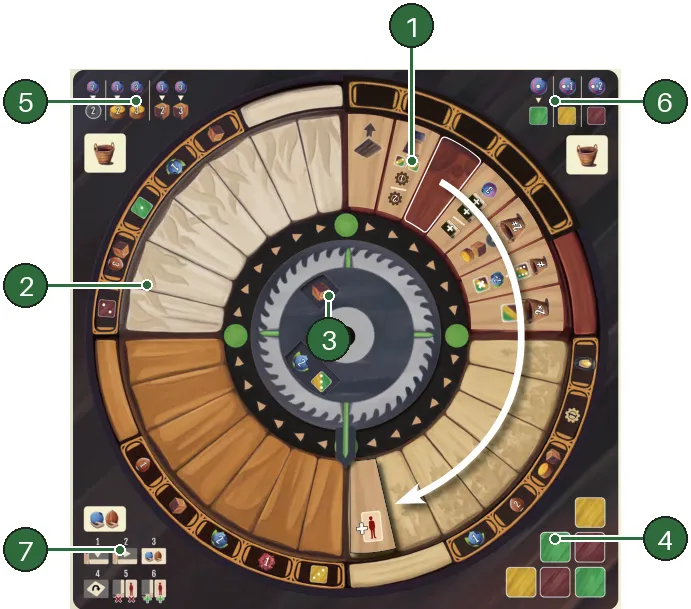
- Action tiles — the seven actions; you take one per turn and push it to the next quadrant.
- Wheel bonuses — printed beside each space; a tile left waiting collects them.
- The circular saw — turns as tiles move and shows a bigger bonus for older quadrants.
- Lumber yard — six rolled dice for sale.
- Material prices — glue, sawblades and scrapwood.
- Dice prices — what a die costs by colour.
- Income phase steps — the reminder of what happens every few rounds.
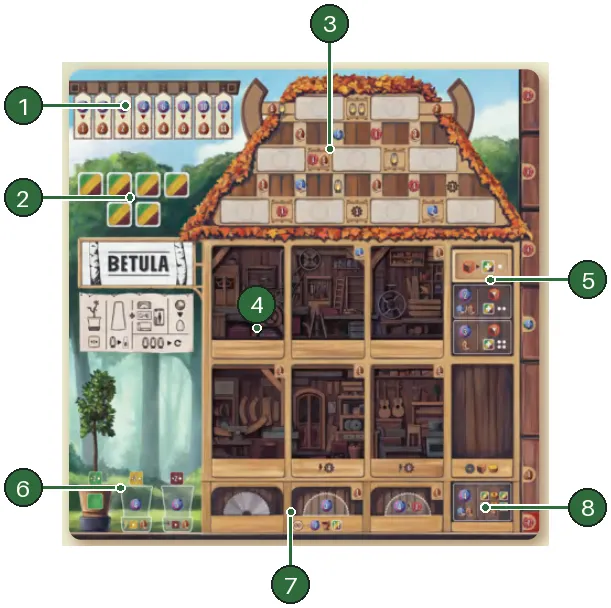
- Marketing track — buy points at the end of your turn.
- Lumber pile — your six dice spaces.
- Attic — tools go here; different neighbours give rewards.
- Workshop rooms — your helpers.
- Splicing tiles — make a die bigger.
- Pots — grow dice as trees.
- Sawing tiles — cut a die into smaller ones.
- Gluing tile — join two dice into one.
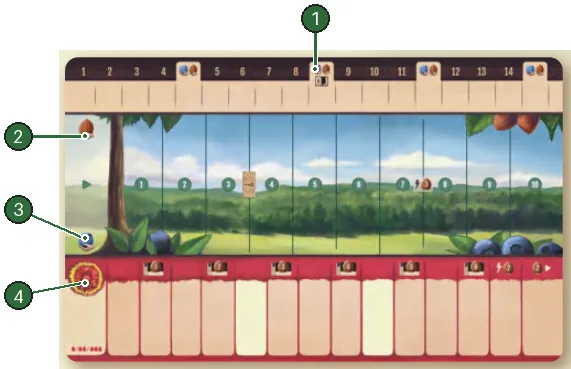
- Round track — the icons after some rounds mark the income phases.
- Hazelnut income — points you score every income phase.
- Blueberry income — blueberries you gain every income phase.
- Reputation track — what each completed order scores at the end.
Beside them: the scoreboard with rows of 4 orders and 4 helpers for sale, and the public contracts.
A turn
Play goes clockwise from the starting player. On your turn (full rules):
- Trees grow — every die in a pot goes up by 2 (no higher than 6).
- Choose an action tile — gain the bonuses beside it, move it to the next quadrant, then do its action. Or take
 3 blueberries instead, or pay 1
 to do another tile’s action.
- Optional: a bonus action for 3 , and any number of free actions — saw, splice, glue, harvest, use helpers, complete orders — in any order.
- End of turn — you may buy points on your marketing track, then keep at most 6 dice.
After 4 rounds and then every 3–4 rounds comes an income phase: orders slip down a row, everyone places a new order from their hand, collects income and resets their tiles.
How the game ends
- After the last round (13 with four players, 14 otherwise) comes a final income phase, then final scoring (details).
- Public contracts you claimed score; leftovers score 1 point per 10; each order still beside your board costs 2 reputation; then each completed order scores your reputation value.
- Ties: the player who sits later in turn order wins — the starting player always loses a tie.
Ways to score
| Source | How and when |
|---|---|
 Order rewards | Points printed on an order, when you complete it |
 Hazelnut income | Points equal to your hazelnut income, every income phase |
 Gluing two colours | 4 points each time you glue dice of different colours |
| Marketing | End of your turn: pay blueberries, score 1 to 11 points |
| Wheel bonuses | Points shown on the wheel or in the saw window |
| Income track line | 3 points when an income counter crosses the line |
 Reputation reward tiles | First players to reach a tile get its reward |
| Public contracts | End of game, for each contract you claimed |
| Completed orders | End of game: each scores your reputation value (up to 6) |
| Leftovers | End of game: 1 point per 10 of dice pips, blueberries and tokens |
 Losses | 1 point for an order completed from the bottom row; 2 reputation for each order that falls off or is left at the end |
What each resource is for
| Resource | Why you need it | How you get it | How you use it |
|---|---|---|---|
| Dice (wood) | Orders ask for exact colours and values | Buy Lumber, Exchange Dice, planting, helpers | Hand them in to complete orders |
| Blueberries | Money for everything | Income, orders, wheel bonuses, selling dice | Dice, materials, helpers, improvements, marketing |
 Sawblades | Extra cuts | Buy Materials, bonuses | One extra cut each when you saw |
 Scrapwood | Raise a die | Buy Materials, bonuses | Splicing; some orders want it |
| Glue | Join two dice | Buy Materials, bonuses | Gluing; some orders want it |
| Lanterns | Flexibility | Start, wheel, orders, helpers | 1: another tile’s action; 3: a bonus action |
 Tools | Attic rewards and contracts | Orders, income track, helpers | Placed in the attic at once |
 Tile-reuse tokens | A second use of a tile | Wheel, helpers, orders | Turn a used sawing, splicing or gluing tile face up |
| Helpers | Abilities and production | Choose a Helper |  production and their ability |
| Orders | Your main points | Starting hand, Choose Orders | Complete them early, from the top rows |
Teaching tips
- Teach the wheel with the tiles in front of everyone: take a tile, show the bonus, move it, turn the saw. The examples make it click.
- Show the dice tools as a set: saw makes smaller, splice makes bigger, glue joins, pots grow. Then an order card: “make exactly these.”
- Explain the order hand clearly — it is the rule new players ask about most: you hold 3 orders and must place one at each of the first three income phases.
- Warn about the end: every order left beside your board costs 2 reputation, so stop taking orders you cannot finish.
Rehearse buying materials
Set aside four blueberries. With Buy Materials, buy two glue tokens and three scrapwood tokens: these are two different purchases. Now try to spend the same four blueberries on five glue tokens. You cannot: two purchases in this action must be of different materials.
Before choosing the action in play, point to the tokens an order or a free action needs. Buying supplies is useful only when you can turn them into the next job.