Solo
Woodcraft solo: setup, the solo deck that moves the action tiles, reputation tiles against a nonplayer counter, disappearing contracts and score targets.
Solo setup
Set up as for two players, with only your own player board and 3 public contracts. Then:
- Take 3 counters of an unused colour. Put one on space 10 and one on space 13 of the round track — the timing counters.
- Put the third on the start of the reputation track: the nonplayer counter you race for the reward tiles.
- Shuffle the 10 solo cards into a deck.
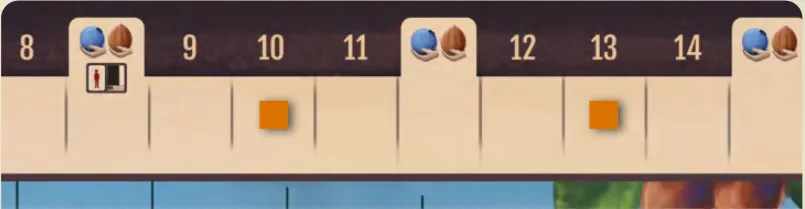
A solo round
- Take your turn as usual.
- Draw the top solo card, do what it shows, discard it.
- Move the round counter.
When the solo deck runs out, shuffle the discards into a new deck. The game lasts 14 rounds with income phases after rounds 4, 8, 11 and 14.
Solo cards
Most solo cards show two action tiles: move them in the order shown, as if two other players had taken them — nobody gains their bonuses. Then do the effect at the bottom of the card, if any.
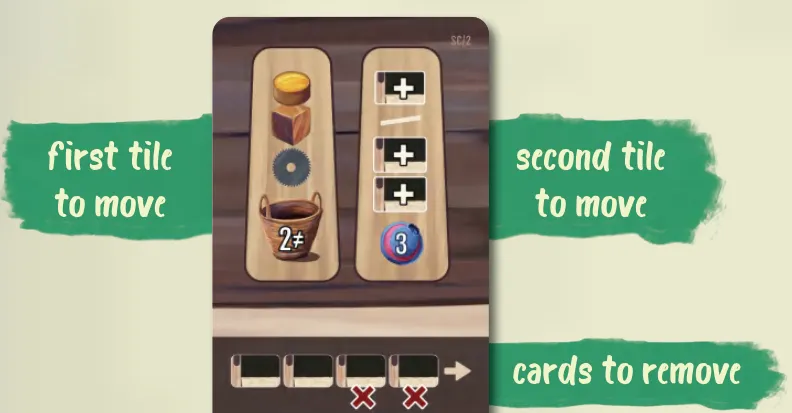
| Picture | Effect |
|---|---|
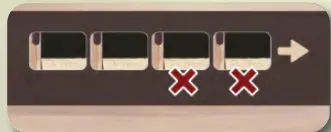 | Remove orders: Remove the marked orders beside the scoreboard and refill the row. |
 | Remove helpers: Remove the marked helpers and refill the row. |
 | Reroll dice: Remove the marked dice from the lumber yard, reroll them and put them back. |
 | One tile, +1: Move only the tile shown; the nonplayer counter advances 1 on the reputation track. |
 | Last tile, +2: Move only the tile farthest behind; the nonplayer counter advances 2. |
Rare special case
If a card asks you to move a tile that cannot legally move, skip that movement and still do the rest of the card (remove the orders even if Choose Orders can’t move). If the card moved no tile at all, draw and resolve another: after your turn, the solo deck must always move at least one tile.
Reputation tiles in solo
You use the 2-player rewards. Reach a tile first and you take it and score its 2-player reward. If the nonplayer counter gets there first, remove the tile: that reward is lost.
Public contracts in solo
At the start of rounds 10 and 13 — where the timing counters sit — remove one unclaimed public contract at random. If none are left unclaimed, nothing happens.
Solo score
110 points is a good solo score and 140 is excellent. How many bonuses the solo deck leaves on the wheel varies from game to game.