Gameplay
Woodcraft's turn, the action wheel and its saw, blocked tiles, the lantern options, end of turn, marketing and the income phase.
Flow of the game
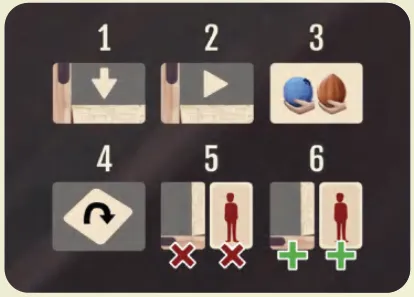
The game lasts 13 rounds with four players and 14 with one to three (the two sides of the income board). In each round every player takes one turn, starting with the starting player and going clockwise. Your turn:
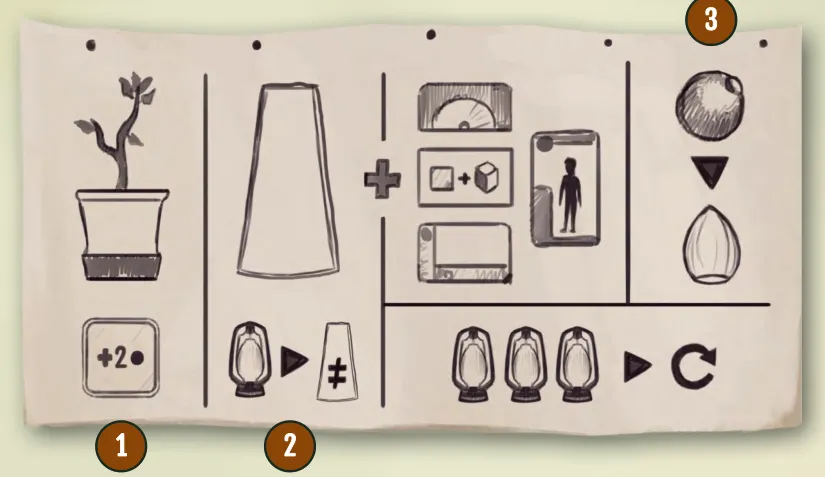
- Trees grow. Each die in one of your pots goes up 2 pips, to at most 6 (tree growth). Skip this on your first turn — you have no trees yet.
- Actions. Choose one action tile on the wheel and do its action. You may also buy one bonus action and do any number of free actions. All of these go in any order.
- End of turn. You may buy points, then trim your lumber pile to 6 dice.
Your player board shows the same three steps in its reminder box.
The action wheel
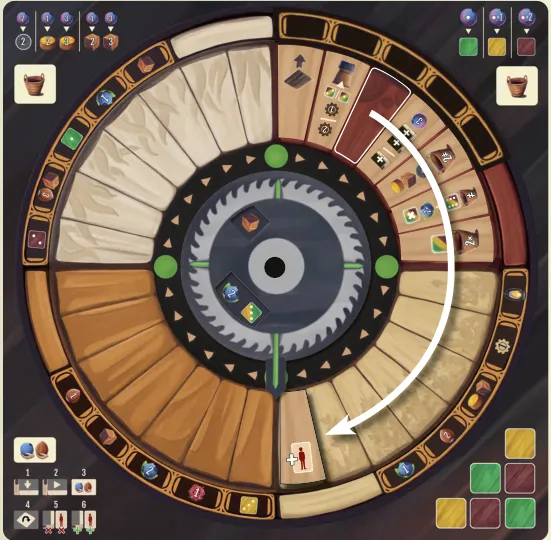
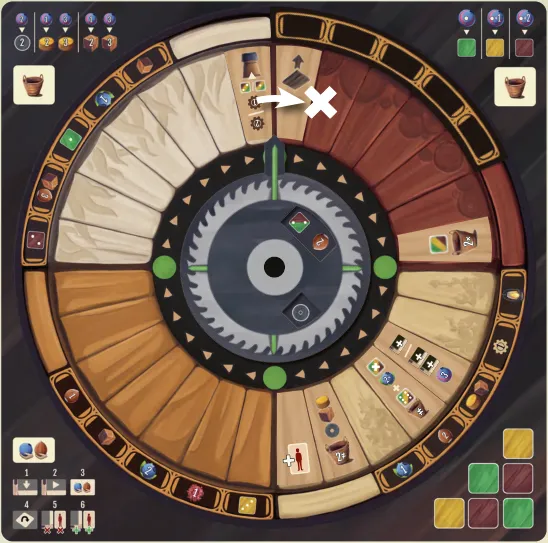
The seven action tiles start together in one quadrant of the wheel. On your turn you choose one tile and:
- gain the bonuses printed beside the space it is on, and the bonus in the saw’s window for its quadrant;
- move it clockwise into the next quadrant — never two quadrants;
- do the action shown on it.
A tile that stays put grows more valuable: older quadrants offer bigger bonuses.
Choosing and moving a tile
- If the next quadrant is empty, the tile goes to its far end.
- If the next quadrant already has tiles, your tile slides along the empty spaces until it meets one; it does not fill gaps.
- The arc tile covers the bonuses of the starting quadrant: tiles taken from there the first time get nothing from the edge. Once the starting quadrant is empty, remove the arc tile — its bonuses count from then on.
The saw and its bonuses
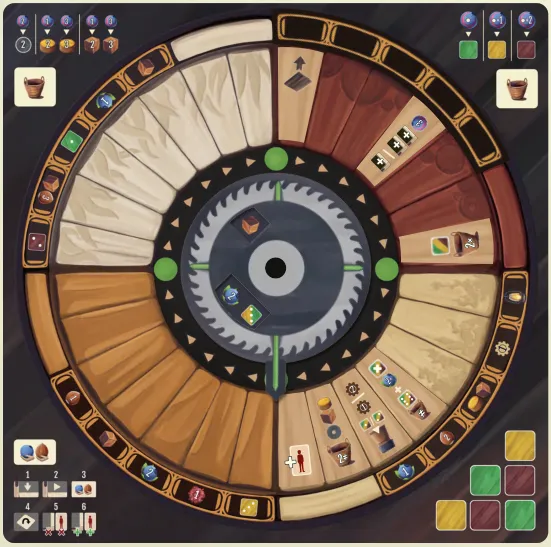
The circular saw in the middle has a black arrow. When a tile crosses that arrow, turn the saw one quadrant: the windows now offer bonuses to the older quadrants, and the oldest gets the biggest. You take the bonus of the space your tile starts on — before the saw turns.
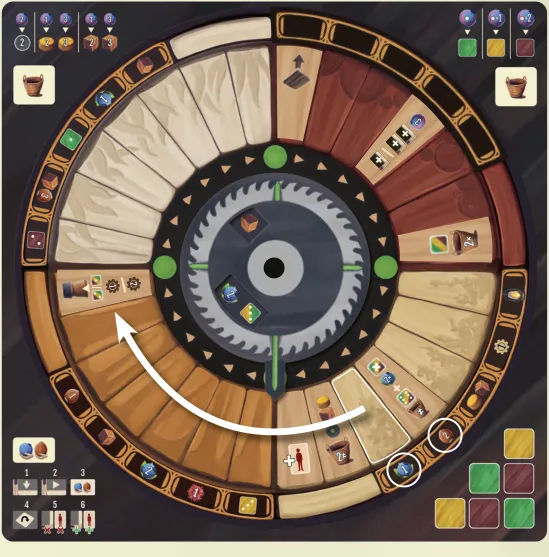
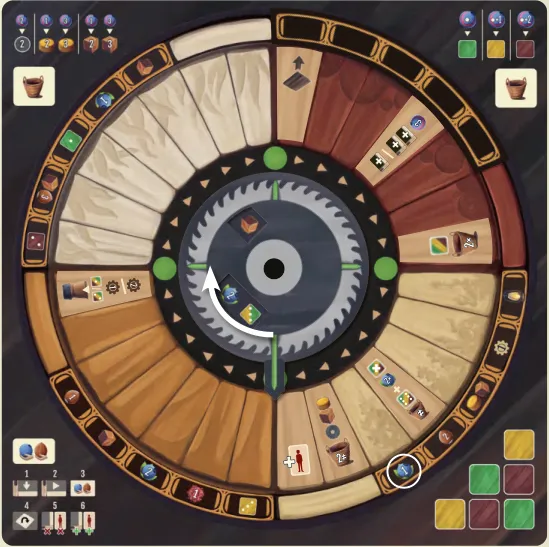
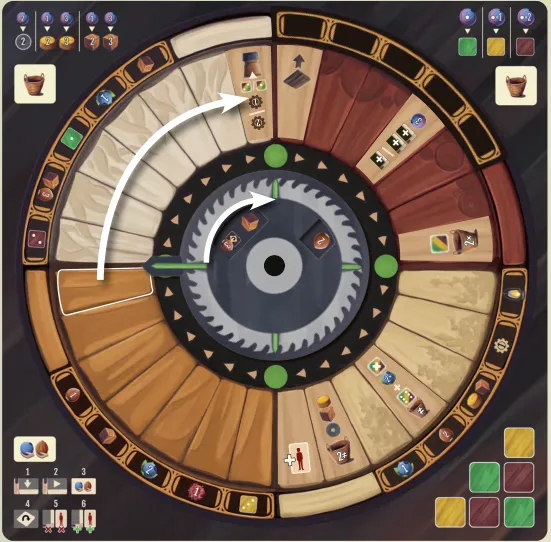
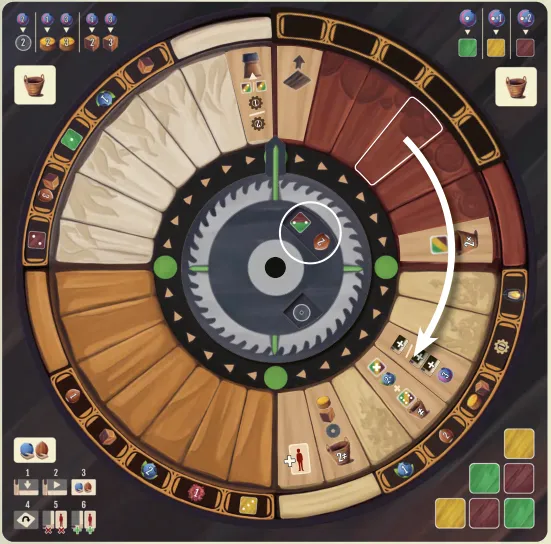
The saw bonuses are listed on the help sheet; see Saw bonuses.
Blocked tiles
A tile may not enter a quadrant that is a full lap behind. In practice: a tile can cross the saw’s arrow only when the quadrant it would move into is empty. A tile that has run so far ahead cannot be chosen until the stragglers catch up.
Different action instead
You always choose and move a tile, and take its bonuses. Then, instead of its action, you may:
- take
 3 blueberries — for when you are stuck; or
- pay 1
 to do the action of any other tile, including a blocked one. The lantern must already be yours before you choose the tile — not one its bonus just gave you.
Bonus action
Once per turn you may pay 3 for a bonus action: any action shown on the seven tiles, even the one you chose. It moves no tile and earns no wheel bonus. Your helpers’ permanent abilities still apply to it.
Free actions
Besides your chosen action and bonus action, you may do any number of free actions during your turn, in any order:
- use a helper’s
 once-per-turn ability (helpers);
- saw lumber, splice scrapwood, glue lumber;
- harvest a tree;
- complete an order;
- spend a
 tile-reuse token.

End of your turn
Marketing
After all your actions you may move your marker one space along your board’s marketing track: pay the blueberries shown and score the points shown. You never have to.
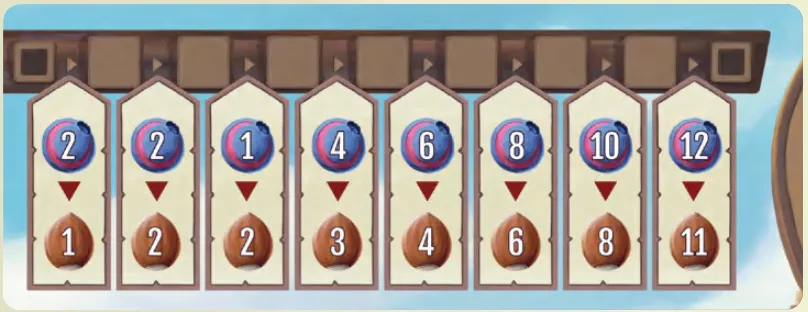
| Space | 1 | 2 | 3 | 4 | 5 | 6 | 7 | 8 |
|---|---|---|---|---|---|---|---|---|
 Cost | 2 | 2 | 1 | 4 | 6 | 8 | 10 | 12 |
 Points | 1 | 2 | 2 | 3 | 4 | 6 | 8 | 11 |
On the last space you stay there, but may keep paying 12 blueberries for 11 points at the end of each turn. The later spaces are the best rate, so steady progress pays.
Lumber pile
You have six lumber spaces. You may hold more dice during your turn, but at the end of it keep only six; return the rest to the bank. Dice in pots do not count — but a tree that reaches 6 must move to your lumber pile at once.
End of the round
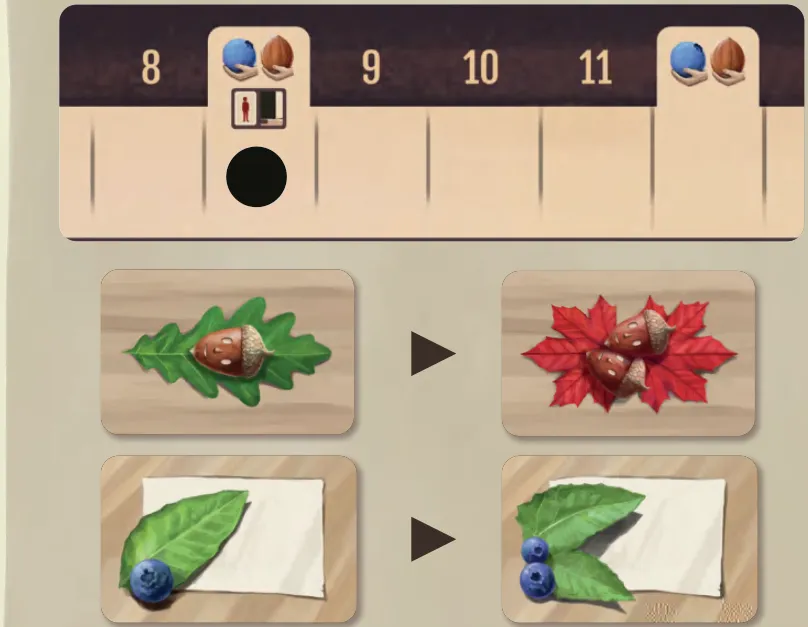
When everyone has had a turn, move the round counter on. If the round you finished has an income icon after it, hold an income phase first.
Income phase
| Players | Income phases after rounds | Late-game decks |
|---|---|---|
| 4 | 4, 7, 10 and 13 | after round 7 |
| 1–3 | 4, 8, 11 and 14 | after round 8 |
Everyone together:
- Orders slip. Move each order beside your board down one row. An order that falls below the bottom row is discarded and costs 2 reputation (rows).
- Place an order. Each player must place one order from their hand. (In the fourth phase your hand is empty: skip it.)
- Income. Gain blueberries equal to your blueberry income and points equal to your hazelnut income.
- Reset. Turn your used sawing, splicing and gluing tiles face up.
- Refresh the rows in the first and third phase: discard the helper and the order on the spaces marked ✗ beside the scoreboard, slide the others along the arrows and deal a new card of each into the gap.
Then the next round starts — or, after the last round, final scoring.
Late-game decks
In the second income phase (after round 7 with four players, round 8 with fewer), instead of step 5: discard every helper and order beside the scoreboard and both early decks, then deal 4 late-game helpers and 4 late-game orders from the late decks. They are used for the rest of the game.