Teach the Game
A table-ready introduction to building Griffintown along the Lachine Canal, from 1840 to 1860.
How you win
We are investors in Griffintown, Montréal, from 1840 to 1860. Over five development phases we build industries, produce goods, develop services and the Lachine Canal, buy city cards and ship goods abroad. Most prestige at the end wins.
Your cash in hand is your action budget: every turn costs money, and you pass once it runs out. Prestige ( ) wins the game. Popularity (
 ) decides who becomes mayor at the three elections, and it is halved after each one.
The boards
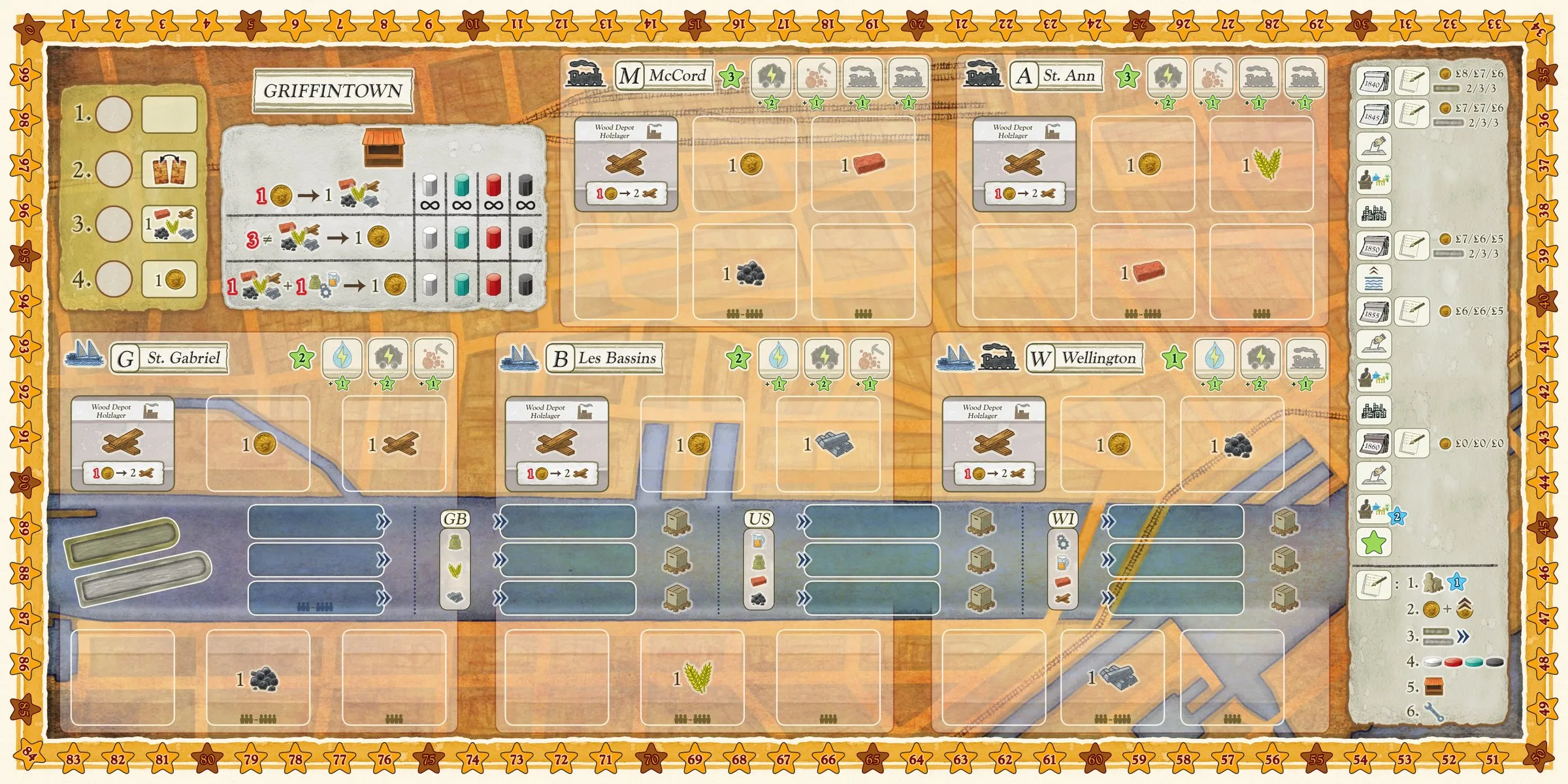
- a Districts along the canal (ship symbol): St. Gabriel, Les Bassins and Wellington.
- b Districts with rail transport (train symbol): McCord and St. Ann.
- c Wellington has both canal and rail.
- d Each district’s printed Wood Depot.
- e Building spaces marked for 3 or 4 players only.
- f Service token spaces.
- g The Lachine Canal: destination sections for ships to GB, US and WI.
- h Order of play box.
- i Local market.
- j Game sequence box: phases, ship arrivals and income.
- k Game sequence marker.
- l Prestige track around the edge.
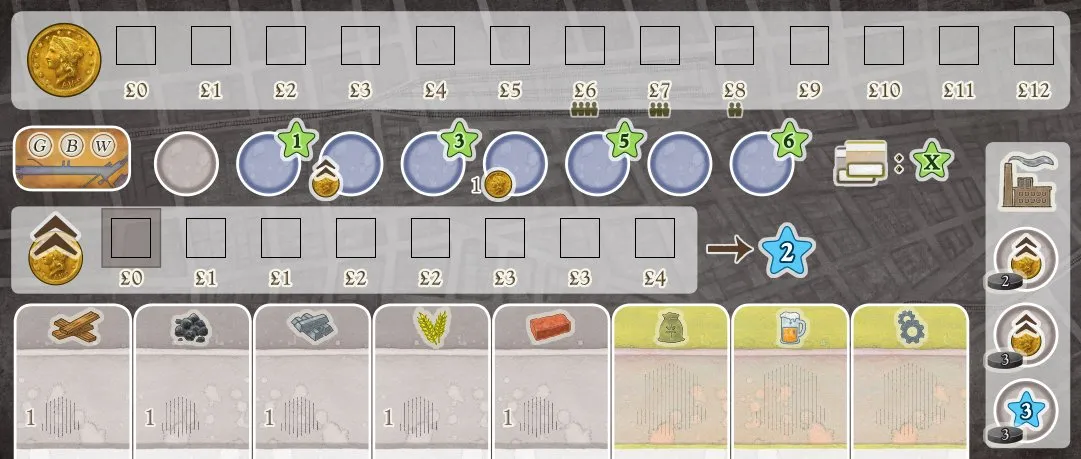
Your company board tracks cash (£0–£12), income, your three canal development markers (G, B, W), your goods and the discs you place on industries you build. Your navigation board holds your five district tiles in a random order and your navigation boat; canal tiles go in the slots below it. See Your Turn.
A turn
- Choose your district: move your boat right for free, or stay or move left for £1. Or pass. Details
- Take one district action there, usually for £1–£2. Details
- Maybe add one canal action (from the canal tile under your boat) and one city action (from a city card you just bought). Details
- At any time in your turn, trade at the local market. Details
Turns go round until everyone has passed. Then an administration phase pays income and brings new ships.
How the game ends
The game has five development phases: 1840, 1845, 1850, 1855 and 1860. Elections follow 1845, 1855 and 1860. After the last one comes final scoring: unload every ship left in the canal, score your industries in each district, and score your canal development. Most prestige wins; ties go to the most cash.
Ways to score
| Source | When |
|---|---|
| Upgrading an industry, building your 8th industry | During play. |
| Developing a service: 1 per industry in the district | During play. |
| Opponents producing in your processing or upgraded industries | During play. |
| Income steps past £4: 2 each | During play. |
| Goods unloaded at foreign markets; first trader at each market: 2 | During play and final scoring. |
| Traders in export agencies: 1 each | Each administration phase. |
| City cards, ranked by the mayor: 3, 2 or 1 each | Each election. |
| Popularity track (17: 2; first to 22: 3) | During play. |
| Modernizing the canal: 3 per tile | 1855 and 1860. |
| Industries × district value; canal development × industries | Final scoring. |
What each resource is for
| Resource | Why you need it | How you get it | How you use it |
|---|---|---|---|
 Cash | Every turn and action costs money. | Income each administration phase; some bonuses. | Move your boat, pay for actions. Never above £12. |
 Wood | Building. | Wood Depots. | Build (1–4), upgrade supply industries, Shipyard. |
 Coal | Services. | Coal Depot, Wharf. | Develop a service; Manufactory. |
 Iron | Upgrades and machines. | Iron Depot, Wharf. | Upgrade supply industries; Manufactory. |
 Grain | City cards (1840s), flour and beer. | Grain Silos, Warehouse. | Acquire a city card; Flour Mill, Brewery. |
 Brick | Canal and upgrades. | Brickyard, Warehouse. | Widen the canal; upgrade processing industries. |
 Flour,  Beer | Exports and city cards. | Flour Mill, Brewery. | City cards (1850s on); ship abroad. |
 Machine | Modernization and upgrades. | Manufactory. | Modernize the canal; upgrade processing industries. |
 Trader | Trade level and bonuses. | 12 each. | Board on neutral ships at McCord or St. Ann. |
Teaching tips
- Set out the boats and district tiles first: “move right is free” explains most of the turn.
- Show one Produce Goods in an opponent’s industry: both players gain, and that interaction drives the game.
- Point at the popularity track bonuses and say early that popularity is halved after each election.
- Remind everyone that cash above £12 is lost, so spending before passing matters.