City Cards and the Mayor
Buy city cards, gain popularity, win mayor elections and score your cards by the mayor's priorities.
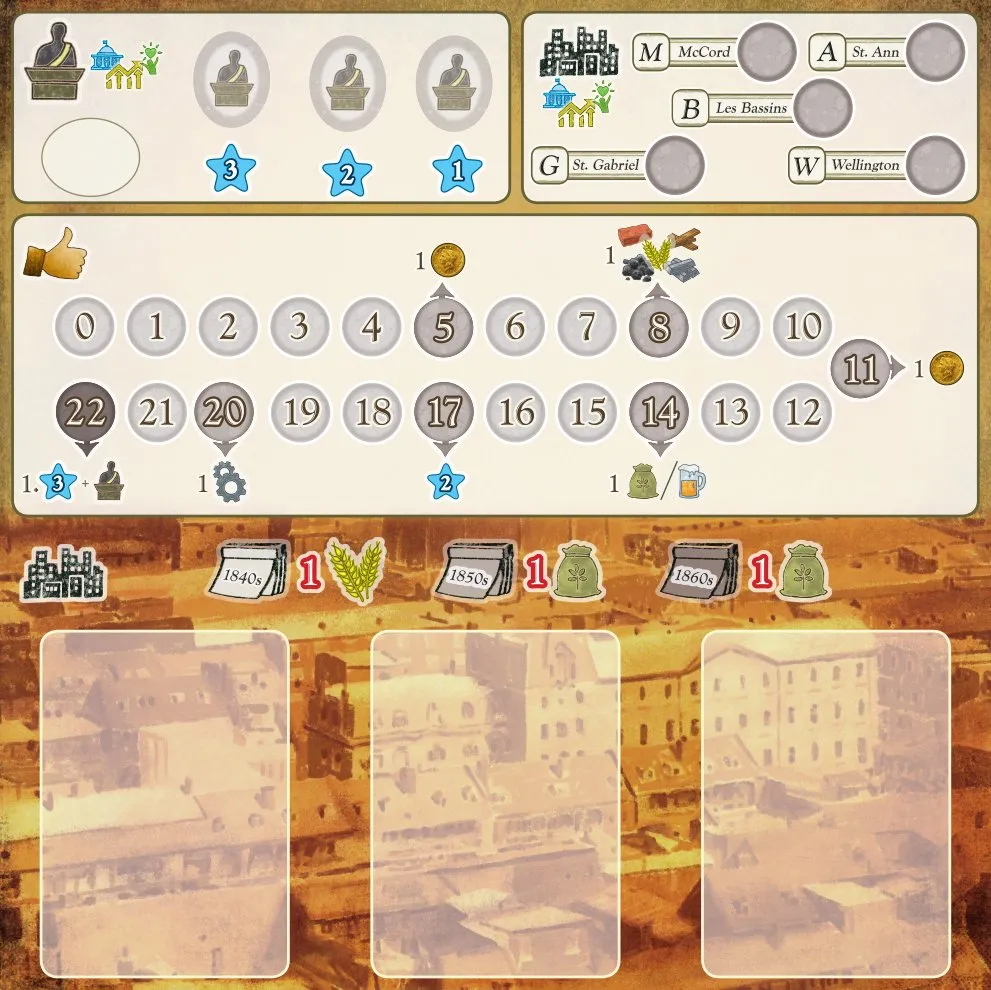
Acquire a city card
You need at least 1 industry of your own in your current district (your Wood Depot counts).
- Pay £1 and spend 1
 in the 1840s, or 1
 in the 1850s and 1860s.
- Take one of the 3 face-up city cards. Some need a
 canal or
 rail district.
- Put one of your discs on that district in the city box of the city development board. You may buy only one city card per district in the whole game, so at most 5.
- Draw a replacement from the current decade’s stack.
- Gain 1
 and resolve the card.
What a card does
| Part | When |
|---|---|
| Top box: instant actions | When you acquire it. |
 Immediate effect | When you acquire it. |
 Permanent effect | From then until the end of the game. 1860s cards have none. |
Resolve a card’s parts in any order. Each card belongs to one category, which matters at elections:  economic and industrial development,
 quality of life or
 public service.
All 42 cards are listed under City cards.
City actions
A card showing  +A gives you one city action: take one more district action of your choice in your current district, paying its cost as usual.
Popularity
Popularity decides elections. You gain 1 for building an industry, producing in 2 or more opponents’ industries, developing a service, developing the canal, acquiring a city card, and placing your 2nd and 3rd local market markers. Some cards and canal tiles give more.
The first time you reach or pass these spaces, take the bonus:
| Space | Bonus |
|---|---|
| 5 | £1 |
| 8 | 1  basic good of your choice |
| 11 | £1 |
| 14 | 1 flour or 1  beer |
| 17 | 2  |
| 20 | 1  machine |
| 22 | The first player there gains 3 and wins the next election. Nobody else can move onto 22. |
The city council phases
After the 1845, 1855 and 1860 development phases (and their administration), hold a city council: mayor election, mayor priorities, then new city cards. In 1860, skip the new city cards.
Mayor election
The player with the most popularity becomes mayor and takes the mayor card. A player on 22 wins automatically. In a tie, the tied player whose disc is on top of the stack wins (they got there last).
Then everyone halves their popularity, rounded down. Landing back on a bonus space gives nothing, but you can earn a bonus again by passing it later.
The mayor bonus
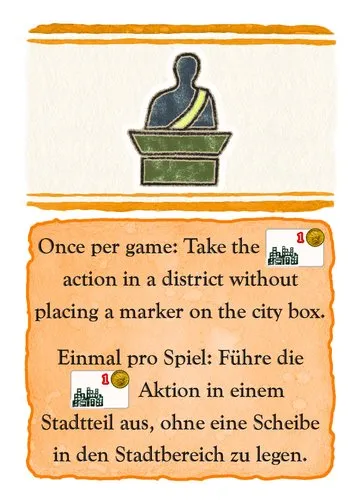
Once per game, when you are mayor and take Acquire a City Card, you may take the card without placing a disc in the city box. You still need an industry in the district. So a mayor can hold 2 cards from one district and 6 cards in total. As mayor, you may even use a city action from the first card to buy a second card in the same district: the only way to take 4 actions in a turn.
Mayor priorities
The mayor ranks the three categories by placing the priority tokens. Then everyone scores every city card they own:
| Category rank | Prestige per card |
|---|---|
| 1st | 3 |
| 2nd | 2 |
| 3rd | 1 |
Put the priority tokens back afterwards. After the 1860 election, the mayor also gains 2 , since the mayor bonus can no longer be used.
New city cards
Remove the 3 face-up cards and the rest of their decade’s stack from the game. Deal 3 cards from the next decade: 1850s after the first election, 1860s after the second.