Teach the Game
A script to read aloud: how you win Mombasa, the board and your player board, a round, the end, every source of money and what each card, track and piece is for.
How you win
“We are investors in Africa’s four chartered companies — Mombasa, Cape Town, Saint-Louis and Cairo. Nobody owns a company: we all buy shares in them. Over 7 rounds, about 30 minutes per player, we play cards to buy shares and to spread the companies’ trading posts across the map. Whoever has the most money at the end wins.”
- You need: pounds — cash in hand, plus at the end your shares of each company times that company’s share value, plus the last value you passed on your diamond and bookkeeping tracks.
- You get it by: playing goods cards to climb the company tracks (shares) and buy better cards, expansion cards to push a company’s trading posts out of its base (each uncovered coin raises its share value), and bookkeepers and diamond merchants to climb your own two tracks.
The boards
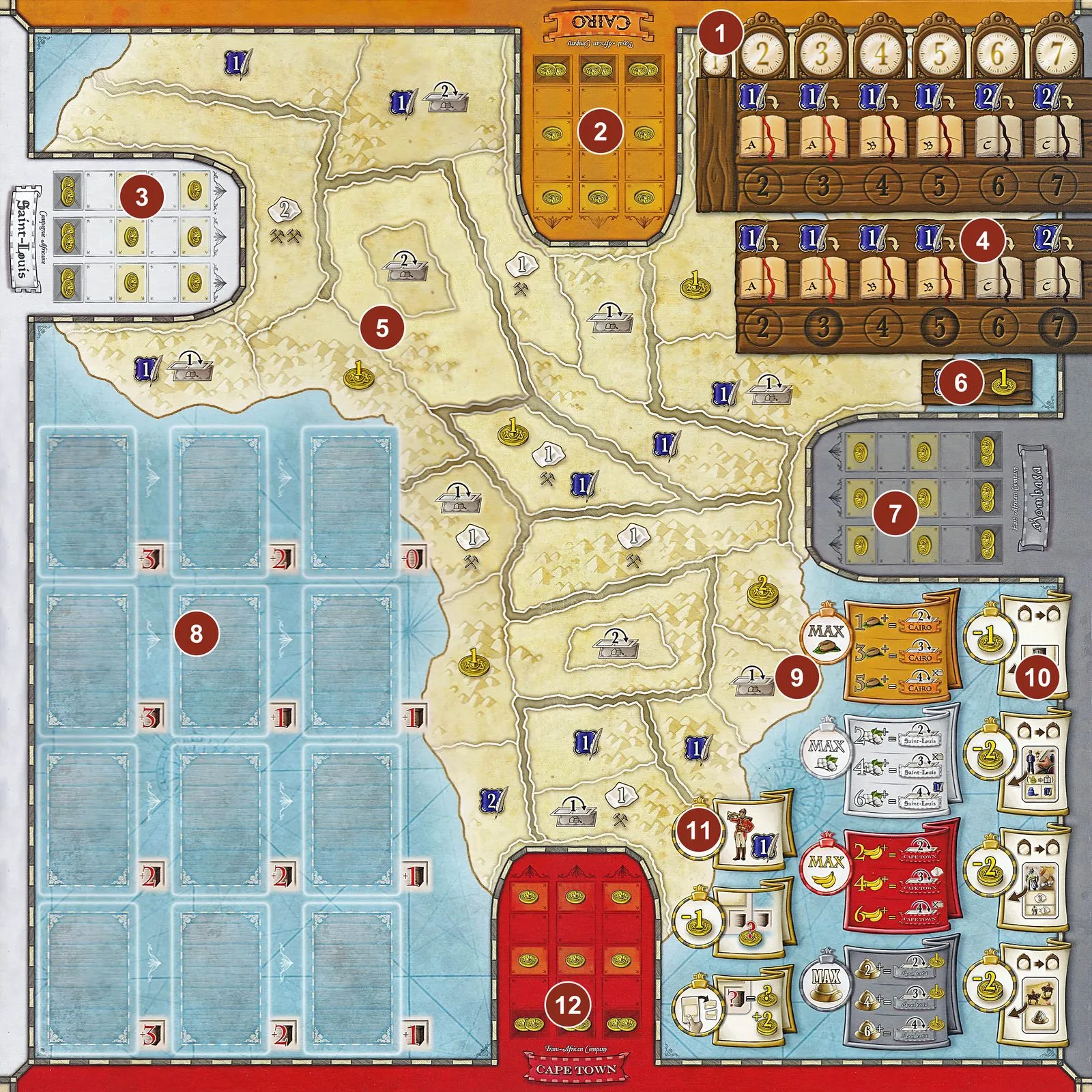
- Round track — rounds 1 to 7; the coins on it move down to the book display.
- Cairo company base — orange trading posts; each uncovered coin icon adds 1 pound to a Cairo share.
- Saint-Louis company base — the white company.
- Book display — 12 books (A, B, C) bought with bookkeeping points.
- The map — 24 regions with their rewards; single and double borders.
- Bookkeeping exchange — a reminder: 1 bookkeeping point buys 1 pound.
- Mombasa company base — the black company.
- Card display — 12 action cards; the red number beside each space adds to the card’s price.
- Majority bonus spaces — MAX coffee, cotton, bananas and expansion points.
- Bonus tile spaces — reserve a bonus tile for next round.
- Other bonus spaces — first player, buy a card with money, remove a card for money.
- Cape Town company base — the red company.
Each edge of the board also gets one company track, joined to that company’s base.
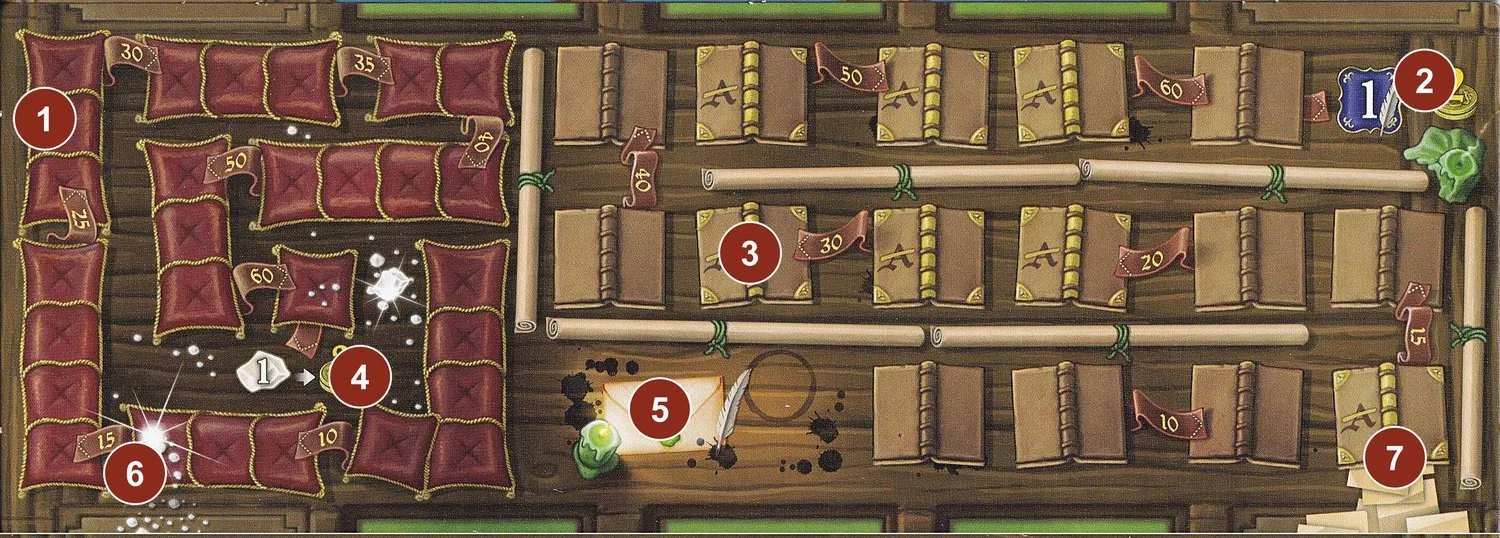
- Diamond track — winds inwards; the last value passed (10 to 60) scores.
- Final book space — reach it and each bookkeeping point pays 2 pounds instead.
- Bookkeeping track — you fill it with books; the last value passed (10 to 60) scores.
- Final diamond space — reach it and each further diamond step pays 2 pounds instead.
- Starting tile space — your starting tile and ink jar start here.
- Diamond slot space — pass it to open a 4th action slot below.
- Book slot space — pass the book on it to open another action slot below.
Above the board are your 3 resting slots; below it your 3 action slots.
A round
- Planning — everyone at once places up to 3 cards (4–5 with extra slots) face down in their action slots, then all turn them up (details).
- Actions — from the first player, one action per turn, round and round, until everyone has ended (details):
| Action | What it does |
|---|---|
| Use goods cards |    One type: buy 1 card from the display and/or advance on company tracks |
| Use all expansion cards | Spread one company’s trading posts into the map and take the region rewards |
| Use a bookkeeper | Move your ink jar over books whose needs your cards meet; then  |
| Use a diamond merchant |  Move up your diamond track, take  |
| Place a bonus marker | Take a bonus space on the board or on a company track |
| End your action phase | Take back one resting deck, move your played cards up to the resting slots |
- Preparation — coins move from the round track to the book display, the card display slides right and refills, bonus markers (and reserved bonus tiles) come back (details).
How the game ends
After the action phase of round 7. Everyone takes back all their cards and scores (details):
- cash;
- for each company: your shares (track + share icons on cards) × the uncovered coin icons in its base;
- the last value passed on your diamond track and on your bookkeeping track.
Most money wins; a tie is a shared win.
Ways to score
| Source | How and when |
|---|---|
| Cash | Pounds in hand at the end — from rewards, special spaces, bonus spaces, books, removed cards |
| Shares × value | At the end, per company: shares on its track + shares on your cards, × uncovered coin icons in its base |
| Diamond track | At the end, the last value passed (10 up to 60) |
| Bookkeeping track | At the end, the last value passed (10 up to 60) |
| [Cooked] Cooked Books | At the end, 5 or 10 for each promo book your ink jar reached (Cooked Books) |
| Lost money | Capital calls on company tracks, bonus space costs, flipping books, buying cards with money |
What each resource is for
| Resource | Why you need it | How you get it | How you use it |
|---|---|---|---|
| Goods cards | Climb company tracks; buy cards; majorities; book needs | Starting hand, card display | Spend one type per action (goods) |
| Expansion cards | Raise share values; oust rivals; region rewards | Starting hand, card display | All at once on one company (expansion) |
| Bookkeepers | Move the ink jar; bookkeeping points | Starting hand, card display | One per action (bookkeeper) |
| Diamond merchants | Diamond track and a little cash | Card display only | One per action (merchant) |
| Pounds | Final score; capital calls; costs | Rewards, special spaces, books | Pay  costs, or keep them |
| Bookkeeping points | Books for your track | Regions, bookkeepers, books, bonuses | Spend at once: A or B book 1, C book 2, or 1 pound each |
| Books | The steps of your bookkeeping track | Book display | Placed on your track; their needs gate the ink jar |
| Bonus markers | Bonus spaces | 2 (3 at two players), more with track A2 | One per action; back each round |
| Track markers | Shares; special track bonuses | On every track from the start | Moved by goods units and rewards |
Teaching tips
-
Start with the money: “shares × coins in the base”. Everything else feeds that sum or the two personal tracks.
-
Show the resting decks early — the hardest part for new players is that a played card comes back only when you pick up its deck.
-
Tell players to use a bookkeeper before the goods cards that meet its books’ needs: used cards turn face down and stop counting.
-
First game: use the fixed tracks A1–D1 and the four fixed starting tiles; allow about 30 minutes per player.
-
Test a four-unit book with 2 bananas and 2 coffee, then 4 bananas: only one type qualifies, and the cards must still be face up. Practice example.