Rounds and Planning
Mombasa's 7 rounds: planning cards into your action slots, resting decks, the general action phase, ending your action phase and the preparation phase.
Mombasa lasts 7 rounds. Each round has three phases: Planning, General actions and Preparation. After the general action phase of round 7 comes the final scoring.
Planning phase
Everyone plays at the same time:
- Place cards face down from your hand into the available action slots below your board — one card per slot.
- When everyone is done, turn all placed cards face up.
You start with 3 action slots, so you play up to 3 cards. You may always play fewer. The cards in your action area decide which actions you can take this round (actions).
Action slots and resting slots
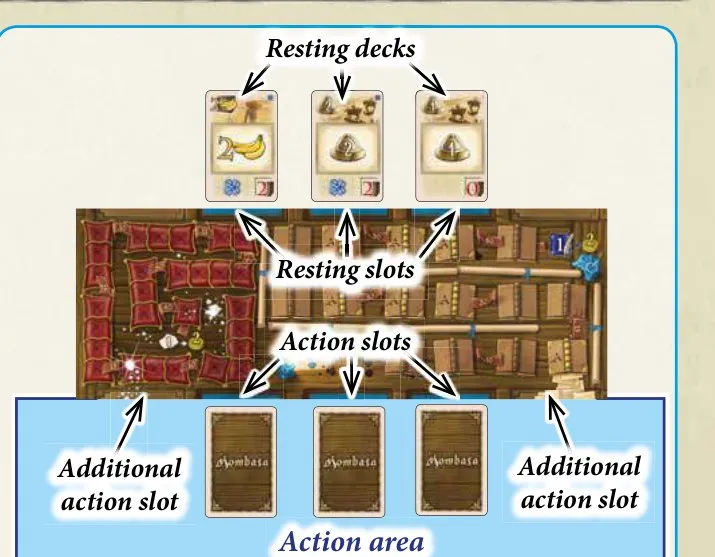
Each action slot is linked to the resting slot straight above it on the top edge of your board. When you end your action phase, each card moves up from its action slot to its resting slot, slid in behind the cards already there so the top of every card stays visible. Over the rounds a resting deck builds up in each resting slot.
Cards in resting decks are inactive. Each round you take back only one resting deck. So choose the slot of every card with care: it decides with which other cards it comes back, and when.
At the start your three resting slots each hold one card — the three cards shown on your starting tile.
In rounds 6 and 7 the slot no longer matters: those cards will not come back before the end.
Additional action slots
Your board has two more action slots, one at each end, each with a resting slot above it (player board):
- the left one opens when your diamond marker reaches or passes the marked space of your diamond track;
- the right one opens when your ink jar reaches or passes the book on the marked space of your bookkeeping track.
From the next Planning phase on, you may play one more card for each open slot — up to 5.
General action phase
The first player takes a turn, then the others clockwise, round after round. On your turn you take exactly one action:
- Use 1 or more goods cards of one type
- Use all your expansion cards
- Use 1 bookkeeper
- Use 1 diamond merchant
- Place 1 bonus marker
- End your action phase
A used card is turned face down and cannot be used again this round. If you lack the cards for an action you cannot take it; with nothing left to do you must end your action phase.
End of your action phase
Take this action only when you cannot or will not do anything else — unused cards and bonus tiles are lost, not kept. Then:
- Pick up one resting deck into your hand. In round 1 each holds a single card.
- Clean up: turn the cards in your action area face up and move each up to the resting deck of its slot. Return any bonus tiles beside the board.
You are out of the general action phase for this round; the others go on without you. When the last player ends, the round moves to Preparation.
Preparation phase
Coins to the book display
Take the coins from the leftmost stack on the round track (spaces 2 to 7) and move them down to the book display, under the column with the same number: one coin goes to the first row, a second to the second row. Whoever later takes the book above a coin takes the coin too. The number now uncovered on the round track is the round about to begin.
Refill the card display
- Discard any cards still in the right column.
- Slide the cards in each row to the right: two cards fill the right and middle spaces, one card goes to the right space.
- Refill the empty spaces from the action card stack: right column top to bottom, then middle, then left.
If the stack runs out, the remaining spaces stay empty. The last 8 cards of the stack are the share cards (D and E).
Bonus markers come back
Everyone takes back their bonus markers. A marker taken from a bonus tile space brings the reserved bonus tile: place it face up in your action area (the “+1” goods tile beside your board). Then the next round starts with Planning.