Actions
Mombasa's six actions in full: goods cards, expansion and ousting, bookkeepers and books, diamond merchants, bonus spaces and bonus tiles.
On your turn in the general action phase you take one of these actions. A card you use is turned face down at the end of the action.
Use goods cards
Goods cards come in three types —  coffee,
 bananas and
 cotton — each worth 1 to 4 units (the big number). Choose any number of face-up goods cards of one type in your action area; their units add up to your total unit value. Use it to:
- acquire at most 1 card from the card display, and/or
- advance on one or more company tracks.
Then turn the cards you used face down.
Acquire a card
A card’s price is its own red crate value (bottom right of the card) plus the red value printed on the board beside its space in the display. Your total unit value must at least match the price. Take the card into your hand; units left over move you up company tracks. You must always use at least one goods card, even for a card whose price is 0. A price never drops below 0.
The display is not refilled until the Preparation phase.
Advance on company tracks
Each unit moves one of your track markers 1 space forward. Split the units over the tracks as you like. Crossing a capital call costs money; reaching a share icon or special space pays off — see Company Tracks.
Use expansion cards
Use all expansion cards in your action area at once — you may not keep any for later. Add up the helmets: that is your total expansion value, all spent on one company of your choice. The share icon at the bottom left of some expansion cards does not matter here; it counts only at the end.
Entering regions
Repeat until your expansion value is spent (forfeit what you cannot or will not use):
- Choose a region the company can reach: one next to its base, or next to a region holding one of its trading posts. It must not already hold one of this company’s posts; it may hold another company’s post.
- Pay expansion points: 1 to cross a single-line border, 2 for a double-line border, +1 if another company’s trading post is there.
- Take a trading post from the company’s base. Any of its three columns, but within the column always the foremost post (the one nearest the map).
- Put it in the region on its side, to mark that you entered it but have not collected yet.
Notes:
- The two enclave regions lie entirely inside another region: enter the surrounding region first. Those two surrounding regions are the only ones with no reward.
- A trading post does not need a link back to its base: any post of the company is a starting point.
- Company bases are not regions.
- An empty base cannot expand until posts come back by ousting; if it empties during your expansion, the rest of your points are lost.
- If your only expansion card cannot pay for any region you want, you forfeit the action and turn the card down.
- The last space at the back of each column shows 2 coin icons, and an emptied last space can never be refilled. Usually empty one column completely before starting the next.
Region rewards
When you have spent your points, collect the rewards of every region you entered, in any order:
| Reward | What you get |
|---|---|
 | That many pounds |
 | Move your diamond marker that many spaces (ignore the mine icons — they matter only to diamond merchants) |
| Track arrow | Move that many spaces up the track of the company you just expanded |
 | Bookkeeping points — the points of all regions entered are added together and spent at once (books) |
Ousting trading posts
- Every post of another company in a region you entered goes back to its own base. You choose the column; within it, it takes the rearmost empty space. An emptied final space cannot be covered again, so a post returning to an empty column goes on the space in front of it. If there is no valid space, the post leaves the game.
- Stand your own tipped posts upright (roof up).
- Turn all your expansion cards face down.
Use a bookkeeper
Books and bookkeeping points
Your ink jar can only stand on books, so you first fill your bookkeeping track with books from the book display (you start with one, on your starting tile). You buy them with bookkeeping points , earned from regions, bookkeepers, books and bonuses. Points must be spent when you get them; they cannot be saved. Split them as you like:
| Cost | Buys |
|---|---|
| 1 point | 1 A-book from the display |
| 1 point | 1 B-book from the display |
| 2 points | 1 C-book from the display |
| 1 point | 1 pound from the bank |
A coin lying under a book in the display comes with it. At the end of your turn, if you took books:
Placing books
- Put each new book on a space of your bookkeeping track. Any space is allowed, but:
- an A-book may not go on an empty space showing a crossed-out A;
- a placed book cannot be removed (only flipped);
- you may cover a book with a new one, but never cover a B- or C-book with an A-book.
- Refill the display from the face-down pile of the matching letter. If a pile runs out, its spaces stay empty.
Books in the upper half show needs. Books with similar needs side by side are easier to cross in one go. You cannot skip empty spaces, so it is usually best to fill the track from the start.
Moving the ink jar
- Flipping a book (optional): you may pay 2 pounds
 to turn one book on your track face down. A face-down book has no needs and no reward. It is meant as a last resort.
- Move the ink jar forward book by book. To enter a book you must meet each of its needs with the cards face up in your action area: the total value of that card type must reach the number shown. Needs are checked book by book, not added up, and the cards are not used up. You cannot enter an empty space.
- Where you stop, take that book’s reward — only that one. A face-down book gives nothing; not moving gives nothing.
- Then spend the bookkeeping points of the bookkeeper card and turn it face down.
Special needs and rewards:
| On a book | Meaning |
|---|---|
| A crate with a number | That many units of one good face up (4 coffee, 4 bananas or 4 cotton) |
| A good with a number + a crate with a number | That good, and that many further units of one good (3 coffee + 3 crate: 3 coffee and 3 cotton, or 3 coffee and 3 bananas, or 6 coffee) |
| Merchant / bookkeeper | 1 diamond merchant or 1 bookkeeper face up — besides the bookkeeper you are using |
| A helmet with a number | That total expansion value face up |
| Question mark + good (reward: coin ”?−1”) | Need: at least 1 unit of that good. Reward: pounds equal to your units of that good, minus 1 |
| Crossed trading post(s) | Remove 1 (or 2) trading posts from any company base, each the foremost of its column, out of the game |
End of the bookkeeping track
When your ink jar reaches the book on the last space it stays there; from then on every bookkeeping point you receive pays 2 pounds instead, and can be used no other way.
Use a diamond merchant
Diamond merchants are the only cards not in your starting hand: 5 are in the action card stack. Use one in your action area:
- The plain merchant: 1 space and 2 pounds.
- A company’s merchant (one per company): 2 spaces and 1 pound, then 1 more space for every 2 mine icons in the regions that company controls (regions holding its trading posts).
Then turn it face down.
End of the diamond track
When your diamond marker reaches the last space it stays there; from then on each diamond step you would take pays 2 pounds instead.
Place a bonus marker
Put one of your bonus markers on an empty bonus space — on the board or an extra bonus space you have unlocked on a company track. Meet or pay what its circle shows at once, then take the reward (or reserve the tile). The space stays blocked until the end of the round.
Bonus spaces on the board
| Space | Needs / cost | Reward |
|---|---|---|
| First player | Not if you are first player on your first turn of the round | Take the first player marker (you start next round) and receive 1 bookkeeping point . The only way the first player changes |
| Buy a card | Pay 1 pound | Buy 1 card from the display for its full price in pounds — the only way to buy with money |
| Remove a card | Remove 1 card from your hand to the discard pile, for good | Pounds equal to its red crate value + 2 |
Majority bonus spaces
You may take a MAX space only if no other player has more of that type face up in their action area right now (a tie is enough). The cards are not used up. You may always take a lower line than you qualify for.
| Space | Your total | Reward |
|---|---|---|
| Coffee | 1+ / 3+ / 5+ | Cairo track 2 / 3 / 4 spaces; at 5+ also remove a trading post |
| Cotton | 2+ / 4+ / 6+ | Saint-Louis track 2 / 3 / 4; at 4+ also remove a trading post; at 6+ also 1 |
| Bananas | 2+ / 4+ / 6+ | Cape Town track 2 / 3 / 4; at 4+ also 1; at 6+ also remove a trading post |
| Expansion points | 2+ / 4+ / 6+ | Mombasa track 2 / 3 / 4, each with 1 |
“Remove a trading post”: take the foremost post of a column in any company base out of the game — it raises that company’s value.
Bonus tiles
The four bonus tile spaces cost 1 or 2 pounds and give nothing now: they reserve a tile that you receive in the next Preparation phase and use in the next round. The tile goes back beside the board when that round ends for you.
| Picture | How it works |
|---|---|
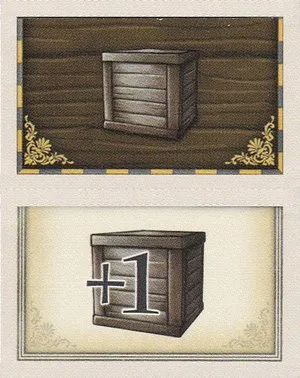 | Cost: 1 pound. Kept beside your board. On one of your turns lay it on a face-up goods card: that card is worth 1 unit more, until both are turned face down. It cannot move or be used alone. FAQ |
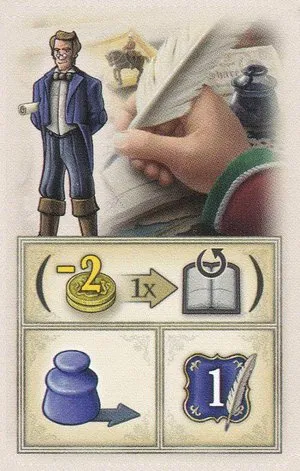 | Cost: 2 pounds. A bookkeeper worth 1 bookkeeping point. FAQ FAQ |
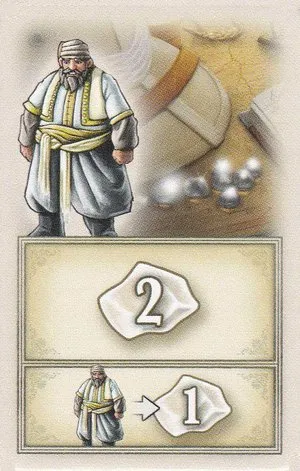 | Cost: 2 pounds. A merchant: 2 diamond steps, +1 for each other face-up merchant card in your action area. FAQ |
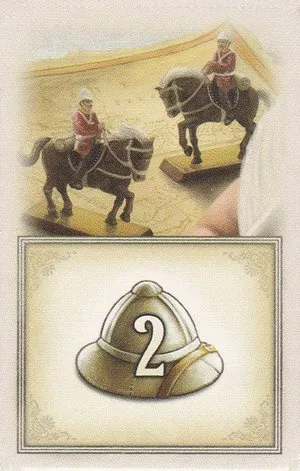 | Cost: 2 pounds. An expansion card with value 2. FAQ FAQ |
Card tiles count as cards of their type in every way but take no action slot.