Workbench, Patrons and Instruments
Your Luthier workbench: storage, award benefits, the four patron types, requirements, gifts and patience, completing patrons, and roughing and finishing instruments.
The workbench board
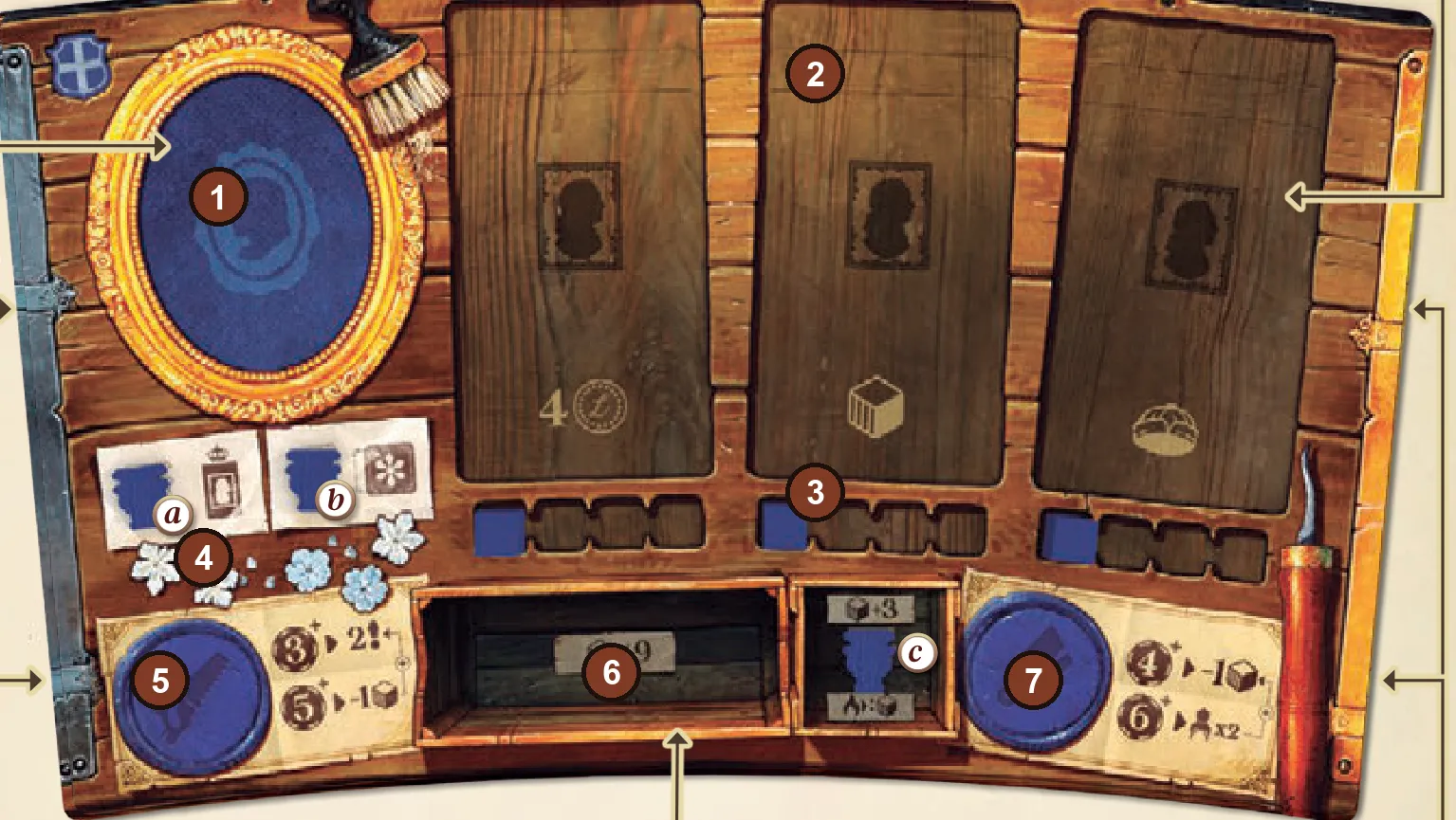
- Luthier family tile — face down (setup side) at the start, then turned to its portrait.
- Patron spaces — three; placing a patron here pays 4 money, 1 material or 1 apprentice (left to right).
- Patience rows — one cube under each patron.
- Award benefits — royal patron, purple die, extra storage, each under an award marker.
- Roughing bench — two card slots and one worker space.
- Materials storage
- Finishing bench — two card slots and one worker space.
Completed patrons are tucked along the top of the board, their lifetime powers showing.
Materials storage
You may keep 9 materials of any kind (12 with the extra-storage award benefit). If you ever gain
more, discard down to the limit at once; you may discard materials whenever you like.
 Animal (bone, gut, hair) is usually cheapest,
 wood in the middle and
 metal the most expensive.
Patrons
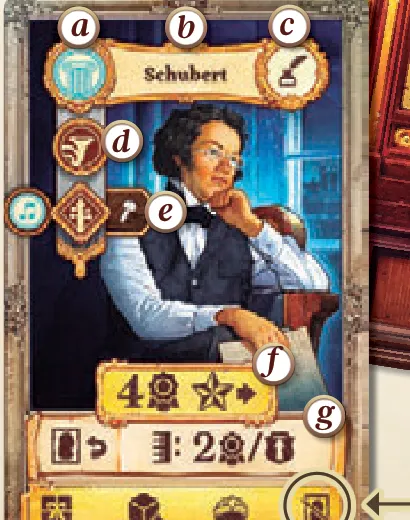
a. The patron’s musical era. b. Name. c. Patron type. d. Primary requirement. e. Secondary requirement(s). f. Prestige for completing the patron. g. The lifetime power, repeated on the back. Below the card, the patience row shows the gift for each space and, at the far right, the space where the patron leaves.
You may have at most three active patrons; there is no limit on completed ones.
Patron types
| Type | Requirements | Gifts | Lifetime power |
|---|---|---|---|
 Performer | Primary only | Apprentices, inspiration | A: better performances. B: end points for performance tokens |
 Composer | Primary + 1 secondary | Apprentices, materials | A: changes rules for you. B: end points for repair tokens, specialty workers, maxed tracks or awards |
 Noble | Primary + 2 secondary | Money | A: start-of-round income. B: end points for instruments or patrons, or an extra First Chair |
 Royal | Primary only | Prestige | 2 prestige at every start of round |
Patron A cards come out in rounds 1–3 and have ongoing or start-of-round powers; after round 3 the B cards appear, with end-game scoring powers. Royal patrons come only from the royal award benefit. Every patron is listed in the appendix.
Requirements
- The primary requirement is always an instrument of a given family —
 Strings,
 Winds or
 Percussion & Keyboards.
- A secondary requirement accepts an instrument of that family, or a repair of that family, or a medium/high performance of the patron’s era — whichever the card shows.
- Instruments and repairs only need the right family; era matters only for performances.
- Meet requirements in any order. Each time you meet one, tuck the card behind the patron (its top visible) and reset the patience cube to the far left. Assigned cards can’t move to another patron.
Gifts and patience
At every start of round the cube moves one space right and you take the  gift above it.
If it reaches the last space, the patron leaves: discard it with its tucked cards and lose
3 prestige per unmet requirement, primary and secondary (never below 0). There is no penalty
for patrons still active when the game ends.
Completing a patron
When a patron’s last requirement is met:
- Score the patron’s prestige.
- Move one step up the Reputation track.
- Discard the cards tucked under it.
- Take it off its space (freeing it) and reset the cube.
- Turn it over and tuck it along the top of your workbench: its lifetime power works at once.
Instruments
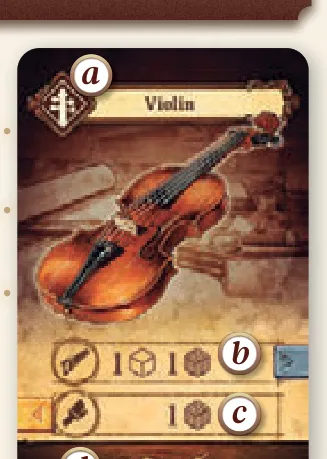
a. Name and family. b. Roughing cost. c. Finishing cost. d. Prestige and the Orchestra token.
Instruments belong to three families. There are two cards of each standard instrument (four
Violins) and one of each  rare instrument (diamond). The full list is in the
appendix.
Roughing
When you resolve your  roughing bench worker:
- Choose an instrument card on the roughing bench and discard its roughing materials.
- Move it to your finishing bench (two slots).
 3+: gain 2
 inspiration.
 5+: also reduce that roughing cost by 1 material, once per action.
Bonuses add up: a skill-5 worker gets both. If you lack the materials, take 2 money and get your worker back for next round.
Finishing
When you resolve your  finishing bench worker:
- Choose an instrument on the finishing bench and discard its finishing materials.
- Score its prestige (+2 with the Reputation bonus).
- Put one of your
 instrument tokens on its space in the
Orchestra and take the First Chair if it is free or held only by performance or
repair tokens. Rare instruments always take a First Chair.
- Give the card to an active patron that needs that family (primary or secondary) — tuck it behind and reset the cube — or discard it.
 4+: reduce that finishing cost by 1 material, once per action.
 6+: also double the Orchestra bonus, once per action.
Instruments still on your finishing bench at the end score half their prestige, rounded up.
Two instruments in one action
Two ways to build two instruments in one turn: put two workers on the bench (two separate actions), or reach rough ×2 / finish ×2 on the Craft Skill track to do two with one worker. In a double finish, complete them one at a time: materials and bonuses from the first can pay for the second. The 4+/5+/6+ discounts and Chopin-style powers still apply only once per action — you choose which instrument gets them.