Solo: the AI
Luthier's solo mode: setting up the AI, its special rules, how it plans and resolves with action cards and the priority tracker, its upkeep, scoring and difficulty.
Setup changes
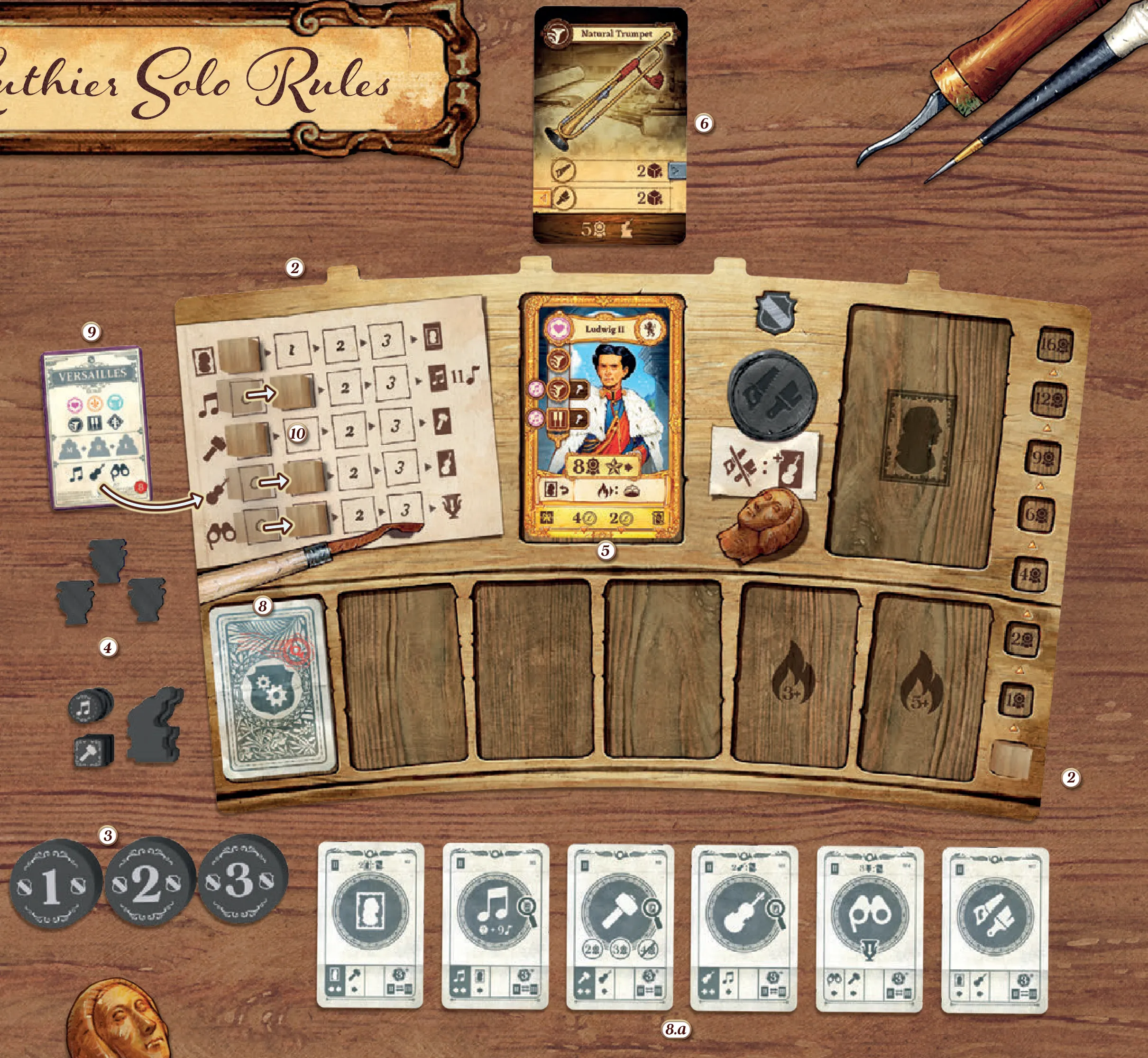
Set up a two-player game (orchestra setup card and cover-up tiles included), then add the AI (the setup page lists every step for one player):
- The AI uses the reverse of a player board: 5 cubes on the 0 spaces of its priority tracker (one row per location) and 1 cube at the bottom of its AI Goals track.
- It starts with worker chips #1, #2 and #3; #4 joins in round 3 and #5 in round 5.
- Its other pieces go by its board as normal.
- One patron on its left patron space.
- An instrument found by its back that matches that patron’s primary requirement, face up above it (already assigned).
- No family tile and no goals for the AI.
- The six level-1 AI action cards shuffled face down on the bottom-left space; the level-2 and level-3 cards face up beside the board.
- After your own setup, a random solo guild card left of its board.
- Move the priority cubes up once per icon at the bottom of the guild card. The AI goes first if the guild card’s number is equal to or lower than your family tile’s.
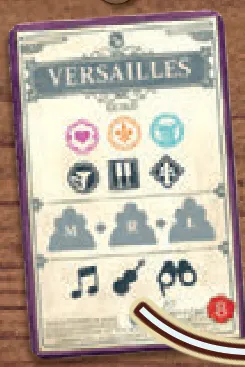
The solo guild card (a city of instrument makers) sets the AI’s tastes: its order of eras and instrument families for tie-breaks, and the order in which it scores the awards (L, M, R).
What the AI ignores
- Apprentices, money, inspiration and materials — it never goes to the Market.
- Patron gifts and patron powers.
- The Performance Skill, Craft Skill and Reputation tracks.
- Orchestra bonuses and location skill bonuses.
For a first game, also ignore the AI Goals track and the goal icons on its action cards.
Planning phase
At the start of planning, shuffle the AI’s workers face down into a stack. On its turn, flip the top AI action card into the left-most empty action space of its board and put the top worker, unseen, on the location the card shows; a Workbench card sends it to the AI’s single workbench space.
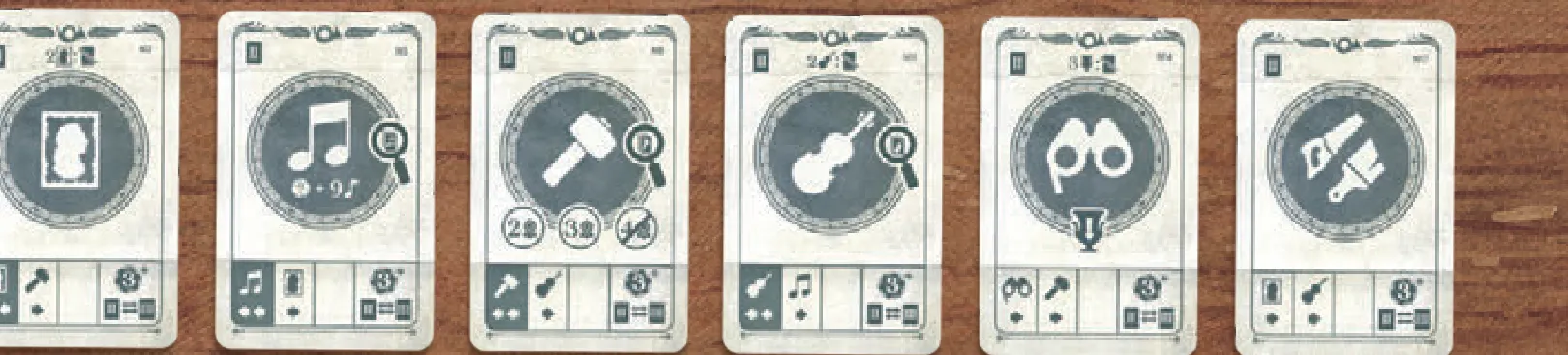
If the card shows a limit the AI has already reached — 2 active patrons, 2 unfinished instruments or 3 awards — discard the card for this round and put the worker on the workbench space instead (several workers there each make an instrument).
Resolution phase
Lay the AI’s action cards out left to right by the matching value on its priority tracker (ties top to bottom), Workbench always last. On the AI’s turn it activates the left-most card without a worker on it, resolving that location for everyone in the normal priority order, then puts its worker on the card. AI skill = worker chip + that location’s priority tracker value.
The AI may take any card in a row, whatever its tier. When a level-2 or level-3 card says so and no card in the display fits an unmet patron need, it searches the deck by the backs. With no valid card, it skips the action.
Salon
Take a patron by these priorities: one whose primary requirement matches an unassigned instrument it holds → the era first on its guild card → the one furthest from the deck. Place it in the left-most free space and assign a matching instrument. A level-3 card also moves it up the AI Goals track.
Guild
Take an instrument: one matching an unassigned primary requirement (left-most patron first; level 2–3 may search) → the family first on its guild card → furthest from the deck. Assign it to that patron, or keep it face up right of the board. Level 3: one step up AI Goals.
Perform
Choose a performance: matching an unmet secondary requirement (level 2–3 may search) → era first on the guild card → furthest from the deck. No dice: result = worker + tracker + the card’s printed number. Lowest level: discard. Medium or high: score the card’s points, place a token and assign it to a patron who needs that era, or discard it.
Repair
Choose a repair the same way (family instead of era). A level-1 card can only do repairs worth 2, level 2 those worth 2 or 3, level 3 any — repairs above its level are ignored. It pays nothing, scores the points, places a token and assigns or discards the card.
Balcony
Put an AI token on the turn-order space for its priority. Level 1 does nothing else. Level 2 scores the lowest available level of the next award on its guild card, level 3 the highest — the AI needs no qualification.
Workbench
For each worker there, the AI builds an instrument in one go, for free: first those assigned to patrons (left-most first), else its top unassigned one; with none, it draws one as at the Guild. It scores the card and places the token (claiming a First Chair if possible); an unassigned instrument goes to a patron who can use it, else it is discarded. A level-3 Workbench card gives one AI Goals step.
Placing tokens in the Orchestra
Usual rules, with these priorities: claim an empty First Chair → steal one where it would have the most tokens → the space with the fewest tokens (ignoring spaces with an instrument). Ties follow the guild card, then a white die.
Completing patrons
As soon as all requirements are met, the AI scores the patron, discards it with its cards and shifts its other patrons left.
AI upkeep
At the end of every Resolution phase (round 6 too):
- Adjust the priority tracker by the icons at the bottom of the used action cards: first all reductions (−2, minimum 0), then increases left to right. A row pushed above 3 gives its bonus — draw and place a patron (if it has fewer than 2), perform the top card at 11, complete the top repair, take the top instrument, or score the lowest level of its next award — and resets to 0.
- Upgrade a level-1 card that carries a worker of skill 2+ to level 2.
- Upgrade a level-2 card with a worker of skill 3+ to level 3.
- A level-3 card with a worker of skill 4+ gives one AI Goals step.
- Set the workers aside and shuffle the six current cards (discarded ones included) as next round’s deck.
Scoring and difficulty
Normal final scoring, but the AI scores only First Chairs, its AI Goals track position and half the points (rounded up) of unfinished instruments assigned to patrons. Beat its score to win; a tie is a loss.
Harder: at the end the AI also scores the best level you didn’t reach on each of your goals (the top level if you reached the bottom or middle, the middle level if you reached the top). Harder still: deal yourself two extra goal cards and keep one more, as often as you like.