Teach the Game
A script to teach Luthier at the table: how you win, the boards, a round, the end, every way to score and what each resource is for.
How you win
“We are families of instrument makers in 18th- and 19th-century Europe. Over six rounds we build violins, harps and harpsichords, perform and repair instruments, and win the support of patrons like Bach, Mozart and Madame de Pompadour. Everything earns
prestige; the family with the most prestige after round 6 wins. Expect about two hours, longer the first time.”
To win you need instruments finished, patrons completed and First Chairs in the Orchestra. Patrons ask for instruments (and sometimes a performance or a repair); you get the instrument plans at the Guild, the materials at the Market and on the board, and you build them in two steps on your own workbench. Every finished instrument, performance and repair puts a token in the Orchestra, where the best tokens hold First Chairs worth big points at the end.
The boards
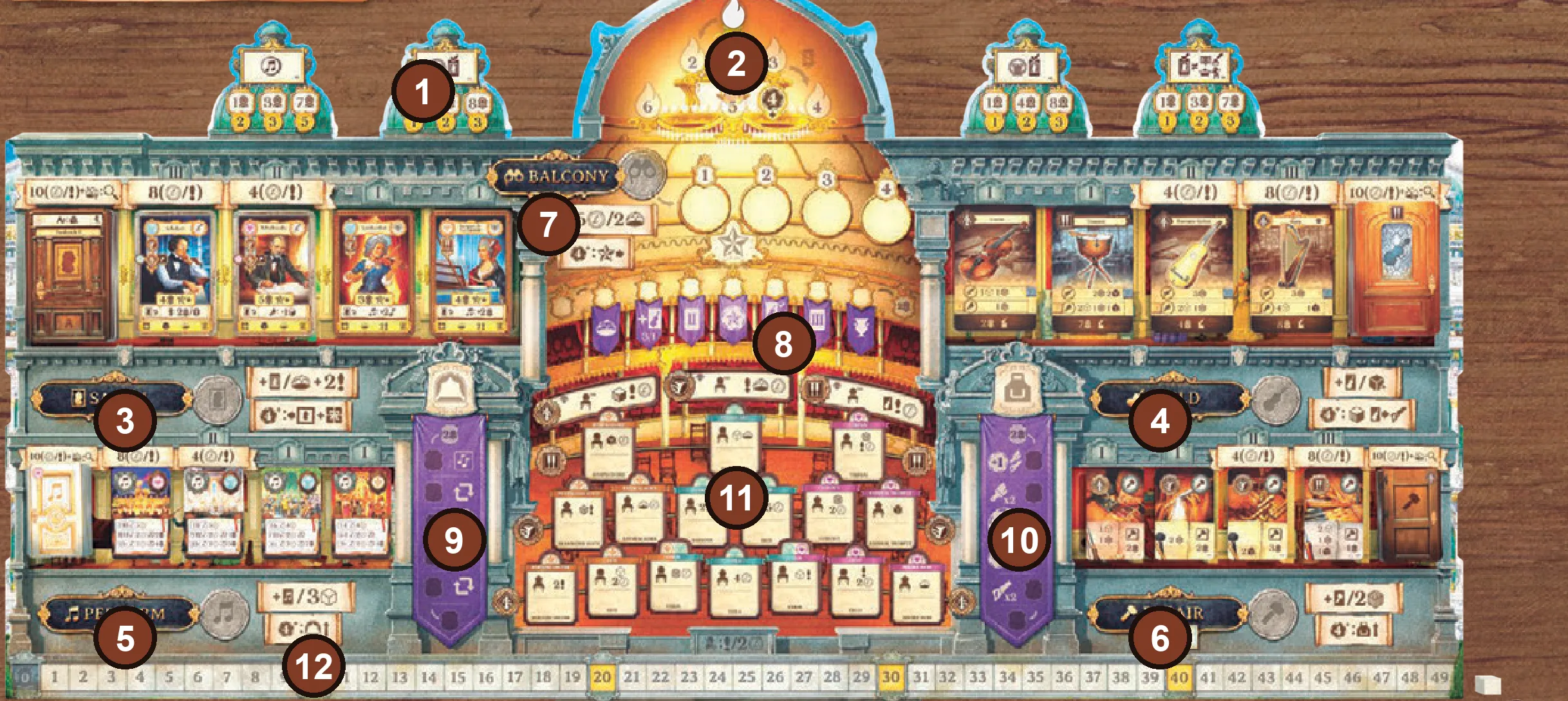
- Public awards — 3 or 4 race goals with three levels each.
- Round tracker — six rounds; workers #2 and #4 join at rounds 3 and 5.
- Salon — take a patron.
- Guild — take an instrument plan.
- Perform — roll dice for money and prestige.
- Repair — pay materials for prestige.
- Balcony — score a public award and claim turn order.
- Reputation track — free access to better cards, awards.
- Performance Skill track — better dice and rerolls.
- Craft Skill track — stronger, faster benches.
- Orchestra — where your tokens fight for First Chairs.
- Score track — your prestige.
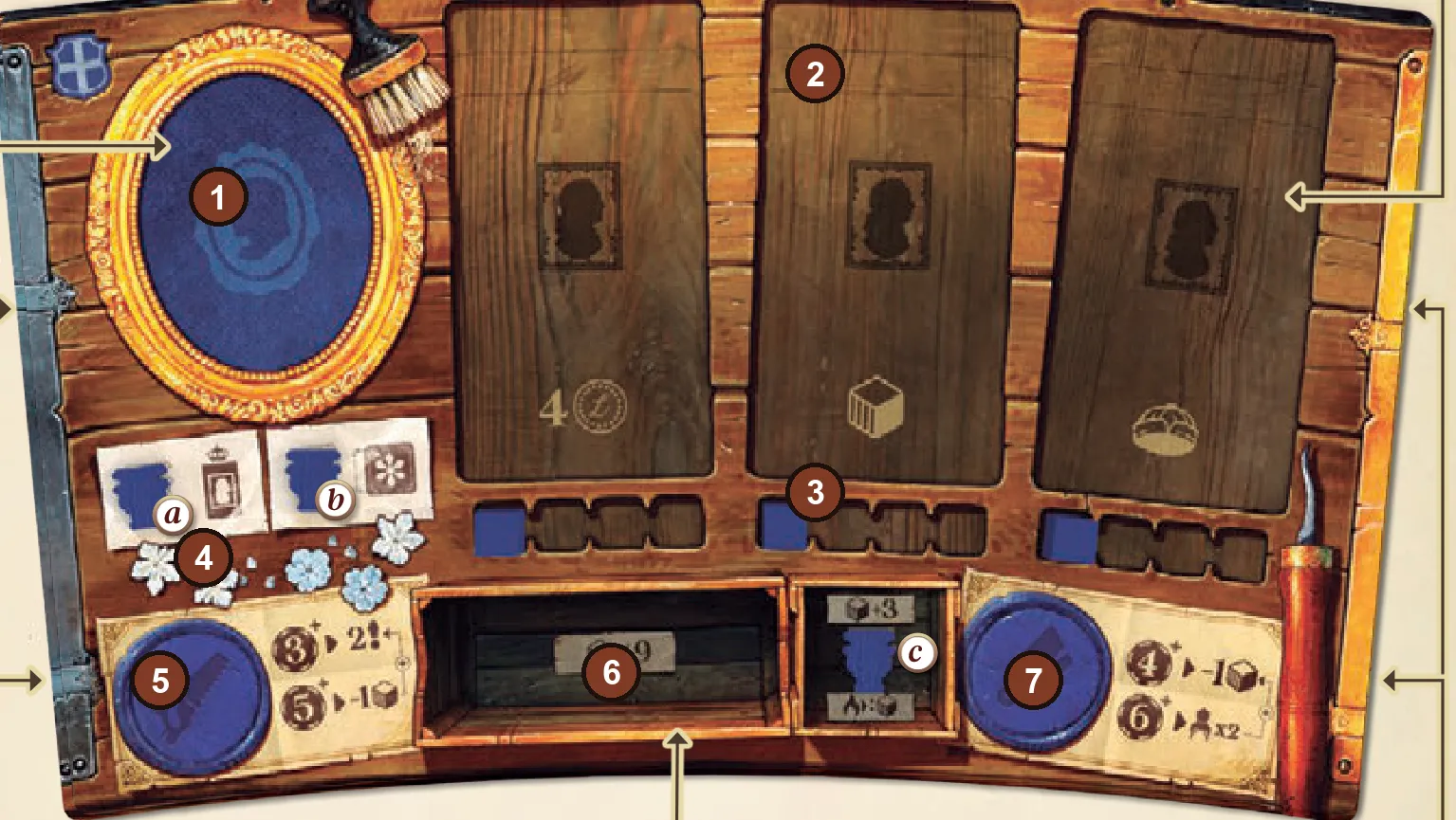
- Family tile — your starting bonus and turn-order number.
- Patron spaces — up to three active patrons.
- Patience rows — gifts each round until patience runs out.
- Award benefits — unlocked as you score awards.
- Roughing bench — first step of building.
- Materials storage — 9 cubes at most.
- Finishing bench — second step: prestige and an Orchestra token.
A round
- Start of round —
 bonuses; every patron’s
patience cube moves right and gives the
 gift above it; put up to two instrument
cards from hand on your
 roughing bench.
- Planning — in turn order, place one
 worker
chip face down at a time, on a main-board location or one of your two benches, with up to three
 apprentices on it. Higher numbers are more skilled.
- Resolution — in turn order, activate one location where you
have a worker: everyone there acts, highest skill first. Or spend your turn at the
 Market, once per round.
- End of round — new turn order from the Balcony, new market prices, tier I cards discarded and displays slide and refill.
How the game ends
After round 6, skip the end-of-round steps and score: First Chairs, Patron B powers, half the value of instruments left on your finishing bench, your two personal goals, 1 per specialty worker card and 1 per 10 leftover resources. Most prestige wins; ties go to the most leftover money. Full scoring
Ways to score
| Source | How and when |
|---|---|
 Finished instruments | The card’s prestige when you finish it; +2 more each with the Reputation track’s late bonus. |
 Completed patrons | The patron’s printed prestige, plus one Reputation step. |
 Performances | Money and, at good results, prestige from the card. |
 Repairs | The repair card’s prestige. |
 Public awards | The level you claim (1st come, one level per award per player). |
| Track tops | 2 prestige for every step past the top of the Performance, Craft and Reputation tracks. |
 Royal patrons | Prestige gifts and 2 prestige at every start of round once completed. |
 First Chairs | End: 1–24 by number held and player count. |
| Patron B powers | End: points for the tokens, workers or awards they name. |
 Personal goals | End: highest level reached on each of your two goals. |
| Unfinished instruments | End: half the prestige of each on your finishing bench, rounded up. |
| Specialty workers | End: 1 each. |
| Leftovers | End: 1 per 10 money, inspiration, materials and apprentices together. |
| Lost: impatient patrons | −3 for each unmet requirement when a patron leaves (never below 0). |
What each resource is for
| Resource | Why you need it | How you get it | How you use it |
|---|---|---|---|
 Money | Materials, apprentices, training, better cards | Performances, First Chairs, patron gifts, 2 money as any worker’s alternative, Balcony (6) | Market purchases; 4/8 for tier II/III cards; 10 to search a deck |
   Materials | Building instruments and repairs | Market, Perform (3 animal), Repair (2 wood), Guild (1 metal), gifts | Roughing and finishing costs, repair costs |
 Inspiration | Flexibility | Salon (2), roughing with skill 3+, gifts, First Chairs | +1 to a performance; −1 money at the Market per item; 2 replace a repair material; pays for tier II/III and searches |
| Apprentices | Win priority and reach skill bonuses | Market (4 money), Salon, Balcony, gifts | +1 skill each to one worker for one action; max 3 |
| Worker chips | Your actions | #1, #3, #5 at start; #2 at round 3, #4 at round 5 | Skill = the chip’s number; 4+ unlocks location bonuses |
 Patrons | Gifts each round, big prestige, lifetime powers | Salon; royal patrons from an award | Satisfy their requirements before patience runs out |
 Instrument cards | Your plans | Guild, Reputation track | Rough, then finish; give to a patron |
| Award markers | Three awards per game | Your workbench | Each one removed unlocks a benefit |
Teaching tips
-
Use The Rehearsal booklet for a first game with 3–4 players: it scripts the whole first round.
-
Teach the patron card first: everything (Guild, benches, Perform, Repair) serves a patron.
-
Show the two-step build early: rough one round, finish the next — and that skill 4+ matters.
-
Stress the two things new players miss: displays only refill at the end of the round, and a patron’s reset gives no gift.
-
Show #1 plus two Apprentices against #5 and #3: the #5 goes first, then placement order breaks the skill-3 tie. Practice example.