Solo: the Forester
Forestry solo against the forester: setup, the forester's turn, how to read forester cards, its actions and exceptions, forester tiles and difficulty, and the forester's scoring.
You play against the forester, an automated rival driven by a deck of forester cards. The game lasts 10 rounds (9 in the advanced game); you go first each round and the forester finishes it. Score more than the forester to win. Setup: the setup checklist with 1 player.
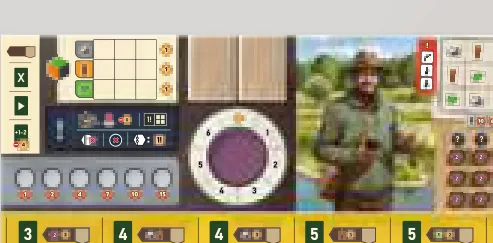
The forester’s turn
- Check the tiles. If your cube under the forester board is behind the forester’s cube, the forester takes the bonus in the dark bar of its current section. Level or ahead: nothing.
- Draw cards. Draw as many forester cards as its yellow development track shows (3 at first).
- Play them one by one.
- Buy cards. Then it pays 4 coins for one more card, if it can — up to 2 extra cards a turn.
When the deck runs out, shuffle all forester cards into a new deck.
Reading a forester card
Each card resolves exactly one of its rows, checked top to bottom: do the first row that is possible. Cards are double-sided: always try the back first (identical on every card); if no back row is possible, flip it and try the front from the top. Played cards go to the right of the forester board.
The advanced cards (yellow corners) work the same way with stronger actions.
The forester’s actions
| Action | Only when | What it does |
|---|---|---|
| Fulfil a contract | It has the exact wood and adjustments | Returns them; takes the card’s rewards in order: stars, VP, coins and resources, task cards face down |
| Wood adjustment | A wood needs an adjustment for its contract | Adds the token (any order for two) |
| Get a contract | It has no contract | Takes the contract on display worth most VP (upper half of a double); you break ties |
| Harvest | Its contract needs a wood still missing and a tree is available | Goes to the nearest such tree, left to right along the contract’s first row; takes 1 wood |
| Reforest | It has a seedling and a dark harvest token exists | Prefers tokens its contract needs, else the nearest; 1 seedling, 2 stars |
| Tend the forest | A forestry table space is free | Takes the nearest token (or the type shown) to its table, left to right; gains the covered reward |
| Water structure | It has 3 temp workers or 3 construction materials | Goes to the nearest river; keeps the river token |
| Forest building | It has a temp worker and a construction material | Builds at the nearest free clearing; no clearing reward |
| Upgrade a sawmill | An upgradable building in the shown area and it can pay | Moves its manager there; upgrades by the priority numbers; doesn’t use the building |
| Gain resources | — | Takes the goods shown (the face-up task card if one is shown) |
It always holds one contract and fulfils only the upper half of a double contract.
Rules exceptions for the forester
- It never pays to move or to cross rivers, however far it goes, and gains no seedlings from meanders.
- It harvests only 1 wood, for 1 action, even on a two-tree space, and earns no stars from harvest tokens.
- It reforests with 1 seedling, for 2 stars, whatever the space.
- It takes no rewards from game round tokens or clearings.
- Equal distances: you choose.
Resource table and coins
The forester keeps up to 3 of each resource on its resource table; a fourth of a kind becomes 1 coin. When the forester uses a sawmill building you have upgraded, you gain 1 coin.
Forester development
The forester has no technologies, but earns stars: each time its star token reaches the development symbol on its reward track, its cube moves one section right on the yellow development track — more cards each turn. If that happens mid-turn, it draws one extra card at once.
Forester tiles
Six forester tiles under the forester board are objectives for you. Complete the next one and your cube moves under it. While your cube is behind the forester’s section, the forester takes that section’s dark-bar bonus each turn.
- Only the next tile counts: objectives go strictly in order.
- Tile objectives include: harvest a given wood, reforest a two-tree space, harvest a two-tree space, get a forester token, build in the forest, upgrade a sawmill, fulfil a contract — the B sides combine two of them.
Difficulty
For a harder game, turn some forester tiles to side B. The rulebook ranks six levels, from Newbie (all A) through Apprentice, Watchman, Lumberjack and Forester to Master.
End of the game
You score as usual. The forester scores:
- 10 VP per river token (no multiplier).
- Its task cards, all counted as fulfilled, by number.
- Its buildings track.
- Filled rows of its forestry table.
- The forester-token majority against you.
- Filled rows of its reforestation table.
- 1 VP per wood in storage.
- 1 VP per 3 coins and resources.