Solo: the Bot
Playing Baghdad alone against the Bot: its setup and four difficulty levels, how its cards choose Boats, Vizier actions and Character cards, and how it scores.
You play against a Bot run by 16 Bot cards and the Bot side of a player board.
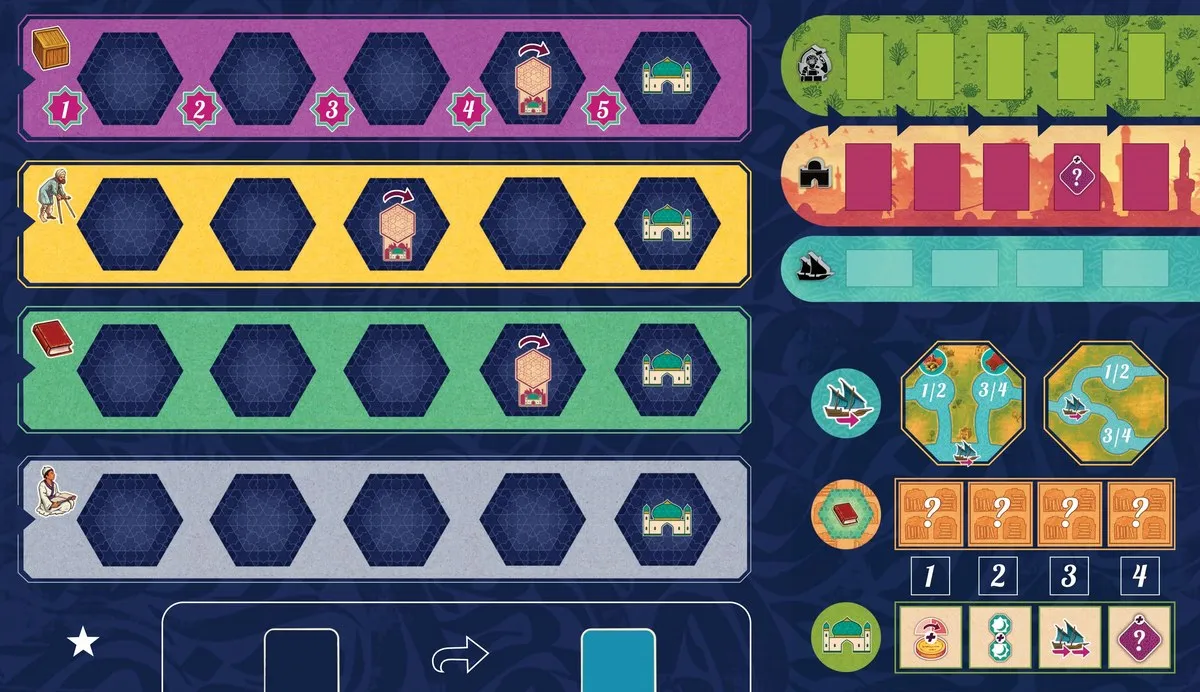
Bot setup
- Choose a difficulty and put the matching player board on its Bot side to the right of your play area: one star Beginner, two Intermediate, three Advanced, four Expert.
- Shuffle the 16 Bot cards face down into the leftmost slot of the Bot’s board.
- Choose the Bot’s colour: its Vizier beside its board, 1 Boat on the river’s starting space, its 4 Library tokens beside its board, and its other pieces on its board. It needs no Favour marker.
Set up the rest of the game as for two players (Setup).
Gameplay and game end
You take a turn, then the Bot takes a turn. Your turns are exactly as in the multiplayer game. Once you have drafted every Character card and played your whole hand, the Bot takes one last turn and the game ends. Score: if you have more points than the Bot, you win; otherwise the Bot wins.
The Bot never gains or spends Coins, Goods, Step tokens, Wild tokens, Shame tokens or Favour.
Bot turns
| Bot card | Side |
|---|---|
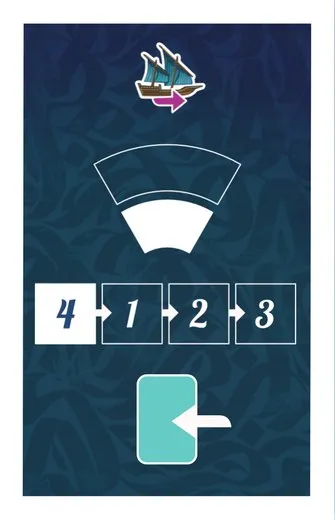 | Top of the deck: Boat moves, a highlighted number 1–4, an outer- or inner-ring arc and a Day or Night arrow |
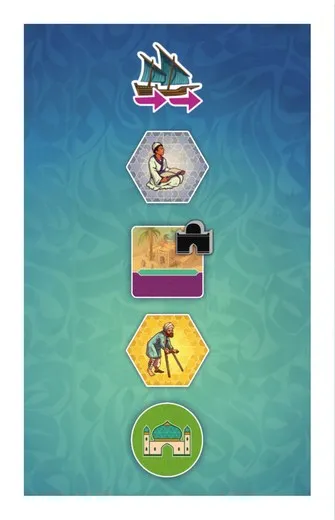 | Active side: Boat moves and four action symbols |
Reveal the active Bot card
Turn over the top card of the Bot deck and put it face up in the rightmost slot of the Bot’s board. This is the active card.
Bot Boats
Add the Boat moves on the active card to those on the top card of the deck, and move the Bot’s Boat that many spaces, with the normal restrictions. When its Boat is on the starting space or at a fork, it chooses:
- the direction of the port with the fewest Boats;
- if tied, the port where it would score most now, counting the slot’s multiplier and how many items it has (for the Night Characters tile, it counts every Night card in its stack);
- if still tied, the direction shown by the highlighted number on top of the deck, read against the graphic on its board.
When its Boat arrives in port, put another Boat from its board on the starting space; leftover moves go to the new Boat.
Bot Vizier
The active card shows four action symbols. The Bot takes the one you have done most: Books, Patients, Artefacts or Students on your board, Buildings you built or Palace pieces you built. It ignores a symbol it has already done five times. Ties go to the symbol highest on the card.
City tile: it takes a matching tile in the next quadrant clockwise (on its first turn, the quadrant after yours) and puts it on the leftmost free space of that row on its board. With none there it tries each next quadrant in turn. With several, it takes:
- the slot connected to the fewest Students and Patients;
- the outer-ring or inner-ring tile, as the arc on top of the deck shows;
- the first one clockwise from its Vizier.
For Artefacts it ignores types it already has. Its second to fifth Books put a Library token in the matching Wisdom section, on the space given by the highlighted number (1 = leftmost): it blocks that reward but never gains it.
Building: it stops on an empty Building site in the next quadrant, the one connected to the fewest Students and Patients (ties: the first clockwise). It builds its lowest unbuilt level, choosing the outer or inner Building as the arc shows, and puts its leftmost House on it. For level 5 it takes the one that would score it most.
Palace: it stops on the Palace site in the next quadrant (or the one after, if your Vizier is there) and builds the piece it would score most for (the Base whenever it can), then the cheapest in Goods, then the first clockwise. Its leftmost Architect goes beside it, and the piece goes on the space given by the highlighted number, or the next one along the arrows. It blocks that reward but never gains it. The two-player Palace rule applies.
Bot bonus actions
When the Bot covers an icon with a City tile, or uncovers one by taking a House off its board:
- an action symbol: it takes another action from the active card, as above, but not the one it just took, and without moving its Vizier;
- a Palace symbol: it builds a Palace piece without moving its Vizier (ignored once it has five).
It can get several in one turn.
Bot Character card
Look at the top card of the deck:
- Day arrow: it takes a Day card whose goal it already meets (several: the leftmost). Otherwise, the one it is closest to meeting (ties: the leftmost). With no Day cards on display, the leftmost card.
- Night arrow: it takes a Night card whose goal it meets (several: the most points, then the rightmost). Otherwise, the one it is closest to (ties: the most points, then the rightmost). With no Night cards on display, the leftmost card.
The card goes face down in a stack beside its board. Then refill the Wisdom area and the City as after a player’s turn.
End game scoring
The Bot scores like a player, except:
- it scores the Night cards in its stack whose goals it meets at the end of the game;
- it counts as having 0 Favour and no Shame.
Solo with modules
You may add any modules:
- Public Works: each time the Bot passes the Black Gate, it puts a City tile from the board onto the Civic board, of the type of the topmost empty slot in its column. It makes every Building public while the board has room, and scores its Houses there normally.
- Contracts: when a Bot Boat reaches a port, discard the top Contract of that stack.
- Objectives: each time it passes the Golden Gate, it puts a marker on the highest space it qualifies for (ties: the left card). If it holds the 5-point space when the card is discarded, the card goes face down in the rightmost slot of its board and scores normally.