Teach the Game
A script to teach Wendake at the table — how you win, the boards, a year, the end, every way to score and what each resource is for.
How you win
“Each of us leads a Native tribe around the Great Lakes during the Seven Years’ War. Over seven years — seven rounds, one to two hours — we farm, hunt, fish, trade, hold ceremonies and send warriors out. We score on four tracks: Economic, Military, Ritual and Mask. The tracks are paired, and at the end each pair only scores its lower track. The most balanced tribe wins.”
What you need, and how you get it:
- Points on all four tracks —
 Trade scores Economic,
 Military
scores Military,
 Ritual scores Ritual,
 the Mask Ceremony scores Mask.
- A good action grid — every action comes from the 3 × 3 grid of tiles on your Action board. Each year you use three tiles in a straight line, and between years you swap weak tiles for stronger Advanced Action tiles.
- Natives on the map —
 Warriors claim land, then
 Women and
 Hunters work it. They feed your resources and earn
 Turtle tiles.
The loop: pick three tiles in a line → do their actions → reshape the grid for next year. Keep an eye on the weaker track of each pair.
The boards
-
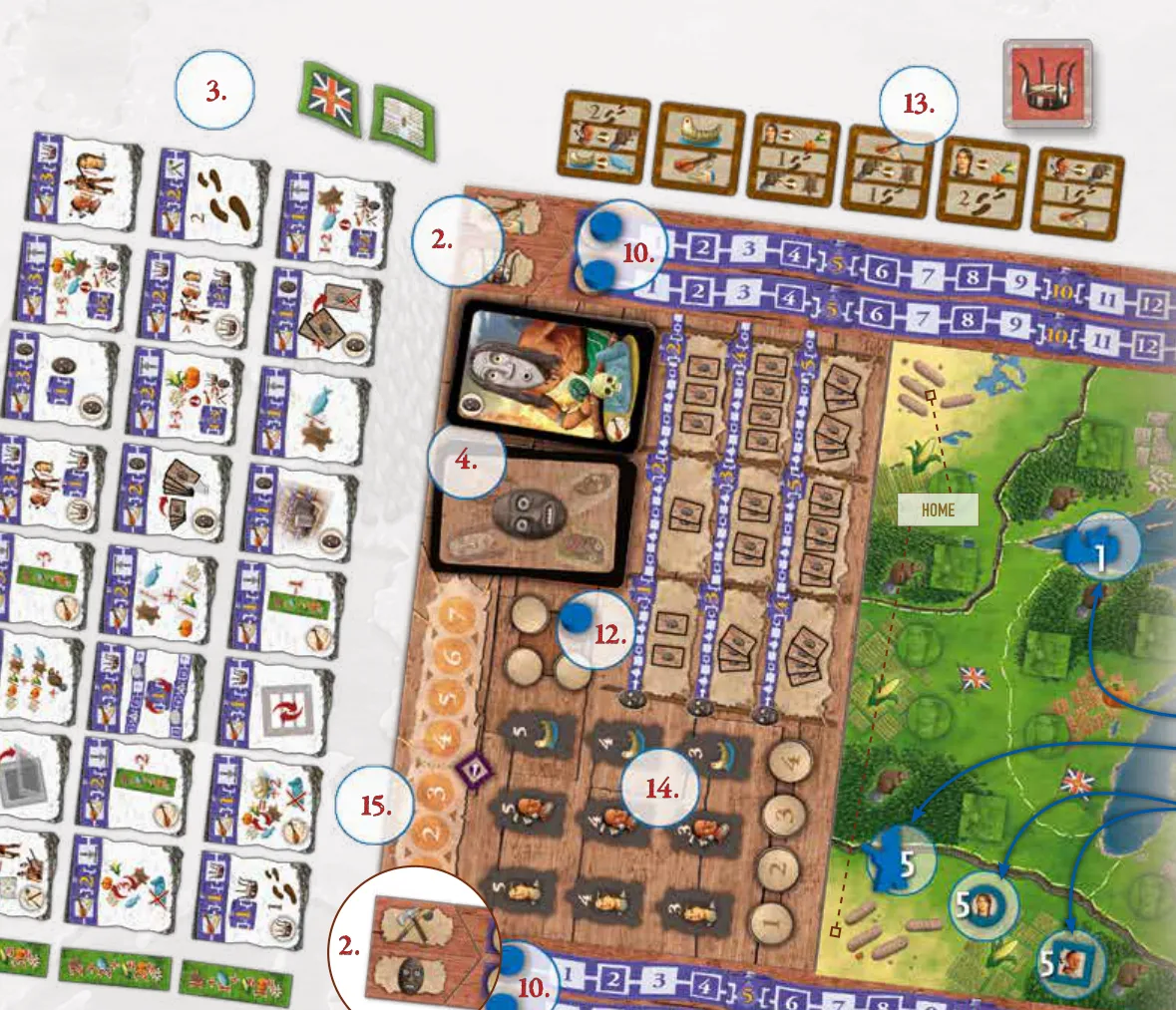
2 Score Tracks — four tracks in two random pairs.
-
3 Progress tiles — three rows, bought with the Trade action.
-
4 Mask deck — Mask cards and their face-up discard pile.
-
10 Score markers — your Tribe disks at the start of each track.
-
12 Restore area — where Mask disks wait between ceremonies.
-
13 Advanced Action tiles — six on offer, Level 2 from Year 4.
-
14 Turtle tiles — taken with the Military action, scored at the end.
-
15 Round Track — Years 1 to 7.
-
The map — territories with Productive Areas (fields for Women, forests for Hunters), Lakes for Canoes and one Home territory per tribe. The map
-
The Ceremonial Mask board — Turn Order area, Ceremonial Mask area, Turtle spaces, Round Track.
-
Your Action board — the 3 × 3 grid, the Sages (Action markers) and the Long House (injured and unused Natives).
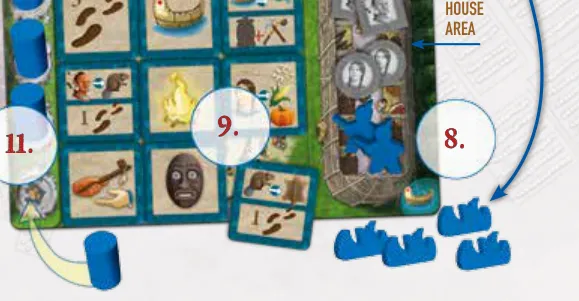
- 8 Long House — Natives that are not in play yet, or were injured.
- 9 Action grid — Sacred Fire in the middle, eight tiles around it.
- 11 Sages — your four Action markers.
A year
Seven years; each has two parts. Full rules
- Individual turns — in turn order, each player places one Action marker per turn, four turns
each:
- three times take an action: put the marker on a grid tile and use its actions top to bottom. The three tiles must end up in one row, column or diagonal;
- once change turn order: put the marker on the leftmost free space of the Turn Order area.
- Restore — new turn order; flip the tiles you used (Action side ↔ Ritual side),
slide the grid down one row, swap one tile for an Advanced tile in turn order and deal the three
new tiles into the top row; take your Mask cards back; refresh Progress tiles; next year.
[Allies] With New Allies, the turn-order space you choose comes with a Turn card and often an Alliance action (New Allies).
How the game ends
After the Restore of Year 7. Reveal your Turtle tiles and add their points to
the tracks they show. Each pair of tracks scores only its lower marker; add the two pairs, plus
1 if your  Swap token is unused. Each track stops at 25. Tie: the lower Turn Order
marker wins. Scoring
Ways to score
| Source | Track | How and when |
|---|---|---|
| Trade — buy a Progress tile | Economic + the tile’s track | 1, 2 or 3 points on each, by tile level |
| Trade — buy Economic points | Economic | 1 per different Resource spent, up to 5 |
| Military action | Military | 1 per territory where you have the most Guards (ties score nothing) |
| Ritual action | Ritual | your smallest group in your Home: Warriors, Women or Hunters |
| Mask Ceremony | Mask | 1–5 by the combination of Mask cards you play |
| Turtle tiles | as printed | revealed at the end: 1 or 2 points each |
| Progress tile powers | any | some move points or buy points with Resources |
| Unused Swap token | total | +1 at the end |
[Allies] Alliance track,  Rifles | flag tracks, total | see New Allies |
| [Promo] the 4-point Action tile | total | +4 at the end (Promo Tiles) |
Nothing is ever lost from a track; the only “loss” is points above 25 (35 with New Allies), which do not count.
What each resource is for
| Resource | Why you need it | How you get it | How you use it |
|---|---|---|---|
 Leather | every Progress tile costs Leather |  Tan Pelts turns all your  Beavers into Leather | Progress tiles, Economic points, [Allies] Rifles |
 Fish | every Progress tile costs Fish |  Fishing: 1 per Canoe in play | Progress tiles, Economic points |
| Corn, Beans, Pumpkins | Progress tiles need different Vegetables |  Harvest: 1 per field with your Woman | Progress tiles, Economic points |
| Beavers | not a resource — only becomes Leather |  Hunting: 1 per forest with your Hunter | Tan Pelts |
 Canoes | more Fish, more Exchanges, Turtle tiles | Canoe action (5 at most) | count during Fishing, Trade and Military |
| Warriors | claim Productive Areas, hold territories | start in Home; Ritual brings back the injured | Guards score Military; Outposts become Women or Hunters |
| Women / Hunters | produce, and earn Turtle tiles | replace your Outposts on the map | Harvest / Hunting; Ritual counts them at Home |
 Mask cards | combinations score Mask points | one per Mask Ceremony (deck or discard) | played once per year, back to hand at Restore |
| Progress tiles | points now, a power every year | Trade, Level 1–3 | flip to use the power once per year |
Teaching tips
- Start with the paired tracks — “only your weaker track in each pair counts” explains every later choice.
- Show the grid rule on a real board: first tile anywhere, the next two in the same line. Then show how the bottom row falls off at the end of the year.
- Teach Guards vs Outposts with pieces on the map; it is the rule most players get wrong (The map).
- For a first game use the identical Tribe-card side and the suggested track pairs.
Rehearse an Outpost transfer
Move a Warrior onto a Productive Area as an Outpost, then finish the Move action. Before beginning another action, return that Outpost to Home and replace it with the Woman or Hunter shown by the area.
Ask: ‘Can the returned Warrior spend the movement I had left?’ No: you cannot interrupt a Move action with a transfer and then move that Warrior again. Transfer between actions, and resolve the actions on a tile from top to bottom.