Teach the Game
A script to teach The Networks: Primetime at the table — how you win, the boards, a round, the end of the game, every way to score and what each card and resource is for.
How you win
“It’s the golden age of cable and each of us has just been handed a brand-new TV network: three dreadful public-access shows, a little cash and a lot of ambition. Over four rounds — about an hour — we draft shows, sign stars and land ads. At the end of every round we count how many
viewers our lineup pulls in and write it down. After round four, the network with the most viewers in total wins.”
What you need, and how you get it:
- Shows in your lineup — your three timeslots,
 daytime,
 primetime and
 late night. Every show scores viewers at the end of
each round it is on the air. You produce better shows from the display.
- Stars and ads to attach — most shows need a star
 or an ad
 before you may produce them. Stars add viewers; ads add
 income.
- Cash — stars and shows cost money and keep costing
 expenses each round;
ads pay a
 cash bonus when you sign them and income every round after.
The loop: sign stars and ads → produce a show with them → score it every round while it ages → replace it with something better. Each new show also climbs its genre track for bonuses and end-game viewers.
The boards
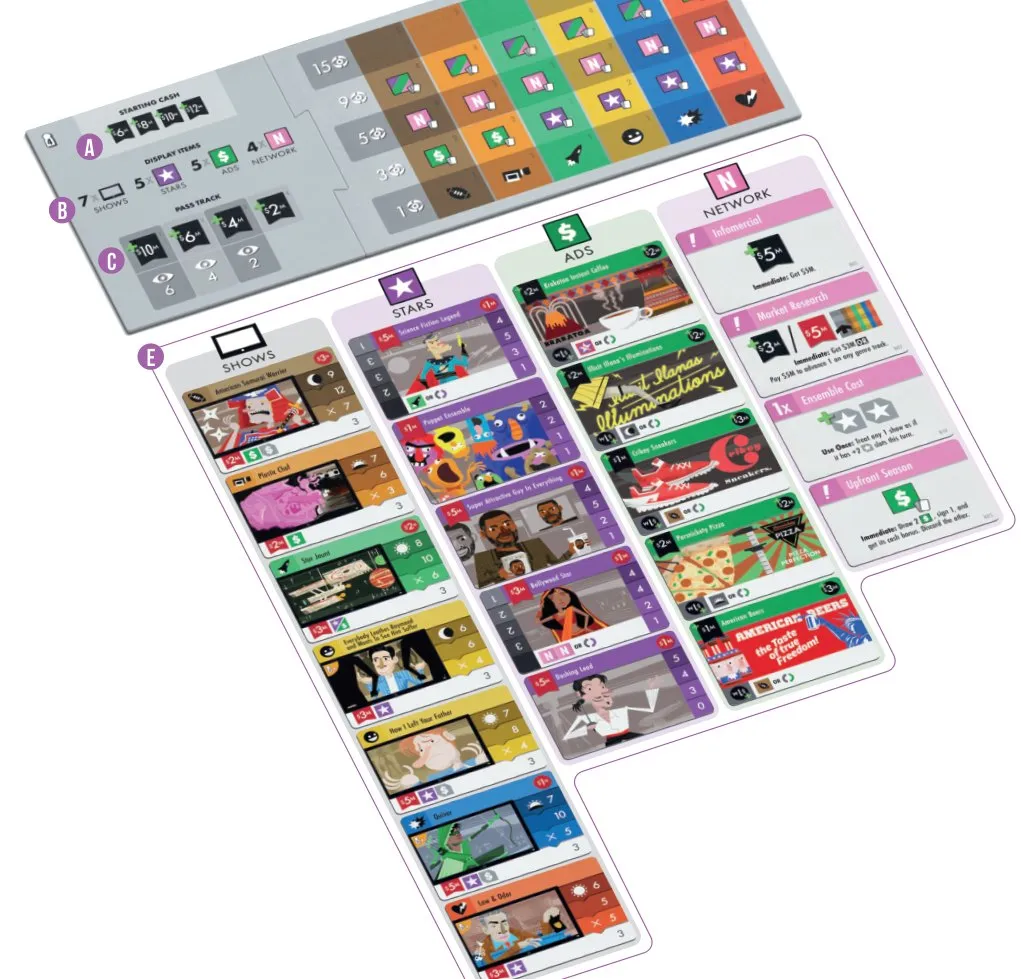
- a Starting cash — what each turn position starts with.
- b Display reference — how many shows, stars, ads and network cards are dealt each round.
- c Pass track — the earlier you pass, the bigger the cash or viewer bonus.
- d Genre tracks — each show you produce moves you up its genre.
- e Card display — everything that can be drafted this round.
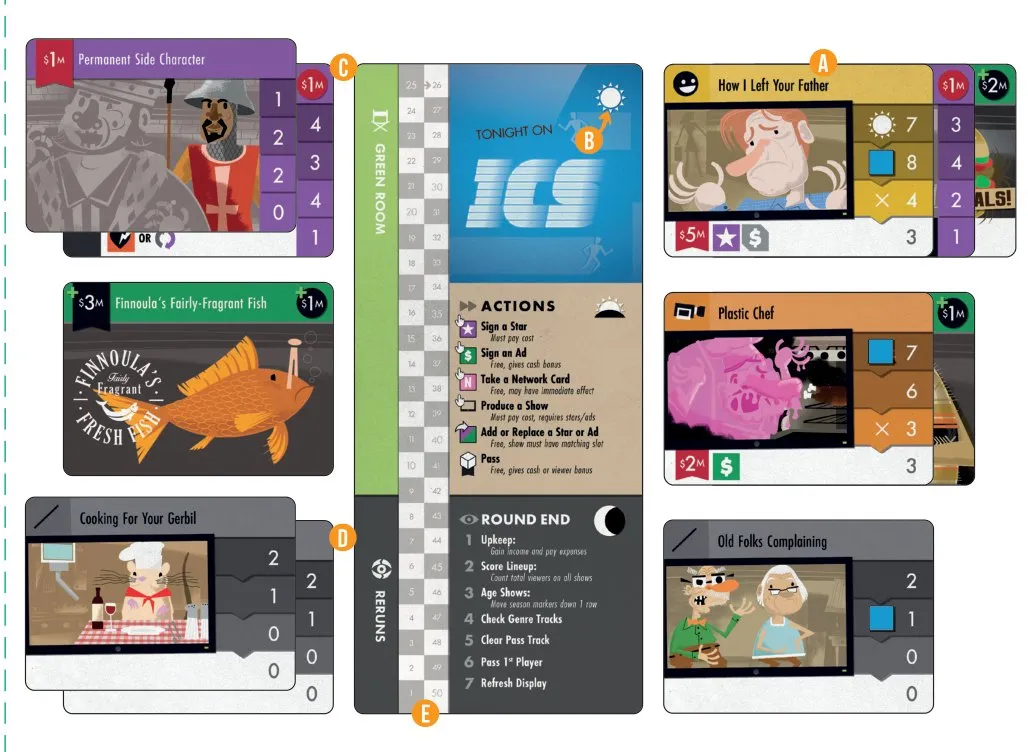
- a Lineup — the 3 shows on the air.
- b Timeslots — daytime, primetime, late night.
- c Green room — signed stars, ads and network cards waiting to be used.
- d Reruns — canceled shows, worth viewers at the end.
- e Round scoring track — an optional counter for this round.
A round
- Turns. From the 1st player, clockwise, each player takes one action a turn
(full rules):
- Sign a star — pay its cost, put it in your green room.
- Sign an ad — free; take its cash bonus, put it in your green room.
- Take a network card — free;
 immediate cards are used at once.
- Produce a show — pay its cost, fill its required slots, put it in a timeslot, cancel the old show.
- Add or replace one star or ad on a show already on the air.
- Pass — take a cash or viewer bonus from the pass track; you are out for the round.
- When everyone has passed, end the round (full rules):
pay upkeep ( income minus expenses), score your lineup and write it
on the scoreboard, then age every show one row. Pass the 1st-player token clockwise and deal a new display.
How the game ends
After round 4 (full rules): do the normal upkeep, scoring and aging, then add the end-game bonuses. Highest total wins; ties share the win.
Ways to score
| Source | How and when |
|---|---|
| Lineup | End of every round: the current row of each show’s season track, plus its stars (and promos) |
| Pass track viewers | End of the round you passed, if you chose viewers instead of cash |
| Genre tracks | Game end: 1 / 3 / 5 / 9 / 15 viewers for reaching space 1 / 2 / 3 / 4 / 5 of each genre |
| Reruns | Game end: the bottom-row value of every canceled show |
 Network cards | Game end: every Game End card in your green room |
| Cash | Game end: 1 viewer per $3M left over |
| Show and star effects | As printed, e.g. Reinfeld’s +2 per attached star with no expenses |
| [Moguls] Moguls |  each round or  at game end — see Moguls |
| [Execs] Executives | Some score or lose viewers each round — see Executives |
| [Telly] Genre grid | +1 viewer per filled square each round, instead of genre tracks — see Telly Time |
Nothing takes viewers away in the base game: a show you cannot afford is canceled at upkeep and simply scores nothing that round.
What each resource is for
| Resource | Why you need it | How you get it | How you use it |
|---|---|---|---|
| Cash | Shows and stars cost money; upkeep may cost more | Ad bonuses, ad income at upkeep, cash from the pass track, Pilot Season | Production costs, star signing, negative upkeep; 1 viewer per $3M at the end |
| Stars | Required by many shows; add viewers | Sign from the display (pay the cost); star genre bonuses | Attach when producing a show, or with Add or Replace |
| Ads | Required by many shows; pay income every round | Sign from the display (free, with a cash bonus); ad genre bonuses | Attach like stars; promos also add viewers if you pay |
| Network cards | Rule-breaking powers and end-game viewers | Free from the display; network genre bonuses | at once,  once,  always, at the end |
| Shows | Your only steady source of viewers | Produce from the display (Pilot Season too) | Score every round, then become reruns when canceled |
| Genre tracks | Bonuses now, viewers later | Every show you produce moves you up 1 | Spaces 2–4 give a card bonus; the height reached scores at game end |
| Pass track | Turn order money or viewers | Passing | Earlier = bigger; the last player gets a small cash bonus only |
Teaching tips
- Start from the show card: point at the timeslot icon, the season track and the gray versus coloured slots. Everything else in the game feeds that card.
- Stress that signed stars and ads go to the green room first; attaching costs an action unless you do it while producing a show.
- Play the Beginner Pilot Season the first time: 2 cards each, no Pilot Season shows.
- Remind everyone that upkeep comes before scoring and that cash is worth viewers at the end.
Rehearse producing a show
Use Millie’s Dawson’s Reek example. Pay its five-million production cost, cancel Plastic Chef from that timeslot and discard its attached ad. Move Plastic Chef to reruns. Dawson’s Reek requires a star, so attach one from the green room now; its ad slot is optional.
Ask: ‘Can I take this show now and find its required star later?’ No. Required coloured slots must be filled when producing the show. Signing a star or ad puts it in the green room first.