Solo: the Rival
SETI solo: setting up the rival research institution, its progress track, action cards, techs, objectives and how it handles each alien species.
Solo setup
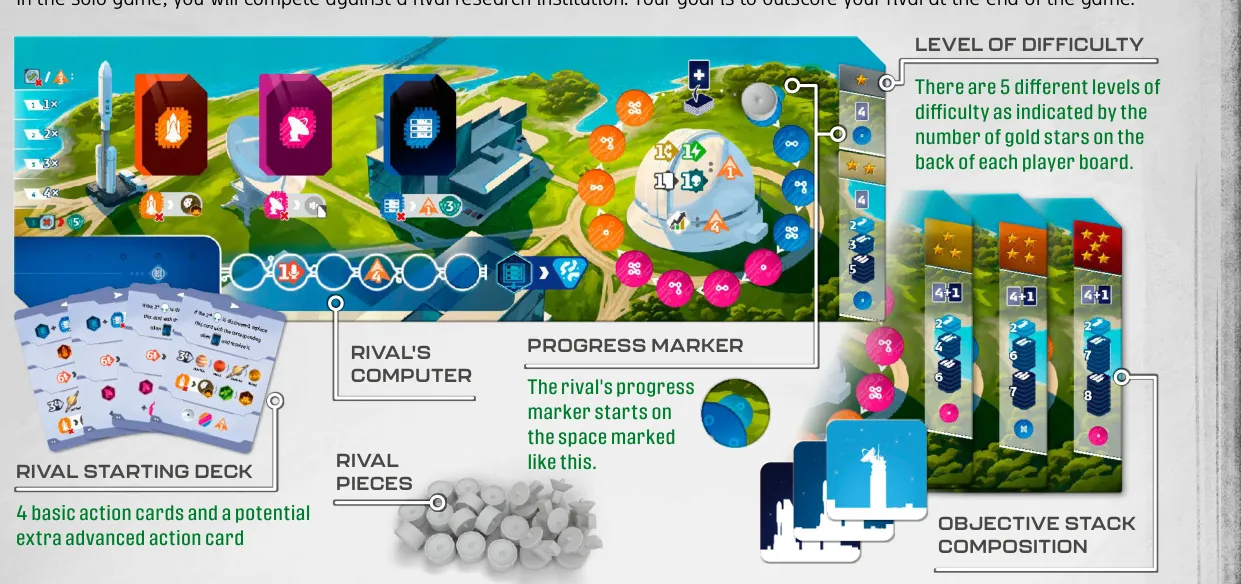
You play a normal 2-player game against a rival research institution; outscore it to win. Give it all pieces of one colour, a marker on the start space of its progress track, publicity 4, and the rival board for your chosen difficulty (1–5 gold stars on the back; 1 and 2 stars share a board). Pick the starting player at random: 1 point for the first player, 2 for the other; the marker alternates every round. A first game at 1 star has no objectives.
Rival action deck
Shuffle the 4 basic action cards S.1–S.4 face down. At 3 stars or more, shuffle in one random advanced card (S.5–S.15). The other advanced cards wait nearby; the 5 alien special cards (one per species) are set aside.
Objectives stack
Skip at 1 star. Shuffle the level I, II and III objectives separately and build the stack the rival board shows — level III at the bottom, II in the middle, I on top — then reveal the top 3. (4 stars: 2 level I, 6 level II, 7 level III.)

The rival’s resources
Progress track
The rival ignores credits, energy and cards. Every credit, energy or card it would gain — from any source, including passing and alien discoveries — moves its progress marker 1 space clockwise; an income increase moves it 4. Some actions show a progress icon too. Each time the marker crosses the deck icon, a random advanced action card goes face down on top of its deck, permanently.
Rival publicity and points
Its publicity works as yours and buys techs. It scores points normally and triggers neutral and gold milestones, but on a gold tile it only ever takes the first (highest) space — the leftmost or rightmost free one by the decision arrow — and nothing if every first space is taken. It does not score gold tiles.
Rival computer
Data goes straight into the rival’s computer; when full, into its unlimited data pool. Covering a marked space gives the rival that benefit.
Rival techs
The rival uses techs as one-shot resources, not abilities: discard a probe tech to prefer a moon, a telescope tech for an extra card-row signal, a computer tech for 3 points and 1 progress. It never takes the move or income bonuses printed on tech tiles.
Rival turns
Reveal the top action card and do the first possible action on it, top to bottom; one is always possible. The decision arrow at the top breaks left/right choices.
| Action | What the rival does |
|---|---|
| Launch | Puts a probe on Earth; skipped if one is already there. |
| Tech | Spends 6 publicity (some cards: free). Takes the tech its progress position prefers if it still has a 2-point tile, otherwise the next one along the track that does. Rotates the system as usual. |
| Move & orbit/land | Flies its Earth probe to the first listed planet reachable with the shown moves (asteroids cost extra), taking the route with the most publicity. Lands on a free moon by discarding a probe tech; else takes whichever first orbiter/lander space is free, the card deciding ties. |
| Telescope | Marks the shown signals; card-row signals use the decision arrow; a telescope tech adds one. Sector choice: one it would win → one scoring 2 points → the one with its most markers; ties to the bigger sector. |
| Life traces | Marks the lowest free space in that colour’s column across both species (overflow only when full). |
| Species discovery | If that species is discovered, swap this card for the species’ special card and resolve it; otherwise skip. |
| Analyze | Only with a full computer: clear it, gain the card’s benefit and a blue trace, refill from its pool, and cash in one computer tech. |
When the rival starts a turn with no cards left, it passes: it takes the top end-of-round card (1 progress) and rotates the system if it passed first.
Objectives
Each objective has tasks; mark a task when you do what it shows (a slash means either part). One trigger marks one task, but it can mark a task and a triggerable mission. At the end of your turn, completed objectives go to your pile and new ones are revealed — you always have 3 until the stack runs out.
At the end of rounds 1–4, before income, spend completed objectives equal to the round number (1, 2, 3, 4). Each one you can’t spend moves the rival 3 spaces on its progress track.
Solo end of game
You score as usual. The rival scores its points plus 5 points for each uncompleted objective — in your row and in the stack. Beat its total to win.
Alien species in solo
Each species has its special rival card, and the rule sheets add rival notes: the rival always marks ‘Oumuamua signals on the tile and pays exofossils or data only when it can; on Centaurians it places a message tile and keeps the leftovers; with Exertians it ignores the milestones, plays cards only via its card, and all its Exertian cards count as fulfilled at the end.
[Agencies] Solo with organizations removes level I objectives and adds long-term objectives (Solo with organizations).