Cards & Components
SETI appendix: every board, piece, card type, tile and token with its picture, each card clarified in the official FAQ, all 12 techs, the 8 gold tile sides, each alien species’ components, Space Agencies, the promos and the full iconography.
Boards
| Component | Component details |
|---|---|
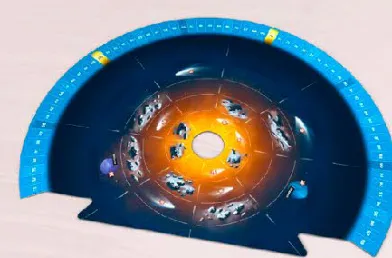 | Count: 1 solar system board; What it is for: The rings your probes fly through. Gap-pushed probes; comet publicity. The solar system |
 | Count: 3 discs + the Sun; What it is for: Rotate to move the planets. Rotation; rotation through gaps. |
 | Count: 4 sector boards; What it is for: The 8 nearby stars and their data slots. Full-sector signals; ties; repeat wins; no second place. Sectors |
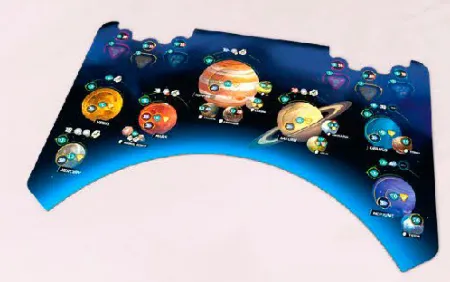 | Count: 1 planetary board; What it is for: Orbit and landing spaces, the alien slots. Landing with an orbiter; opponent orbiter discount. Orbit |
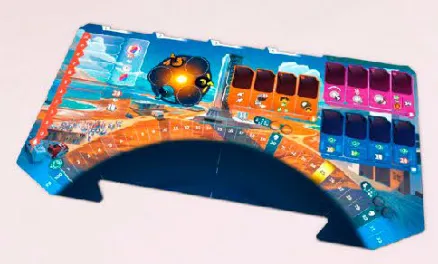 | Count: 1 tech board; What it is for: The 12 tech stacks. Research a tech |
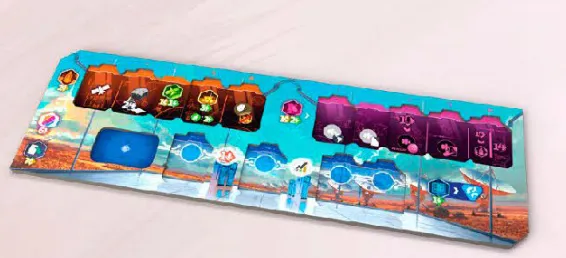 | Count: 4 player boards; What it is for: Data pool, computer, tech slots, action costs. Analyze timing; multiple data placements; computer tech placement. Data |
Cards
| Card | Component details |
|---|---|
 | Count: 138 main-deck cards; What it does: Projects: play for the effect, discard for the corner or a signal, tuck for income. The end-of-round stacks come from this deck. Take from the row; refill after a scan. Each card the official FAQ clarifies: Main-deck cards. Card anatomy |
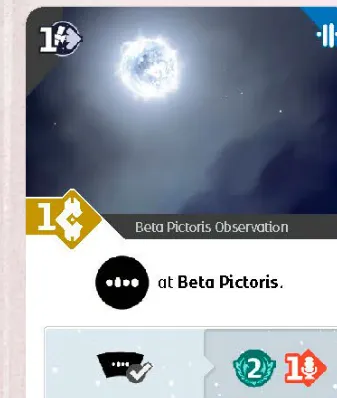 | Count: Conditional missions; What it does: Reward once a condition is true. Mission conditions and opponents’ pieces. Conditional missions |
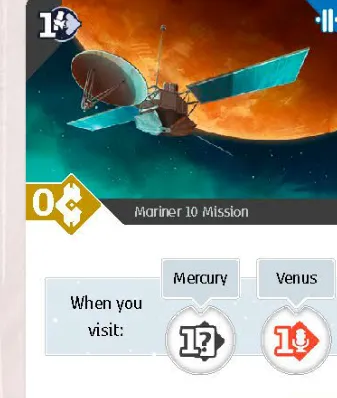 | Count: Triggerable missions; What it does: One reward per circle, triggered by later actions. One reward per action; optional moves; objectives and missions. Triggerable missions |
 | Count: End-of-game scoring cards; What it does: Gold box scored at the end. End-of-game cards |
 | Count: 4 starting income cards; What it does: Back: starting resources. Front: 3 credits, 2 energy, 1 card each round; tuck cards beneath. Starting tuck; income each round; what counts as income. Income |
Main-deck cards
Every main-deck card that CGE clarifies in its official FAQ, in card-number order, with the ruling folded into the description. Cost = credits to play it. Resolve a card’s effects in order; a card that includes a main action uses its own cost, and you may interleave free actions on your turn (effect order, action cost, free actions). Cards with both rotation and a tech rotate only once; the rotation icon is a reminder (FAQ). The deck has 138 cards; the others work exactly as printed.
| Card | What it does |
|---|---|
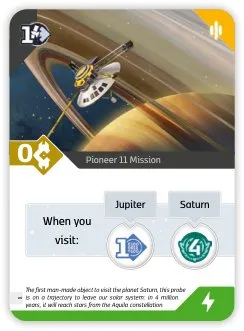 | #1 Pioneer 11 Mission · 0 credits. Mission: the first time you visit Jupiter, and the first time you visit Saturn, cover that reward. Playing it is still your main action even at 0 credits. A probe already on the planet when you play the card doesn’t count — move onto it again; orbiters and landers never count as visits. Rule |
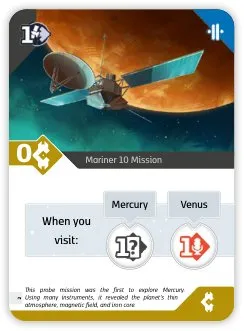 | #2 Mariner 10 Mission · 0 credits. Same as Pioneer 11, for Venus and Mercury. Rule |
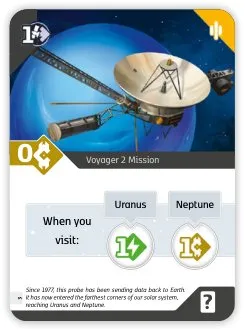 | #3 Voyager 2 Mission · 0 credits. Same as Pioneer 11, for Uranus and Neptune. Rule |
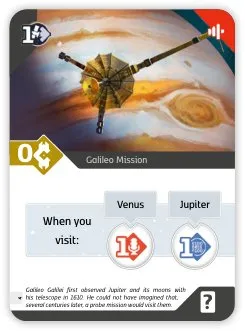 | #4 Galileo Mission · 0 credits. Same as Pioneer 11, for Venus and Jupiter. Rule |
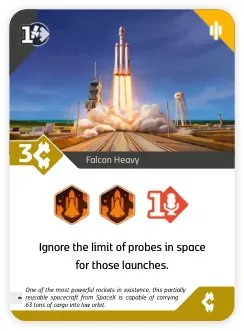 | #9 Falcon Heavy · 3 credits. Launch two probes (plus the printed publicity); these two launches ignore your probe limit, so you can end up with 3 or 4 probes in space. Your normal launches still respect the limit afterwards. FAQ. Rule |
 | #11 Grant · 1 credit. Draw a card (from the row or blind from the deck), reveal it and gain its free-action corner (top left). A blind draw risks a corner you can’t use. Rule |
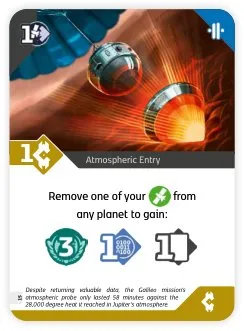 | #15 Atmospheric Entry · 1 credit. Remove one of your orbiters from any planet for the printed points, data and card. The emptied orbit space frees up: if it was the first space, the next orbiter there gains its 3 points again (others don’t slide). Rule |
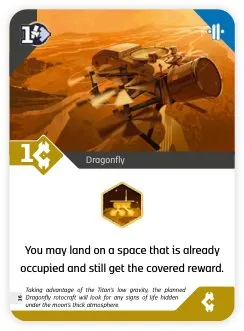 | #16 Dragonfly · 1 credit. Land, even on a space already taken, and still gain the covered reward (the first-lander data). Works on an occupied moon if you have the moon tech. Rule |
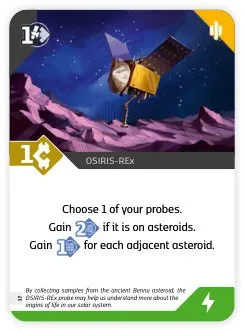 | #17 OSIRIS-REx · 1 credit. Choose one of your probes: data if it sits on asteroids, plus 1 data per orthogonally adjacent asteroid space. The probe doesn’t have to be on asteroids itself. Rule |
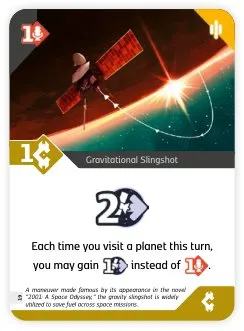 | #19 Gravitational Slingshot · 1 credit. Two moves; each time you visit a planet this turn you may take a move instead of the publicity. Lasts the whole turn, free-action moves included; the planet you start on doesn’t count. Rule |
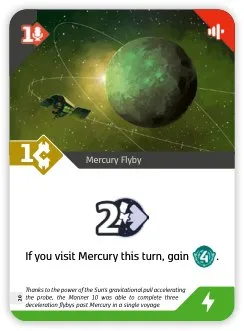 | #20 Mercury Flyby · 1 credit. Two moves; if you visit Mercury this turn, gain the printed points — once, however many visits. Rule |
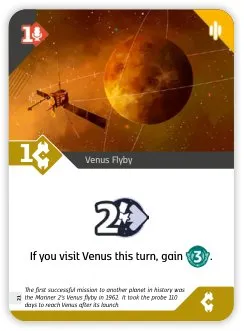 | #21 Venus Flyby · 1 credit. Two moves; points for visiting Venus this turn, once. Rule |
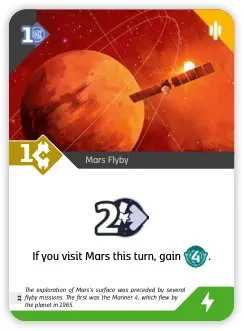 | #22 Mars Flyby · 1 credit. Two moves; points for visiting Mars this turn, once. Rule |
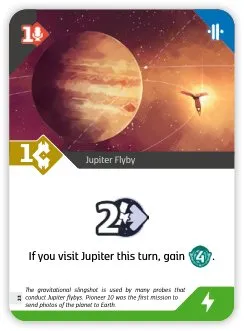 | #23 Jupiter Flyby · 1 credit. Two moves; points for visiting Jupiter this turn, once. Rule |
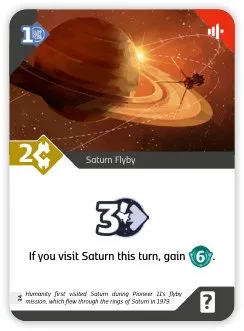 | #24 Saturn Flyby · 2 credits. Three moves; points for visiting Saturn this turn, once. Rule |
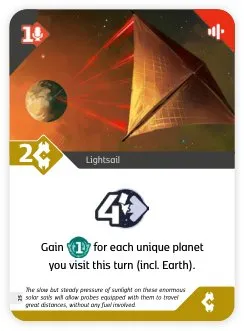 | #25 Lightsail · 2 credits. Four moves; 1 point for each different planet you visit this turn, Earth included (the same planet twice still counts once). Rule |
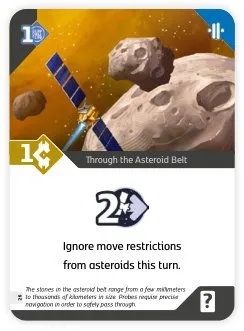 | #26 Through the Asteroid Belt · 1 credit. Two moves, and leaving asteroids costs only 1 move this turn (as with the orange asteroid tech). Rule |
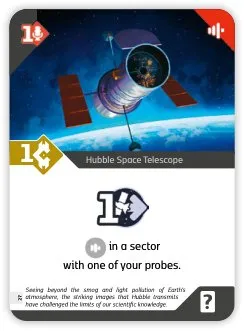 | #27 Hubble Space Telescope · 1 credit. One move, then mark a signal in a sector with one of your probes. Move first; the probe must be on the Solar system board, not an orbiter or lander. Rule |
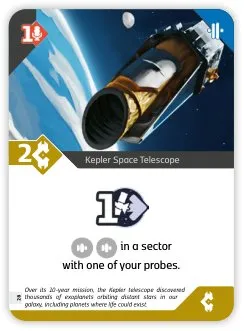 | #28 Kepler Space Telescope · 2 credits. As Hubble, but both signals go in the same sector with that probe. FAQ. Rule |
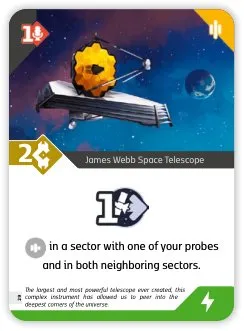 | #29 James Webb Space Telescope · 2 credits. Mark three signals: one in the probe’s sector and one in each neighbouring sector. FAQ. Rule |
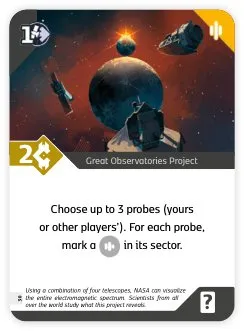 | #30 Great Observatories Project · 2 credits. Choose up to 3 probes on the Solar system board — yours or other players’ — and mark a signal in each one’s sector. Rule |
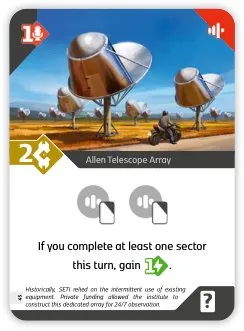 | #45 Allen Telescope Array · 2 credits. Discard two cards from the card row for their signals (refill only after both); if you complete a sector this turn, gain the printed move. Rule |
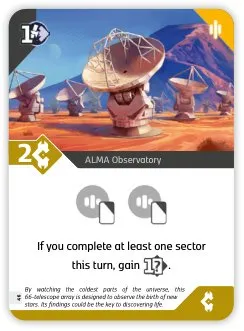 | #46 ALMA Observatory · 2 credits. As Allen, with the printed reward for completing a sector this turn. Rule |
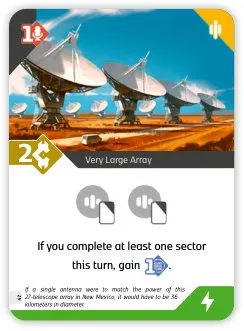 | #47 Very Large Array · 2 credits. As Allen, with the printed reward for completing a sector this turn. Both row cards are discarded before the row refills. Rule |
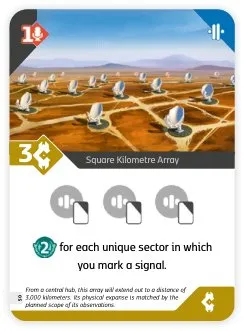 | #50 Square Kilometre Array · 3 credits. Discard all three row cards for their signals, then refill; 2 points per different sector you marked — up to 6. Rule |
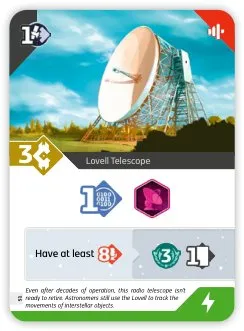 | #51 Lovell Telescope · 3 credits. A Scan action without its base cost (purple-tech extras still cost). Mission: once you have at least 8 publicity, take the reward. Rule |
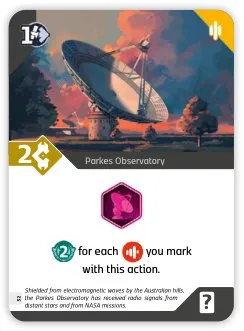 | #52 Parkes Observatory · 2 credits. A Scan without the base cost; 2 points per red-sector signal you mark with it. Rule |
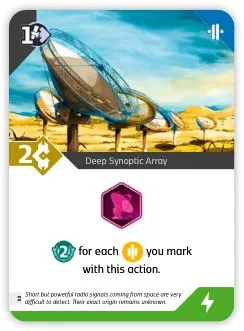 | #53 Deep Synoptic Array · 2 credits. A Scan without the base cost; 2 points per yellow-sector signal you mark with it. Rule |
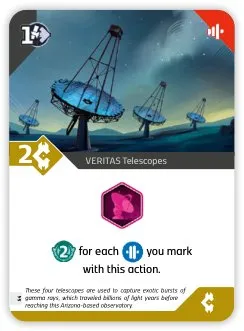 | #54 VERITAS Telescopes · 2 credits. A Scan without the base cost; 2 points per blue-sector signal you mark with it. Rule |
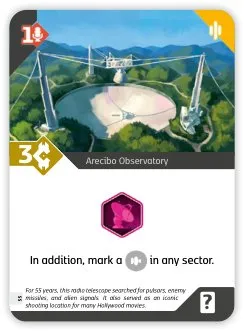 | #55 Arecibo Observatory · 3 credits. A Scan without the base cost, plus one extra signal in any sector. Rule |
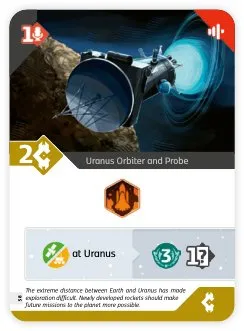 | #58 Uranus Orbiter and Probe · 2 credits. Launch. Mission: an orbiter or lander at Uranus — its moon counts too (CGE: missing from the card text, always intended). Rule |
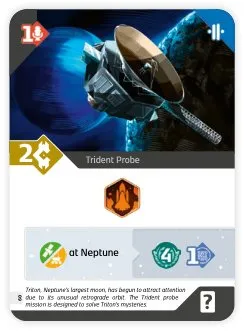 | #60 Trident Probe · 2 credits. Launch. Mission: an orbiter or lander at Neptune — its moon counts too (CGE ruling). Rule |
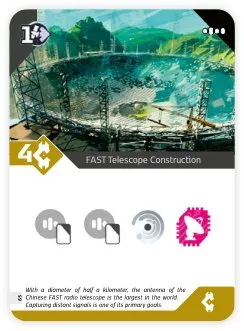 | #65 FAST Telescope Construction · 4 credits. Two row signals (discard, then refill the row), then rotate and take a telescope tech — in that order, so a card from the tech’s bonus comes from the refilled row.. Rule |
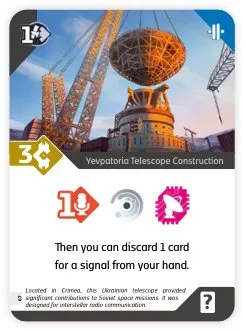 | #67 Yevpatoria Telescope Construction · 3 credits. Publicity, rotate and take a telescope tech, then you may discard 1 card from your hand for its signal (sector = the card’s top-right colour).. Rule |
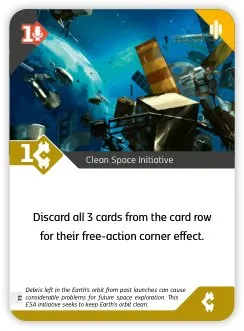 | #73 Clean Space Initiative · 1 credit. Discard all three row cards and use their free-action corners; they’re discarded even when you can’t or don’t want to use a corner. Rule |
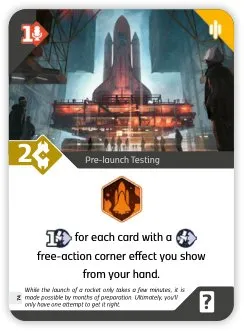 | #74 Pre-launch Testing · 2 credits. Launch; 1 move per card with a move free-action corner that you show from your hand. Rule |
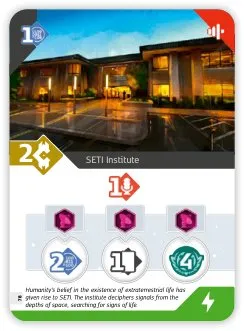 | #78 SETI Institute · 2 credits. Mission with three rewards: cover one each time you scan in the right way, any order — one per triggering action. Rule |
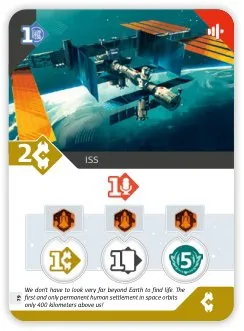 | #79 ISS · 2 credits. Mission with three rewards, one per triggering launch, any order. Rule |
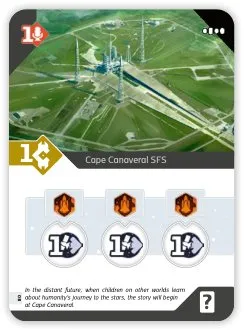 | #80 Cape Canaveral SFS · 1 credit. Mission with three rewards, one per triggering launch, any order. Rule |
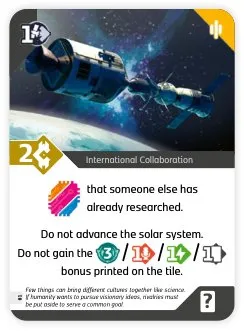 | #81 International Collaboration · 2 credits. Take a tech another player already has — no rotation and no printed tile bonus, but the free launch or 2 data of those two techs still apply. Rule |
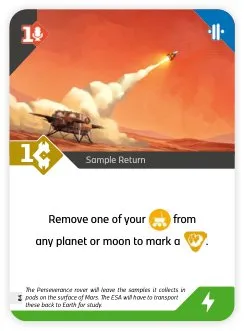 | #84 Sample Return · 1 credit. Remove one of your landers from a planet or moon to mark a trace. A freed first space gives its 2 data again to the next lander. Rule |
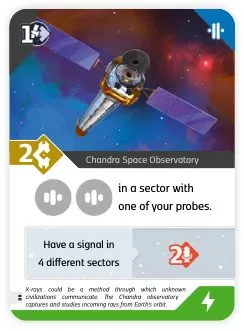 | #88 Chandra Space Observatory · 2 credits. Two signals in a sector with your probe. Mission: signals in 4 different sectors — counted on the board when you complete it; you may complete it before the sector you just filled resolves. Rule |
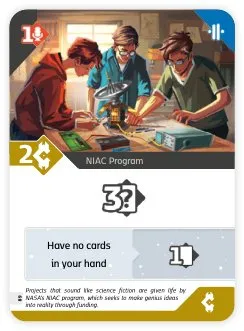 | #89 NIAC Program · 2 credits. Draw 3 cards (shown as “3?”). Mission: no cards in hand — Exertian cards don’t count as in hand. Rule |
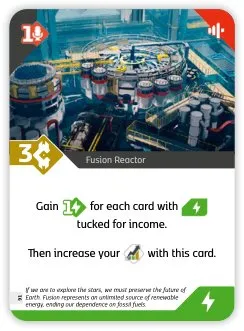 | #91 Fusion Reactor · 3 credits. The printed reward per card you have tucked for energy income, then tuck this card (an income increase: gain its resource now). Rule |
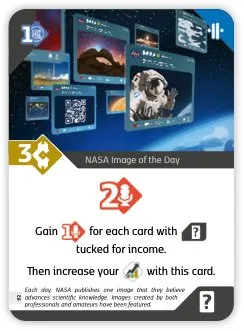 | #92 NASA Image of the Day · 3 credits. Publicity, the printed reward per card tucked for card income, then tuck this card for income. Rule |
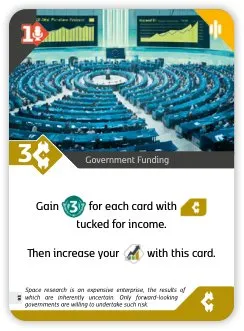 | #93 Government Funding · 3 credits. The printed reward per card tucked for credit income, then tuck this one too — count first, tuck after. Rule |
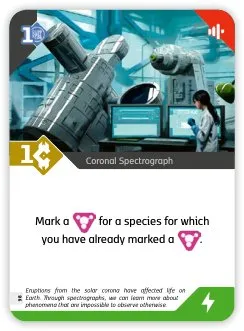 | #98 Coronal Spectrograph · 1 credit. Mark a purple trace for a species where you already have a yellow one (discovery and overflow spaces count as that species’). Rule |
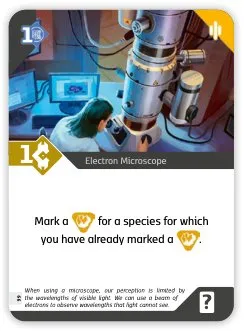 | #99 Electron Microscope · 1 credit. Mark a yellow trace for a species where you already have a blue one. Rule |
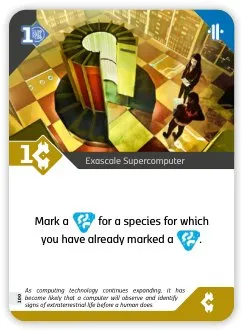 | #100 Exascale Supercomputer · 1 credit. Mark a blue trace for a species where you already have a purple one. Rule |
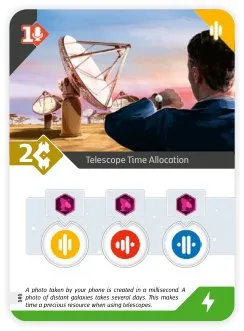 | #101 Telescope Time Allocation · 2 credits. Mission: one reward per Scan, any order. If the Scan completes a sector you may cover a reward first and use its extra signal before the sector resolves. Rule |
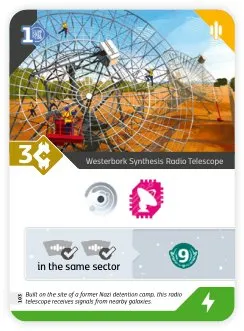 | #103 Westerbork Synthesis Radio Telescope · 3 credits. Rotate and take a telescope tech. Mission: win the same sector twice.. Rule |
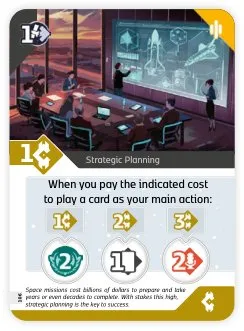 | #106 Strategic Planning · 1 credit. Mission: when you pay 1, 2 or 3 credits to play a card as your main action, cover the matching reward. Discarding a card doesn’t trigger it. Rule |
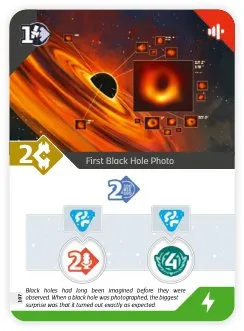 | #107 First Black Hole Photo · 2 credits. Mark a blue trace. Mission: one reward per later blue trace, any order. Rule |
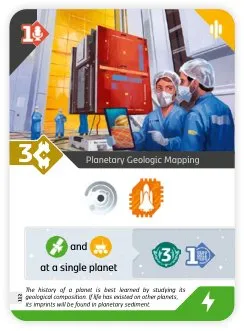 | #112 Planetary Geologic Mapping · 3 credits. Rotate and take a probe tech. Mission: an orbiter and a lander at the same planet — a lander on its moon counts (CGE ruling).. Rule |
 | #113 Solvay Conference · 2 credits. End-of-game: score the gold tile you didn’t mark at its lowest (rightmost) tier; if you marked fewer than 3, pick one of the unmarked. Rule |
 | #114 Planet Hunters · 1 credit. Draw a card, then discard up to 3 cards from your hand for their signals. Rule |
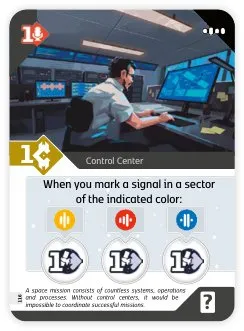 | #116 Control Center · 1 credit. Mission: when you mark a signal in a yellow, red or blue sector, cover that colour’s reward. One Scan can trigger several; older signals don’t. Rule |
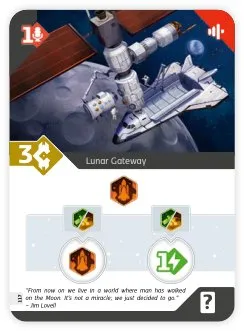 | #117 Lunar Gateway · 3 credits. Land, even on a moon without the tech. Mission: one reward per later orbit or landing, any order. Rule |
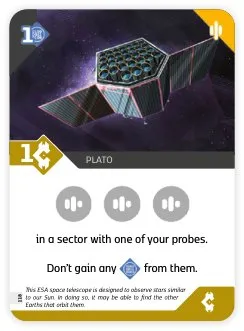 | #118 PLATO · 1 credit. Three signals in a sector with your probe, but return their data to the supply — good for excess signals. Rule |
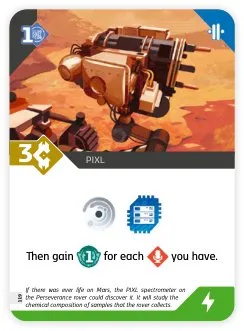 | #119 PIXL · 3 credits. Rotate and take a computer tech, then 1 point per publicity you have. You may place data mid-action to gain publicity first.. Rule |
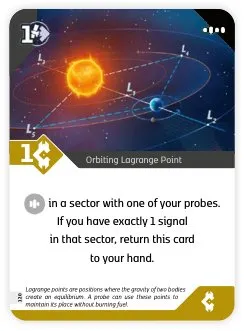 | #120 Orbiting Lagrange Point · 1 credit. A signal in a sector with your probe; if it’s your only signal there (none before), the card returns to your hand — even if the signal completes the sector. Rule |
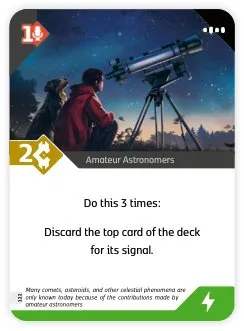 | #122 Amateur Astronomers · 2 credits. Three times, one by one: discard the deck’s top card for its signal. Mandatory, even if it helps others. Rule |
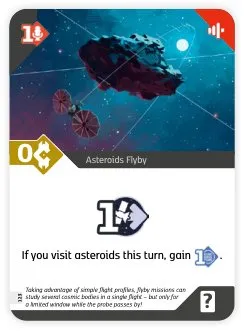 | #123 Asteroids Flyby · 0 credits. One move; data for visiting asteroids this turn, once. A main action despite costing 0. Rule |
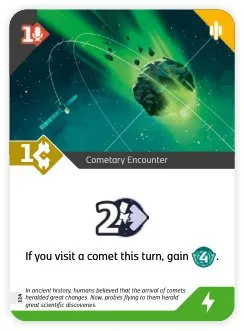 | #124 Cometary Encounter · 1 credit. Two moves; points for visiting a comet this turn, once. Rule |
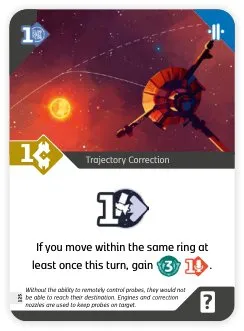 | #125 Trajectory Correction · 1 credit. One move; points and publicity if you move within the same ring (same distance from the Sun) this turn. Rule |
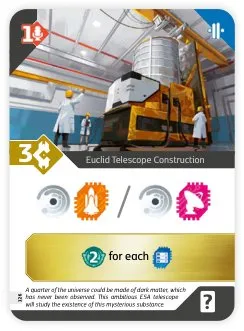 | #126 Euclid Telescope Construction · 3 credits. Take an orange or a purple tech (one rotation either way). End-of-game: points per matching item, as printed. Rule |
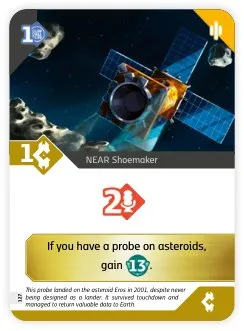 | #127 NEAR Shoemaker · 1 credit. Publicity now; end-of-game 13 points only if one of your probes is on asteroids when the game ends — a rotation after you pass can push it off. Rule |
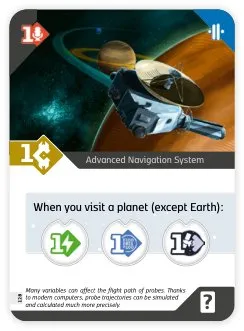 | #128 Advanced Navigation System · 1 credit. Mission: each visit to a planet other than Earth covers one reward; revisiting the same planet counts again. Rule |
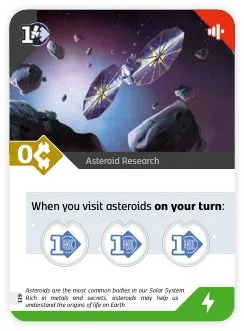 | #129 Asteroid Research · 0 credits. Mission: each time you visit asteroids on your turn, cover one reward — a rotation on your turn that pushes your probe onto asteroids counts. Rule |
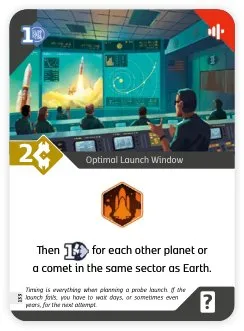 | #133 Optimal Launch Window · 2 credits. Launch, then 1 move per other planet or comet lined up with Earth outward from the Sun (up to 3). Rule |
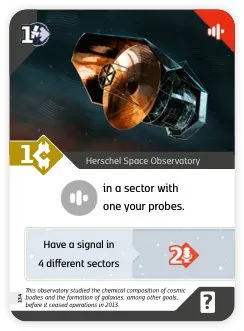 | #134 Herschel Space Observatory · 1 credit. A signal in a sector with your probe. Mission: signals in 4 different sectors, counted on the board. Rule |
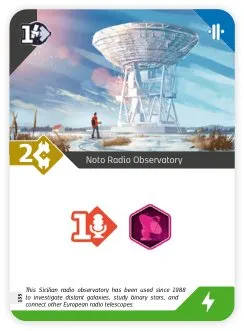 | #135 Noto Radio Observatory · 2 credits. A Scan without the base cost (purple-tech extras still cost), plus publicity. Rule |
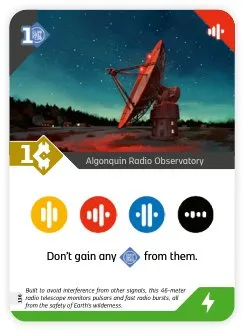 | #136 Algonquin Radio Observatory · 1 credit. A signal in each of the four colours’ sectors, but no data from them. Rule |
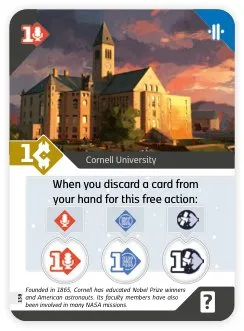 | #138 Cornell University · 1 credit. Mission: when you discard a card from your hand for its free-action corner, cover the reward matching that corner (publicity, data or move); stronger alien corners count if they include it. Rule |
Alien cards
Each species brings its own deck, used once it is discovered. These are the alien cards the official FAQ clarifies; Exertian cards are not among them. Alien cards
Mascamites cards
| Card | What it does |
|---|---|
 | ET.1 First Contact · 1 credit. One move and land, then pick up a sample. Mission: deliver a sample capsule to Earth. Samples come only from Jupiter or Saturn (or their moons) while tokens last; the capsule can deliver on any later turn as a free action. Rule |
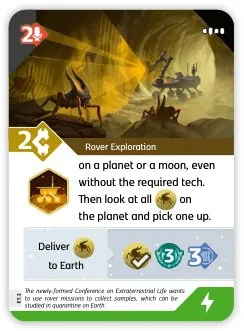 | ET.2 Rover Exploration · 2 credits. Land on a planet or moon even without the tech, then pick up a sample. Mission: deliver to Earth. Rule |
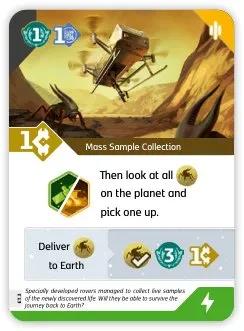 | ET.3 Mass Sample Collection · 1 credit. Orbit, then pick up a sample. Mission: deliver to Earth. Rule |
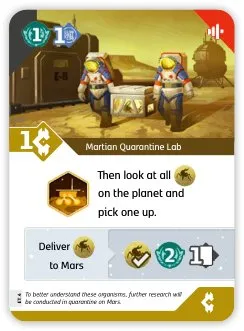 | ET.4 Martian Quarantine Lab · 1 credit. Land, then pick up a sample. Mission: deliver it to Mars instead of Earth. Rule |
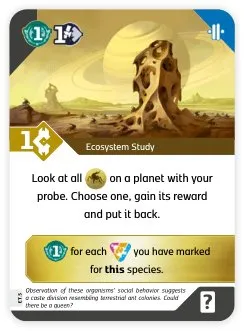 | ET.5 Ecosystem Study · 1 credit. With a probe on Jupiter or Saturn (not an orbiter or lander), look at its samples, gain one’s reward and put it back (show that one only). End-of-game: points per trace for this species. Rule |
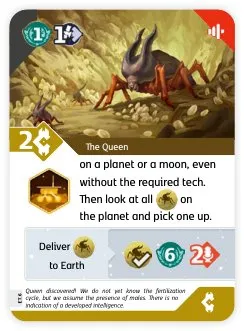 | ET.6 The Queen · 2 credits. Land even without the tech, pick up a sample. Mission: deliver to Earth. Rule |
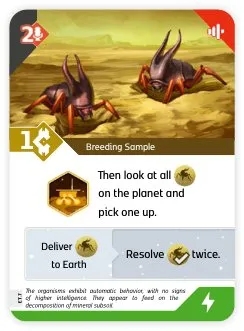 | ET.7 Breeding Sample · 1 credit. Land, pick up a sample. Mission: deliver to Earth and resolve that sample’s reward twice. Rule |
Anomalies cards
| Card | What it does |
|---|---|
 | ET.13 Concerned People · 1 credit. Mission: one reward per tech you research, any order. Rule |
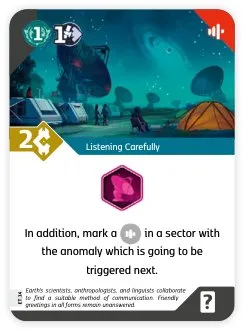 | ET.14 Listening Carefully · 2 credits. A Scan without the base cost, plus a signal in the sector of the anomaly that triggers next. Rule |
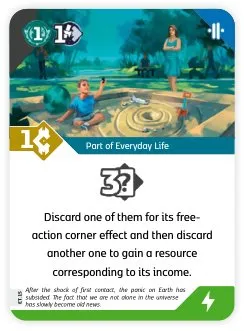 | ET.15 Part of Everyday Life · 1 credit. Draw 3 random cards: discard one for its free-action corner, discard another for its income resource, keep the third. Rule |
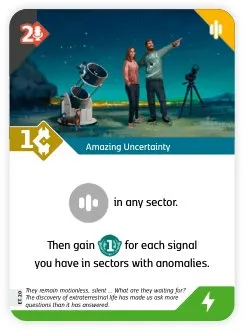 | ET.20 Amazing Uncertainty · 1 credit. A signal in any sector, then 1 point per signal you have in the three sectors with anomalies — score before a completed sector resolves. Rule |
‘Oumuamua cards
| Card | What it does |
|---|---|
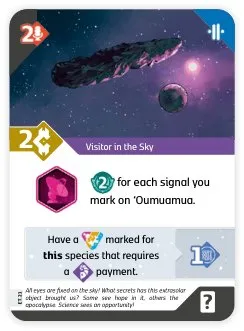 | ET.21 Visitor in the Sky · 2 credits. A Scan without the base cost; 2 points per signal you mark on the ‘Oumuamua tile. Mission: a trace for this species that costs exofossils (a 25-point or a 6-point space). Rule |
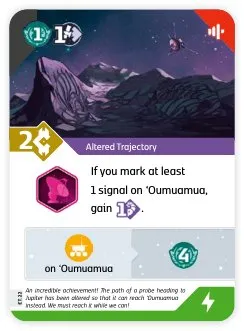 | ET.22 Altered Trajectory · 2 credits. A Scan without the base cost; an exofossil if you mark at least one signal on ‘Oumuamua this way. Rule |
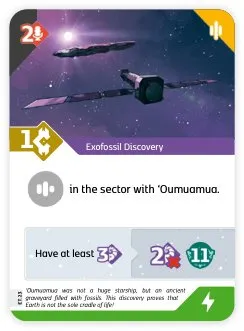 | ET.23 Exofossil Discovery · 1 credit. A signal in ‘Oumuamua’s sector (star system or tile). Mission: enough signals there for the printed reward. Rule |
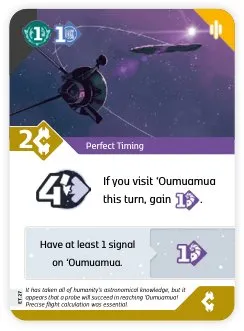 | ET.27 Perfect Timing · 2 credits. Four moves; reward for visiting ‘Oumuamua this turn (moving onto it). Mission: a signal on the ‘Oumuamua tile. Rule |
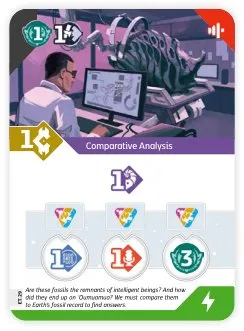 | ET.29 Comparative Analysis · 1 credit. Mission: one reward per trace you mark, any order. Rule |
Centaurians cards
| Card | What it does |
|---|---|
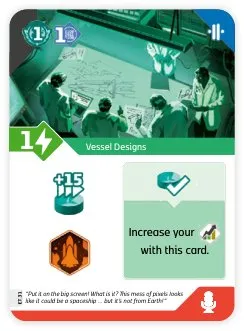 | ET.31 Vessel Designs · 1 credit. Delayed reward: when its message resolves, tuck this card for income and gain that resource at once. It can also be tucked by a normal income increase. Rule |
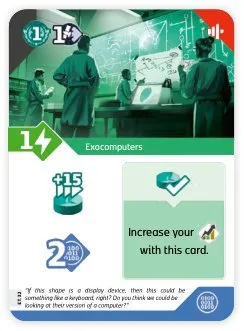 | ET.32 Exocomputers · 1 credit. As Vessel Designs, with its own message reward. Publicity and data income don’t count for the gold income tiles. Rule |
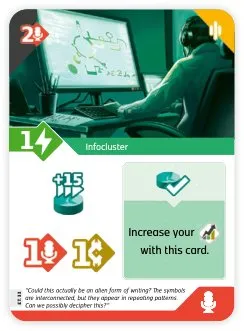 | ET.33 Infocluster · 1 credit. As Vessel Designs, with its own message reward. Rule |
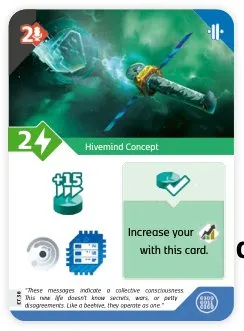 | ET.38 Hivemind Concept · 2 credits. As Vessel Designs, with its own message reward. Rule |
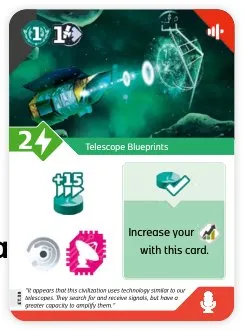 | ET.39 Telescope Blueprints · 2 credits. As Vessel Designs, with its own message reward. Rule |
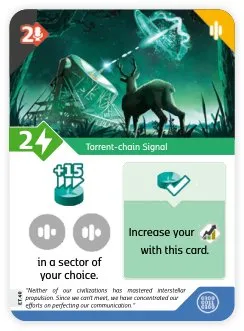 | ET.40 Torrent-chain Signal · 2 credits. As Vessel Designs; its reward marks signals in a sector of your choice. Rule |
Alien species
Each species has an alien board, rule sheet, card deck and pieces. Their cards are not mission cards; discovery rewards apply only to the three marked discovery spaces, not overflow. Traces may go in any free space of the matching colour (card types, alien board spaces, discovery spaces). Rules in brief: The five species.
| Species | Component details |
|---|---|
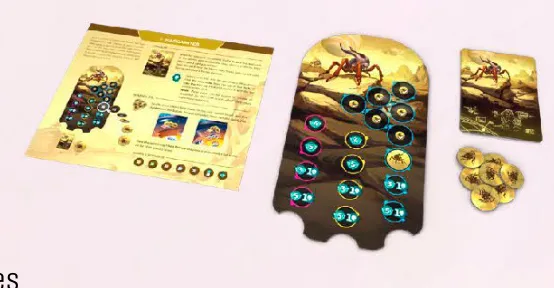 Mascamites | Board: 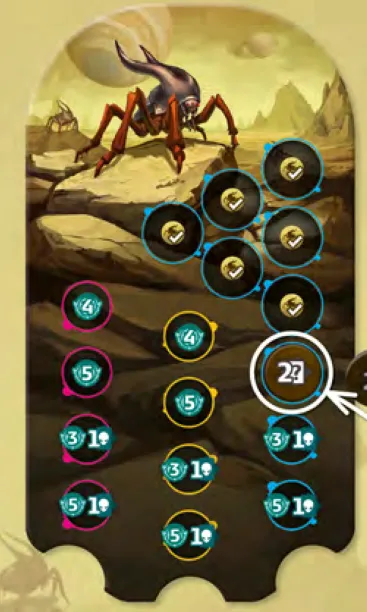 ; Card:  ; Pieces and rules:  10 cards, 7 sample tokens. Collect samples at Jupiter and Saturn, fly them as capsules, deliver for the token’s bonus. Publicity is gained only by moving onto its icon, not when a capsule appears there (FAQ). |
 Anomalies | Board: 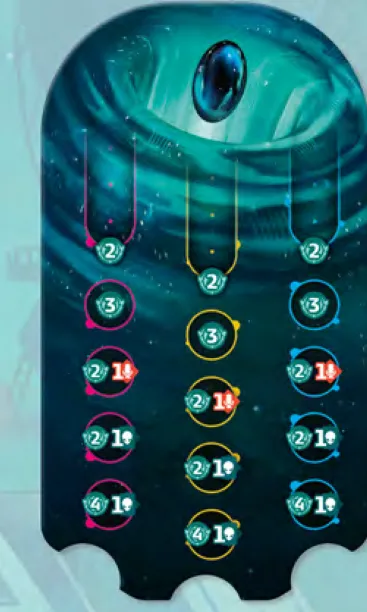 ; Card:  ; Pieces and rules: 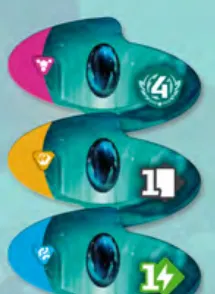 10 cards, 3 anomaly tokens. When Earth rotates into an anomaly’s sector, the leader of its colour column takes the reward. A player at the hand limit may still gain the Anomalies card because the four-card limit is checked only when passing (FAQ). |
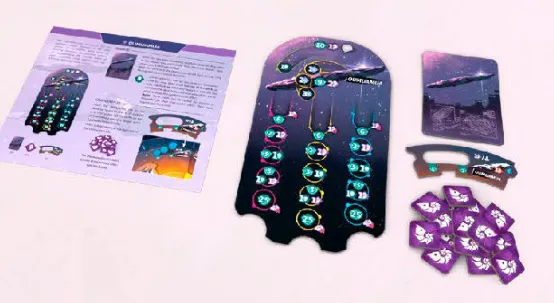 ‘Oumuamua | Board: 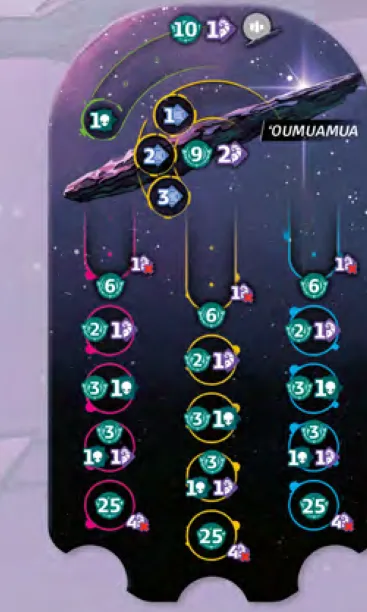 ; Card:  ; Pieces and rules:   10 cards, 1 tile, 17 exofossils. A planet with its own data slot; exofossils pay for board spaces. Leftover exofossils do not score (FAQ). |
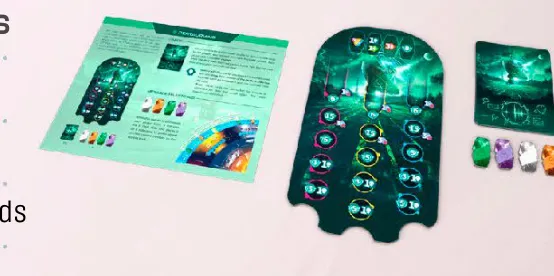 Centaurians | Board: 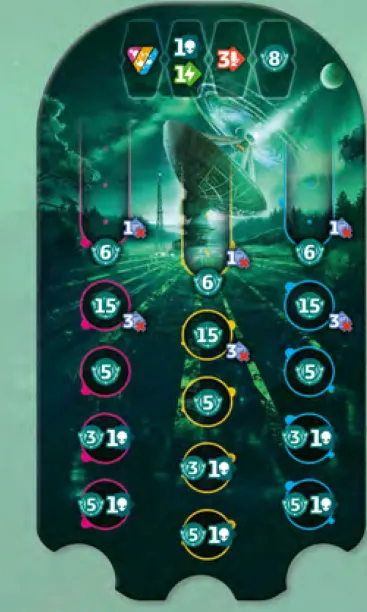 ; Card:  ; Pieces and rules:  10 cards, 4 message tiles. Messages arrive 15 points later; cards cost energy. |
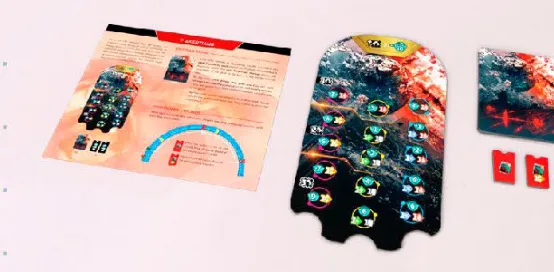 Exertians | Board: 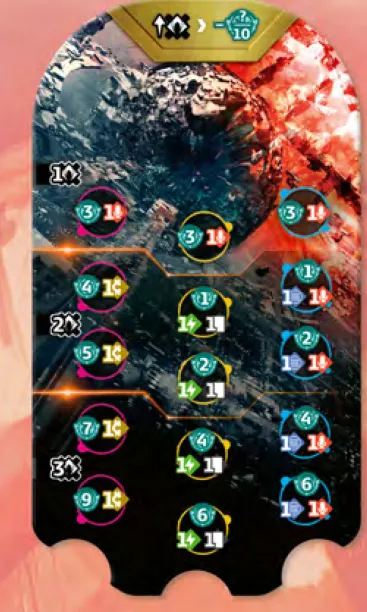 ; Card:  ; Pieces and rules: 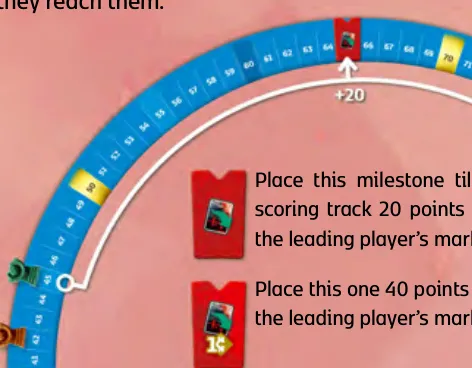 15 cards, 2 milestone tiles. Secret cards score points and add danger; at game end, whoever has the most danger loses 10% of their points, rounded down, including all tied players. Each milestone can trigger only once, and you may inspect your own played cards (milestone, private cards). |
Promo cards
| Card | Component details |
|---|---|
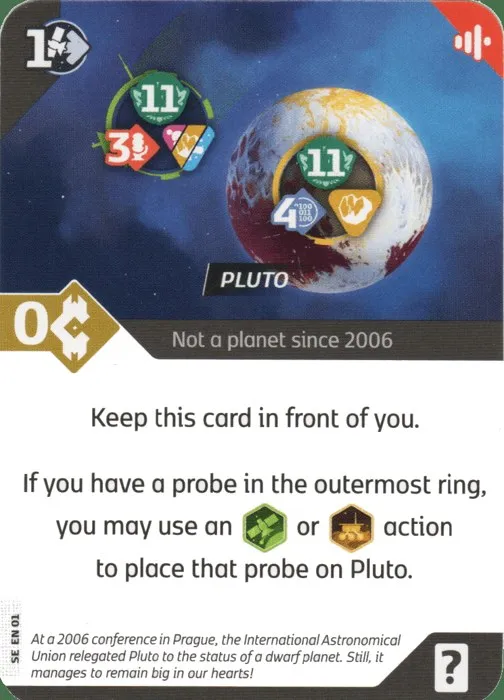 | Tag: [Pluto]; Effect: Orbit or land on Pluto from the outer ring; a probe cannot visit Pluto because it has no solar-system space (FAQ). Pluto Promo |
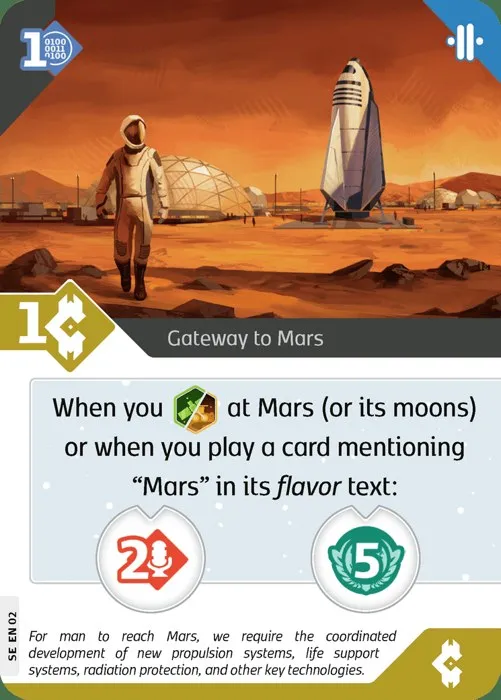 | Tag: [Mars]; Effect: The mission rewards 2 publicity + 5 points. Playing a Mars card and orbiting or landing on Mars are separate triggers, so Perseverance Rover can cover two circles in one action (FAQ). Gateway to Mars |
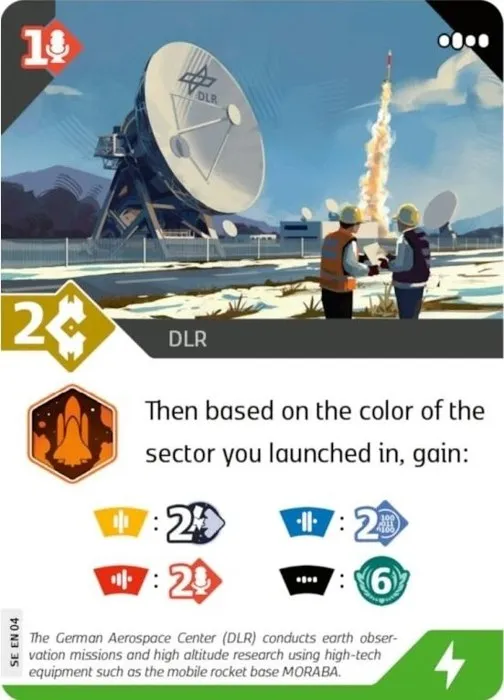 | Tag: [DLR]; Effect: Launch, then a resource by sector colour. DLR |
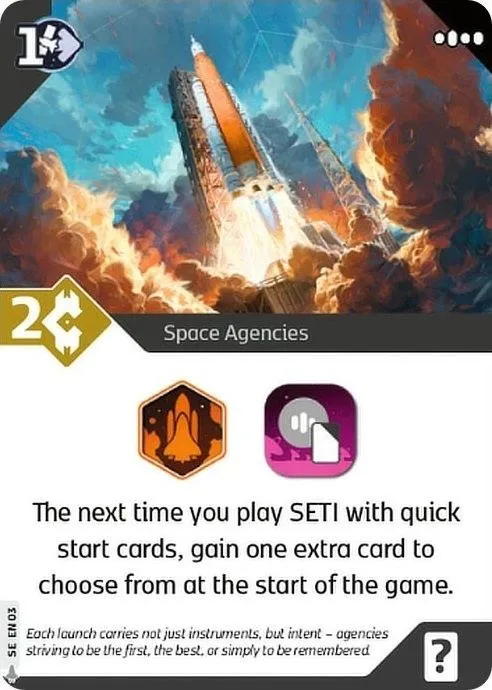 | Tag: [SA-Promo]; Effect: Launch + signal token; in your next game with quick-start cards, deal yourself one extra option but still keep two (FAQ). Space Agencies promo card |
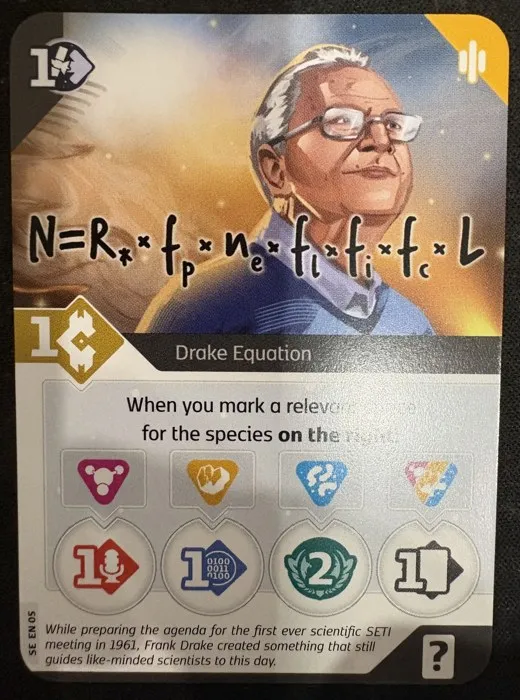 | Tag: [Drake]; Effect: Rewards for each trace you mark for the right species. Drake Equation |
Tiles
Tech tiles
Computer techs give their 2-point tile bonus when taken, and can go in any open computer slot rather than left to right. Tech placement.
| Tile | Component details |
|---|---|
 | Tech: Probe 1; Effect: 2 probes in space; free launch. |
 | Tech: Probe 2; Effect: Publicity at asteroids; no extra move to leave them. |
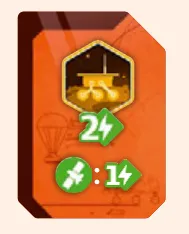 | Tech: Probe 3; Effect: Landing costs 1 energy less. |
 | Tech: Probe 4; Effect: Land on moons. |
 | Tech: Telescope 1; Effect: Scan a sector next to Earth’s; bonus 2 data. |
 | Tech: Telescope 2; Effect: 1 publicity: extra signal at Mercury. |
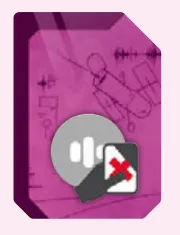 | Tech: Telescope 3; Effect: Discard a hand card for an extra signal. |
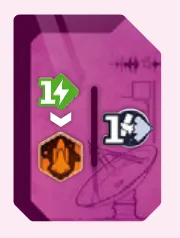 | Tech: Telescope 4; Effect: 1 energy: launch or move during a scan; this free launch does not also cost 2 credits (FAQ). |
 | Tech: Computer 1; Effect: 2 points; lower space credit. Computer techs may be placed in any open slot (slot order). |
 | Tech: Computer 2; Effect: 2 points; lower space energy. Computer techs may be placed in any open slot (slot order). |
 | Tech: Computer 3; Effect: 2 points; lower space card. Computer techs may be placed in any open slot (slot order). |
 | Tech: Computer 4; Effect: 2 points; lower space publicity. Computer techs may be placed in any open slot (slot order). |
Gold scoring tile sides
At game end, each marked tile scores its marked value multiplied by the number of matching sets (for example, a marked value of 4 with 3 matching tech sets scores 12). One side of each tile is used per game; you mark its highest free value when you reach a milestone. Scoring.
| Side | Scores for each… |
|---|---|
 | probe + telescope + computer tech |
 | 2 techs |
 | Credit, energy and card income cards tucked beneath the income card; only tucked cards count, not the printed starting income (FAQ). |
 | The larger of your tucked credit or energy income cards; what counts as income. |
 | completed mission |
 | 2 completed missions / gold-box cards |
 | yellow + purple + blue trace |
 | Sector win paired with an orbiter or lander (moons count): compare the number of win markers with the number of orbiters and landers, then score the smaller total. For example, 3 wins plus 1 lander and 1 orbiter make 2 sets (FAQ). |
Tokens & pieces
Player pieces
| Component | Component details |
|---|---|
| Count: Per colour: 8 figures, 30 markers, publicity counter, score counter, 100/200-point token, starting income card; What it is for: Probes/orbiters/landers; signals, traces and tile marks; the two tracks. Figures and markers are interchangeable and unlimited. Neutral milestone markers resolve one at a time; when one turn crosses both, resolve both, then resolve milestones at the end of that turn (one marker, both milestones, timing). Orbiters and landers are not probes for card effects; a win marker is not a signal. |
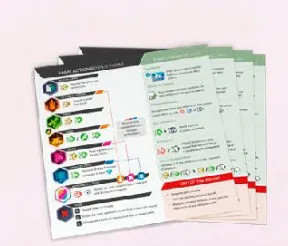 | Count: 4 quick reference sheets; What it is for: Actions, free actions, iconography, techs and gold tiles. |
Shared pieces
| Component | Component details |
|---|---|
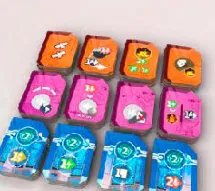 | Count: 48 tech tiles; What it is for: 4 of each of the 12 techs. Techs |
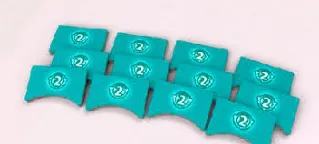 | Count: 12 two-point tiles; What it is for: 2 points for the first player to take each tech. |
 | Count: 1 starting player marker; What it is for: Moves left each round. |
 | Count: 2 rotation tokens; What it is for: Which disc turns next; the first-to-pass reminder. A probe pushed through a gap enters the next space (FAQ). |
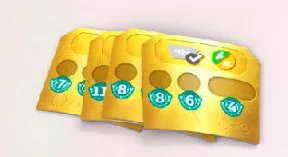 | Count: 4 gold scoring tiles (8 sides); What it is for: End-game multipliers. Income sets; sector win + orbiter/lander side. Gold scoring tiles |
 | Count: 30 credits, 30 energy; What it is for: Unlimited supply. |
 | Count: 70 data tokens; What it is for: Fill star slots; go to your data pool and computer. You may place more than one data each turn (FAQ). |
Solo components
| Component | Component details |
|---|---|
 | Count: 24 solo objective tiles; What it is for: Levels I–III; spend them each round. One action may also satisfy a mission trigger (FAQ). Objectives |
 | Count: 19 rival action cards; What it is for: S.1–S.4 basic, S.5–S.15 advanced, 5 alien cards. The rival has no income (FAQ). Rival turns |
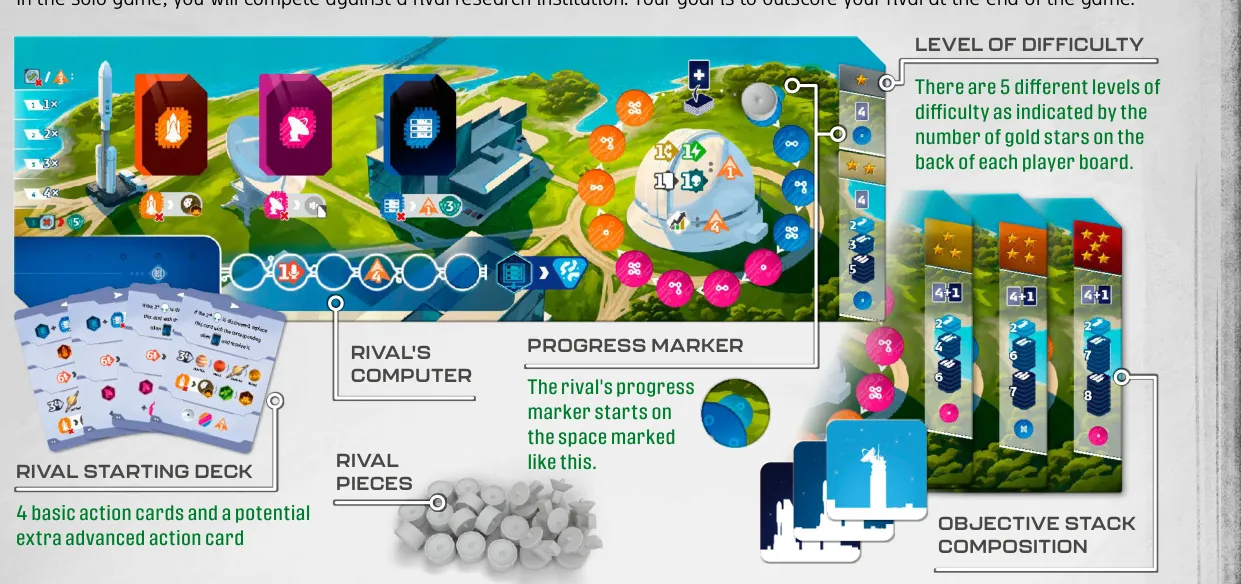 | Count: Rival boards (5 difficulties); What it is for: Progress track, computer, preferred techs. Solo setup |
Space Agencies components
[Agencies] Details on Space Agencies.
| Component | What it is for |
|---|---|
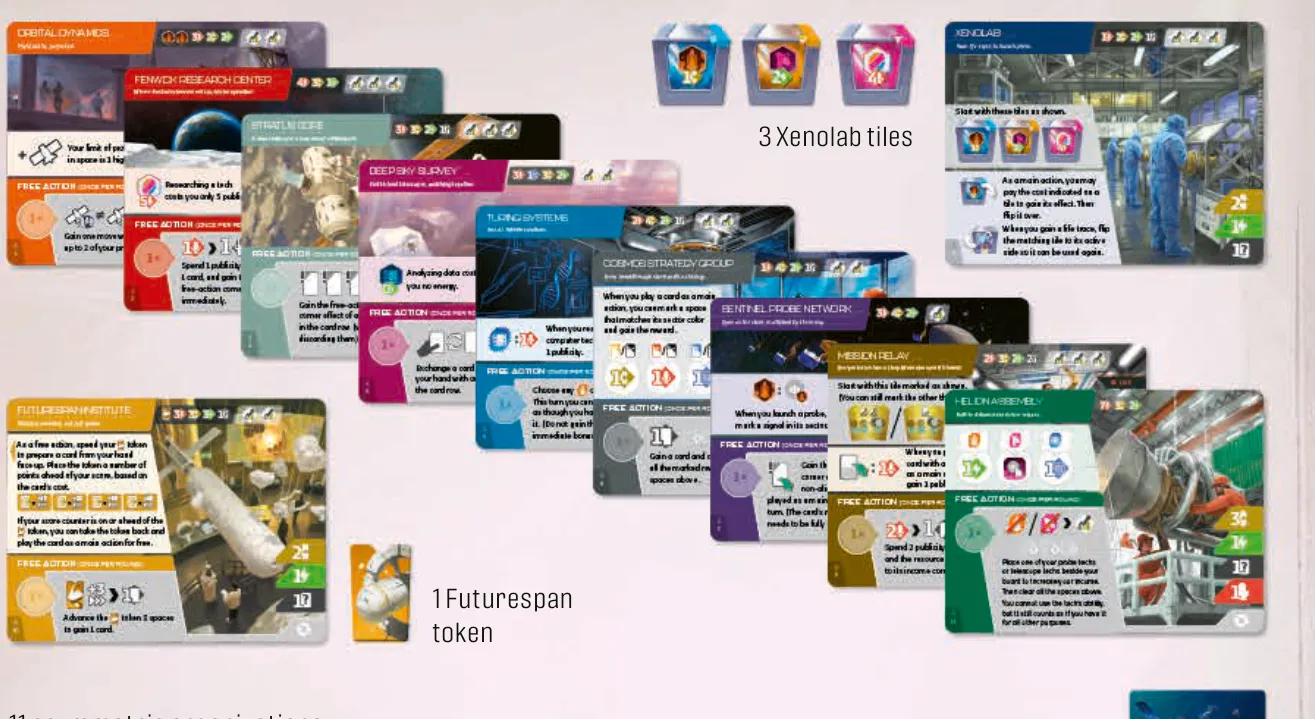 | 11 organizations, 3 Xenolab tiles, Futurespan token. |
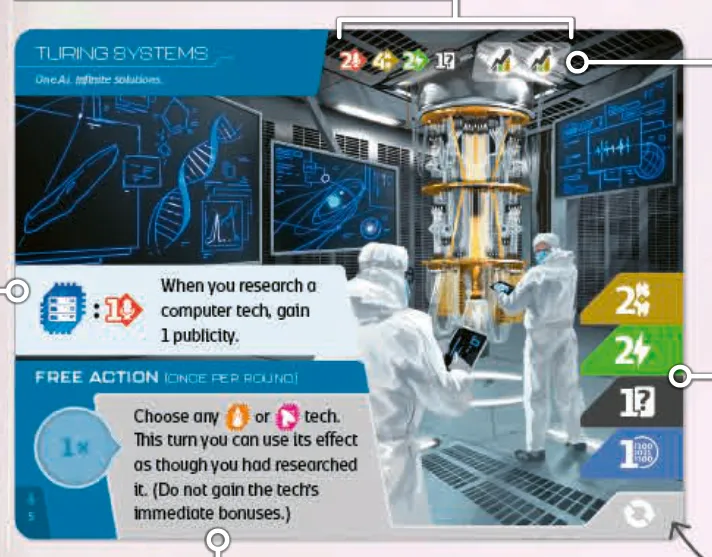 | Organization anatomy: starting resources, passive power, once-per-round ability, income. |
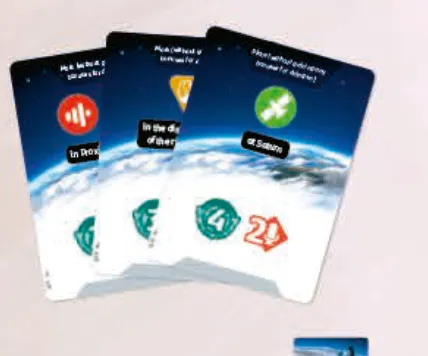 | 21 quick start cards. |
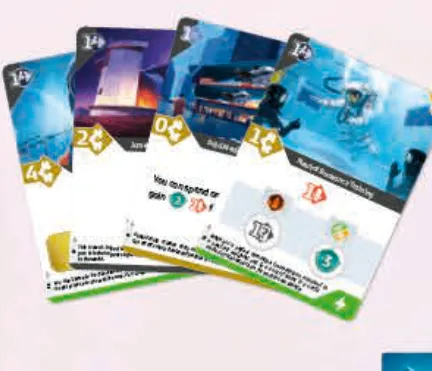 | 42 main-deck cards. |
 | 10 signal tokens. |
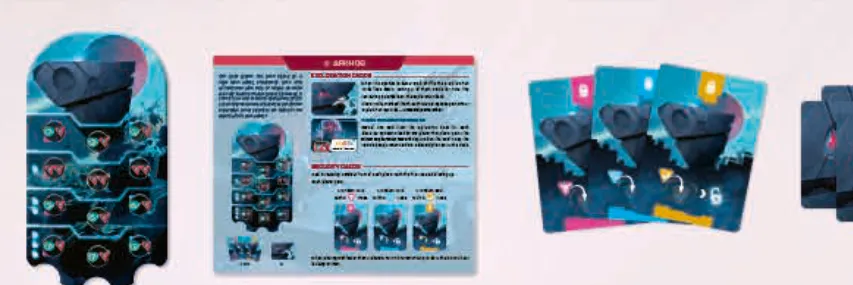 | Arkhos: board, 9 exploration and 12 security cards. |
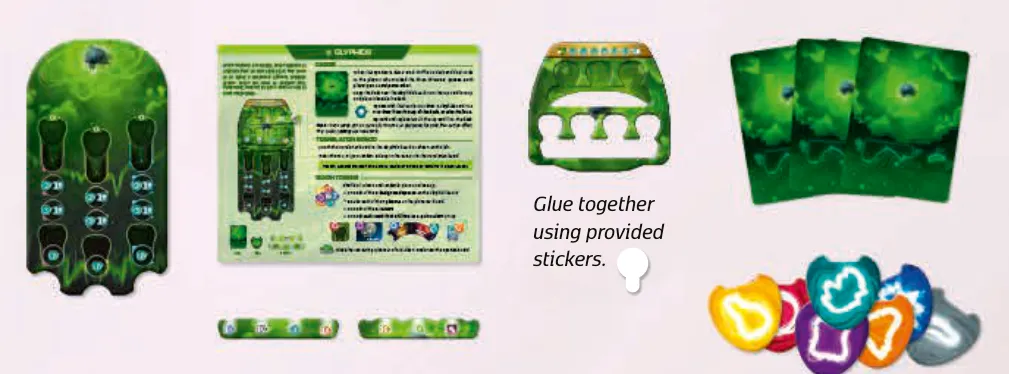 | Glyphids: board, translation board, 2 strips, 10 cards, 35 glyph tokens. |
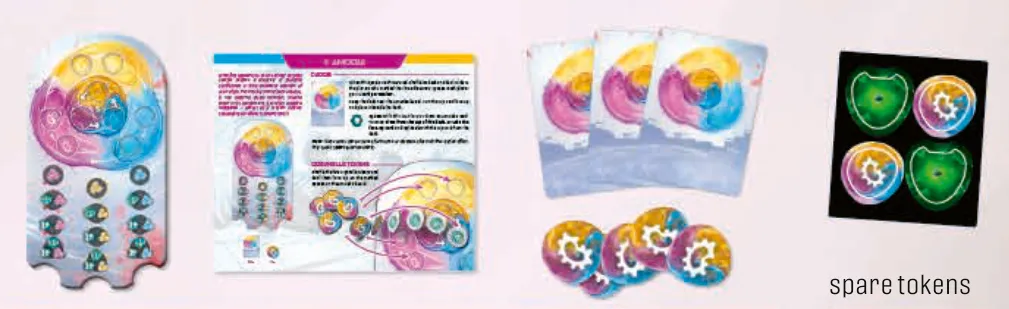 | Amoeba: board, 10 cards, 5 organelle tokens. |
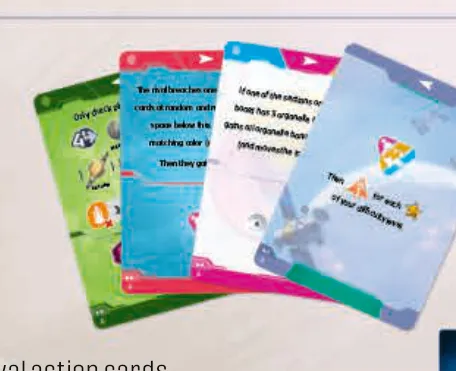 | 4 rival action cards. |
 | 3 long-term objective tiles. |
Space Agencies cards in the official FAQ
[Agencies] CGE’s Space Agencies FAQ clarifies these cards. No public picture of their faces exists yet, so they are listed by number and name: check each against the physical card.
- #2 Tracking and Data Relay Satellite — counts the free-action corner (top left) of cards you show; alien corners with 2 publicity, 1 data + 1 point or 1 move + 1 point qualify, but a 2-publicity corner gives you only 1 publicity.
- #5 Servicing Mission — move first, then check for a probe next to Earth.
- #7 Twin Probes — mission: two probes in space at once, each on a different planet (not Earth; orbiters and landers don’t count).
- #8 Quantum Data Storage — counts the data in your data pool only, not in your computer.
- #10 First Human in Space — publicity stops at 10; any excess is lost.
- #12 Two-planet Flyby Maneuver — two different planets you move onto this turn; the one you start on counts only if you leave and come back, and lasts through later free-action moves.
- #13 James Clerk Maxwell Telescope — a Scan without the base cost (purple-tech extras still cost); its signal token arrives after the Scan, too late to use in it.
- #15 Iterative Engineering — gain the tech tile’s printed immediate bonus a second time; not the free launch or 2 data of those two techs.
- #16 Astronaut Training Experience — resolve the 4 publicity first, then check the mission.
- #17 Paid Media Coverage — spend any credits, even 0; publicity over 10 is lost but each extra credit still scores 2 points.
- #18 Contracted Research — playable at 0 publicity and still gives the tech (the best way to play it).
- #19 New Assignment — removing an orbiter frees its space (a first space gives 3 points again); the probe placed on the planet is not a launch nor a visit and may exceed your probe limit. The exact placement on Pluto is unresolved; the FAQ gives no official answer (Pluto and New Assignment).
- #20 Well Executed Project — “free-action corner” = the card’s top left.
- #21 Orbital Refueling, #26 New AI Models — a main action even at 0 credits.
- #22 TESS Satellite, #37 Pandora Satellite — main actions at 0 credits; signals in your probe’s sector(s) give no data (return it to the supply).
- #27 Better Solar Panels — 0 credits, still a main action; orbiters and landers aren’t probes in space.
- #28 Restructuring — you may discard no cards.
- #29 Abandoned Mission — return an unfinished conditional mission (even if met) or a triggerable one with an open space; its markers go back to you.
- #32 MUREP Idea Competition — you still gain 1 publicity and 2 random cards with an empty hand.
- #33 Delayed Launch — triggers as you pass, so the launched probe can’t move until next round; at your probe limit, mark the mission without launching.
- #34 Private Sector Investment — first an income increase (tuck a card, gain its resource now), then 1 random card per tech of your most numerous tech colour.
- #35 NASA Exoplanet Archive — data in your pool and in your computer both count.
- #38 Space Rendezvous — move first, then check for a shared space with any probe (yours or another player’s).
- #42 LOFAR Array — a Scan without the base cost; needs every one of the 8 sectors won or holding your signal.
- ET.1 (Glyphids) — 3 points per token of your most common glyph colour (7 colours); those tokens still count for sets at the end.
- ET.9 (Glyphids) — 1 point per glyph in your largest set of different tokens (up to 7); the set still scores at the end.
- ET.11 Biosignature Screening, ET.12 Physical Characterization, ET.13 Genome Characterization (Amoeba) — marked overflow spaces below the Amoeba board count for the gold box.
- ET.14 Breakthrough Theory (Amoeba) — overflow spaces count for the mission, the three discovery spaces don’t; the reward counts empty spaces on the Amoeba board only.
- ET.19 Extreme Conditions Testing (Amoeba) — remove your marker from the board, a discovery space or an overflow space; gain the organelle bonuses of the matching colour section and move the tokens.
- ET.34, ET.38 — this launch may exceed your probe limit; normal launches still respect it.
Icons
Iconography
From the quick reference sheet and the alien rule sheets.
| Icon | Meaning |
|---|---|
 | Credit |
 | Energy |
 | Card from the row or the deck |
 | Random card from the deck |
 | Publicity |
 | Data |
 | Data token |
 | Victory point |
 | Move a probe 1 space |
 | Card of this alien species |
 | Tuck a card for income |
 | Credit income |
 | Energy income |
 | Card income |
 | Probe tech |
 | Telescope tech |
 | Computer tech |
 | Tech of any type |
 | Rotate the solar system |
 | Mark a signal |
 | Signal in a yellow sector |
 | Signal in a red sector |
 | Signal in a blue sector |
 | Signal in a black sector (rare) |
 | Signal in the sector with Earth |
 | Card-row card discarded for a signal |
 | Win in a yellow sector |
 | Win in a red sector |
 | Win in a blue sector |
 | Win in a black sector |
 | Win in any sector |
 | Any life trace |
 | Yellow trace (landing) |
 | Purple trace (sectors) |
 | Blue trace (data) |
 | Orbiter |
 | Lander |
 | Orbiter or lander |
 | Mission completed |
 | End-of-game scoring |
 | Launch a probe |
 | Orbit |
 | Land |
 | Scan |
 | Analyze data |
 | Play a card |
 | Research a tech |
 | Pass |
 | 3 publicity (buy a card) |
 | Deliver a Mascamite sample |
 | Signal on ‘Oumuamua |
 | Exertian danger |
 | Exertian milestone |