Probes, Orbiters and Landers
Launching probes, moving through the rotating solar system, asteroids and publicity, and turning probes into orbiters and landers on planets and moons.
The solar system
The solar system board is three stacked, rotating discs inside four fixed sector boards, divided into 8 sectors by white lines. Each ring has 8 spaces; the Sun in the middle is not a space and cannot be crossed. A figure on the solar system board is a probe; once it moves to the planetary board it is an orbiter or a lander and no longer counts as a probe for any effect.
Launch a probe
 Pay 2
 and put one of your figures on Earth’s space.
You may have only 1 probe in space (anywhere on the solar system board) unless a tech or card raises the limit; at the limit you cannot launch. Orbiters and landers don’t count.
Movement
Each  moves one of your probes into an orthogonally adjacent space (never diagonally).
Movement comes from:
- 1
 = 1 move, a free action at any time on your turn — so you can launch and
move on the same turn, or wait;
- cards discarded for a free-action corner;
- card and tech effects.
Moves from one effect may be split among your probes, and you may use fewer than you get.
Asteroids
Leaving a space with asteroids costs one extra move. (The second probe tech removes the penalty — Probe techs.)
Publicity for visiting
Moving into a space with a  publicity icon — comets and most planets — gains
1 publicity. Earth gives none. Each visit counts, even to the same planet twice in a turn.
Rotating the solar system
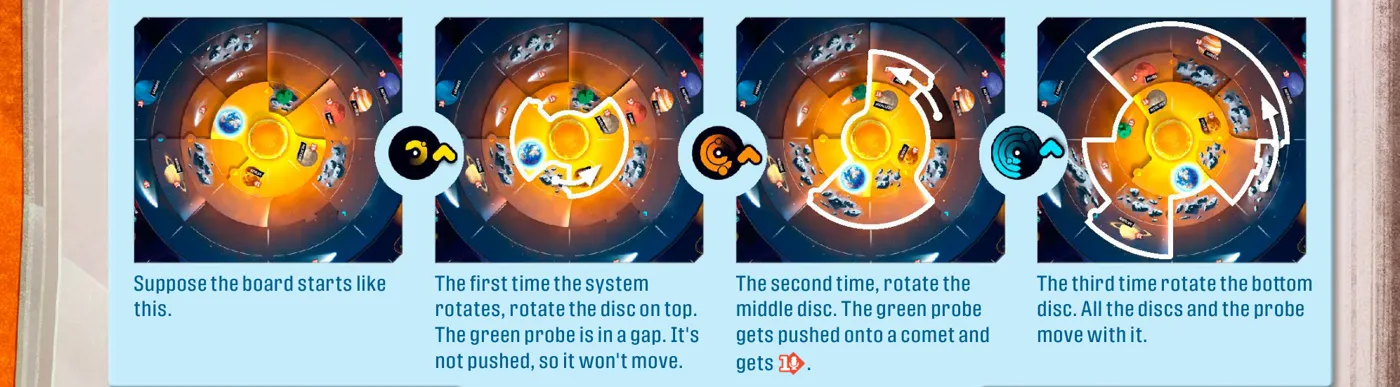
 The solar system rotates every time anyone researches a tech (before choosing it)
and once per round when the first player passes. The rotation token on the tech board shows
which disc turns next:
- first time: disc 1 (the top disc);
- second time: disc 2 — disc 1 turns with it;
- third time: disc 3 — all three turn; then back to disc 1.
Each rotation turns the disc one sector counter-clockwise. Probes ride with their disc, but the discs have cutouts: a probe in a gap may stay put, or be pushed into the next space by a turning disc. A push is free and still earns publicity for a publicity space — even on another player’s turn.
Orbit a planet
 Pay 1 + 1 with a probe on a planet’s space
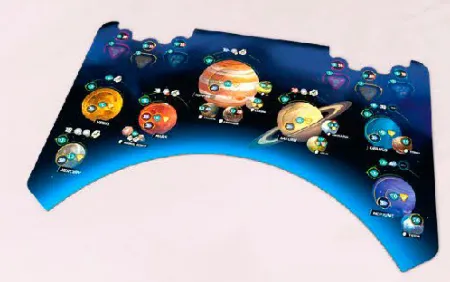
(not Earth). Move the figure to that planet’s orbit on the planetary board and gain the rewards
shown above the planet — usually an
 income increase.
The first orbiter at each planet also scores 3 points and covers that space as a reminder. There is no limit to orbiters per planet. An orbiter stays in orbit for the rest of the game.
Land on a planet or moon
 Pay 3 — only 2 if there is already an orbiter at that
planet, anyone’s — with a probe on a planet’s space (not Earth). Move the figure onto the planet and
gain the rewards in its middle: always a
 yellow life trace and some points.
The first lander also gets the data printed there and covers it; Mars has two such spaces, for
its first two landers. There is no limit to landers per planet.
Gas giants count too: the game calls every such probe a “lander”.
Moons
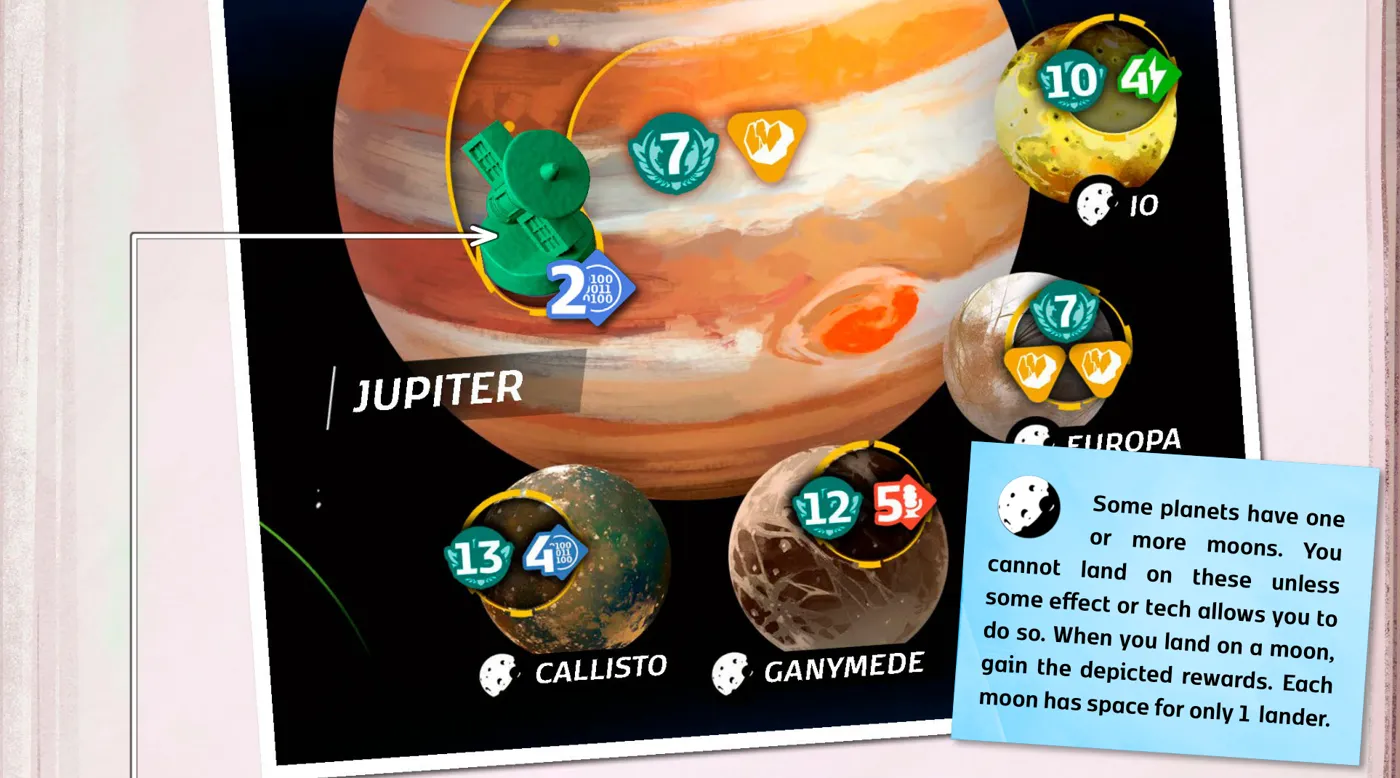
You may land on a moon only with an effect or tech that allows it (the fourth probe tech). It costs the same as landing on its planet, discounts included; each moon holds one lander and gives its printed rewards.
At a planet
Cards that count figures “at a planet” mean your orbiters and landers there, including those on its moons — never probes still on the solar system board.
[Pluto] The Pluto promo adds a planet you reach from the outermost ring (Pluto). [Agencies] Some organizations start with probes in space or move two probes at once (Organizations).