Teach the Game
A short teach for the 2017 edition of The Quest for El Dorado: race, cards, terrain, turns and scoring.
How you win
“We are rival expedition leaders racing through the jungle to reach El Dorado. Build a useful deck, spend cards to cross terrain, and use base camps to clear weak cards out of your expedition. The first player to reach the finish triggers the final round; the player who gets furthest wins.”
- You need: to finish ahead of the other expeditions. If players finish on the same space, compare blockades collected; if still tied, the higher blockade wins.
- You get there by: playing matching terrain cards with enough power, buying at most one card each turn, and planning a route through the map without wasting movement.
The boards
The route is assembled from double-sided landscape boards. The assembly guide gives the selected route; the starting expedition boards and finish tile must create one continuous track. Put each player’s pawn on the start and blockades on the marked joins.
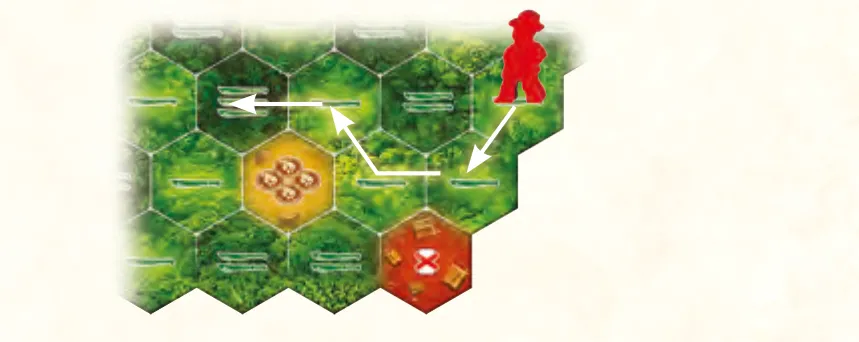
Each hex shows its terrain and the power needed to enter. Green, yellow and blue are landscape spaces; grey rubble and red base camps instead ask for any number of cards. Black mountain spaces and occupied spaces are impassable.
A round
Take turns clockwise. On your turn:
- Play cards. Use any number for movement and/or to buy up to one market card. Each landscape card is used once and can move only onto adjacent spaces matching its terrain symbol. Its power must meet the space’s number; excess power may continue across further spaces of that same terrain. You cannot combine cards to meet a landscape space’s power.
- Discard. Put all cards you played this turn in your discard pile. Cards you did not play stay in your hand.
- Refill. Draw until you have four cards. If the draw pile runs out, shuffle your discard pile to make a new draw pile and continue.
On your first turn, the starting player takes the hat token and plays all three phases; then the next player does the same.
How the game ends
When a pawn reaches any of the three finish spaces, finish that player’s turn and complete the current round so everyone has had the same number of turns. The player furthest along the final board wins. For a tie, the tied player with more collected blockades wins; if tied again, the player holding the highest-valued blockade wins.
Ways to score
| Result | How it is decided |
|---|---|
| Race position | Furthest pawn on the final board when the race ends wins. The game has no points track. |
| Blockade tie-break | Among tied players, most blockades wins; then the highest-valued blockade. |
What each resource is for
| Resource | Why you need it | How you get or use it |
|---|---|---|
| Expedition cards | Move and buy better cards | Terrain symbols and power pay for movement; coin symbols buy cards. |
| Gold coins | Buy cards | The value printed on coin symbols is the card’s purchase value; without one, it is worth 1. |
| Pawn | Show race position | Move it along adjacent spaces; it cannot enter mountains or an occupied space. |
| Blockades | Mark route joins and break ties | The first player to remove a blockade by paying its movement requirement keeps it. |
| Market row | Deck-building choices | Replace a bought card’s empty slot from the matching supply stack. |
| Hand and discard pile | Manage your deck | Played cards go to discard; refill to four, reshuffling when needed. |
Teaching tips
- Lay out the route using the assembly guide before teaching; explain which spaces connect at each join.
- Teach movement with one low-power space first. A matching symbol and sufficient power are both required.
- Emphasize that excess power can continue only through the same terrain, and cards cannot be combined for a difficult landscape space.
- Show base camps as a way to permanently remove weak cards, then explain the race-ending final round and blockade tie-break.