Rounds and Turns
How a game of Lorenzo il Magnifico runs: 3 periods of 2 rounds, the four phases of a round, Family Members and dice, servants, the five action areas and the end of the round.
Overview
You head a Florentine family. Over 3 periods of 2 rounds each — 6 rounds — you send your
Family Members around the city to collect resources, take Development cards and put those cards
to work. At the end of every period the Church checks your  Faith. After round 6 the
player with the most
 Victory Points wins.
The rulebook teaches a basic game first. The full game adds the advanced side of the Personal Bonus Tiles and the Leader cards; play it from your second game.
The board
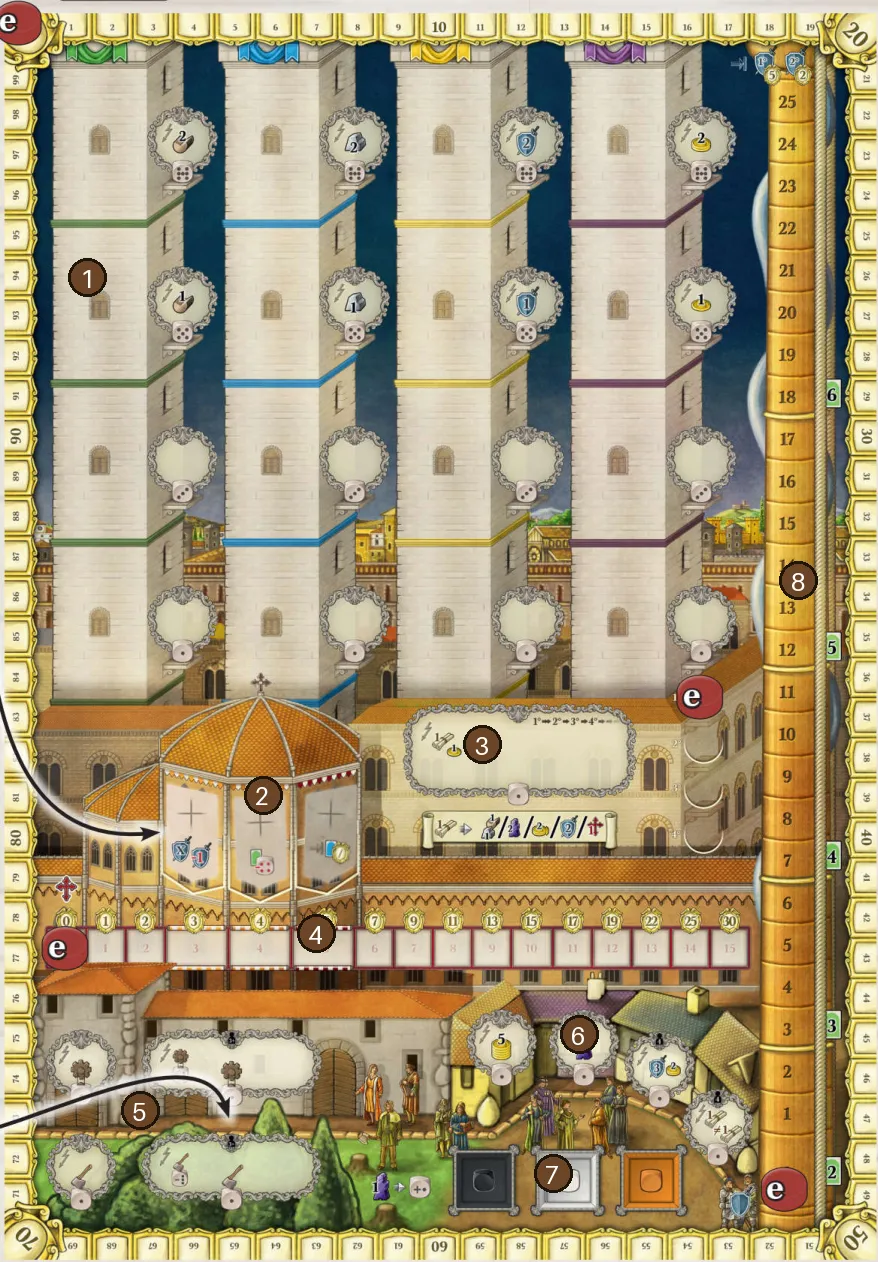
- The four towers — one per card colour, four floors each.
- Excommunication tiles — one per period, under the dome.
- The Council Palace — Council Privilege, a coin and next round’s turn order.
- The Faith track — 0 to 15, with the Church’s reward under each step.
- Production (upper row) and Harvest (lower row).
- The Market — four spaces for coins, servants, Military Points and privileges.
- The dice spaces — black, white and orange.
- The Military track (right) and the Victory Point track (border).
A round
Each round has four phases:
| Phase | What happens |
|---|---|
| A. Round setup | Fill the towers, roll the dice. |
| B. Actions | In turn order, players place one Family Member at a time until all are placed. |
| C. Vatican Report | Only in rounds 2, 4 and 6 — the end of a period. See Vatican Report. |
| D. End of the round | Clear the towers, set the new turn order, take Family Members back. |
Round setup
- Deal 4 cards from the top of each deck onto its tower, one per floor, starting at the bottom floor and going up.
- The first player rolls the 3 dice and puts them on their spaces on the board. They set the value of every player’s Family Members for the whole round.
There is no round marker. If the cards on top of the decks belong to a later period than the ones on the board, you are in an even round and a Vatican Report follows.
Family Members and dice
You have 4 Family Members: three coloured ones, each with a die symbol (black, white, orange) on top, and one uncoloured one with a blank die and a 0.
- A coloured Family Member is worth the number on the die of its colour this round. Roll a 4 on the white die and every white Family Member at the table is worth 4.
- The uncoloured Family Member is worth 0. Its sticker only shows which player owns it.
- Every action space shows a die with the minimum value needed. A Family Member worth more can always take an action that needs less.
Servants
Before placing a Family Member you may spend  servants to raise its value, 1 per
servant, with no limit. Spend only what the action needs.
Taking an action
On your turn, place one Family Member on a free action space whose value you meet and do that action at once. There are five places to go:
| Area | What you get | Page |
|---|---|---|
| Towers | A Development card, plus a resource bonus on the top floors | Towers and Cards |
| Harvest | Run your Territories and your Personal Bonus Tile | Harvest and Production |
| Production | Run your Buildings and your Personal Bonus Tile | Harvest and Production |
| Market | Coins, servants, Military Points or two Council Privileges | The Market |
| Council Palace | A Council Privilege, a coin and a better turn order | The Council Palace |
When you receive resources, take them from the supply onto your Personal Board. When you gain points, move your disc on that track.
[HoR] With Houses of Renaissance a fifth tower, the Special Tower, joins the board, and some Leaders bring an action space of their own (Houses of Renaissance).
End of the round
- Remove all cards still on the towers from the game.
- Set the new turn order from the Council Palace: the player whose Family Member is leftmost there goes first, and so on. Players who did not go there keep their relative order behind them. Uncoloured Family Members count; a player with several there counts only their leftmost one. No one there: the order stays the same.
- Everyone takes their Family Members back.
- Full game: turn your used Leader cards face up again (Leaders).
End of the game
The game ends after the End of the Round phase of round 6. Then you add the final scoring. The most Victory Points wins; a tie goes to the player ahead in turn order.