Teach the Game
A script to teach Kutná Hora: The City of Silver aloud — the goal, the boards, a round, the game end, every way to score and what each resource is for.
How you win
“It is the 14th century and silver has just been found under a Bohemian hill. Each of you heads a wealthy family with a stake in three guilds. In five or six rounds you dig mines, buy building rights, claim plots and raise the town — while every building you put up changes the prices for everyone. Most points wins.”
To win you need points, and points come from buildings in good places, mines with stars, income, reputation and the patricians you put on the council.
- Money is the engine: only the
 Income action pays you, and it pays for your
production at today’s prices.
- Production comes from guild buildings and mines. Each one you build raises supply, so its price drops — the market answers every move.
The boards
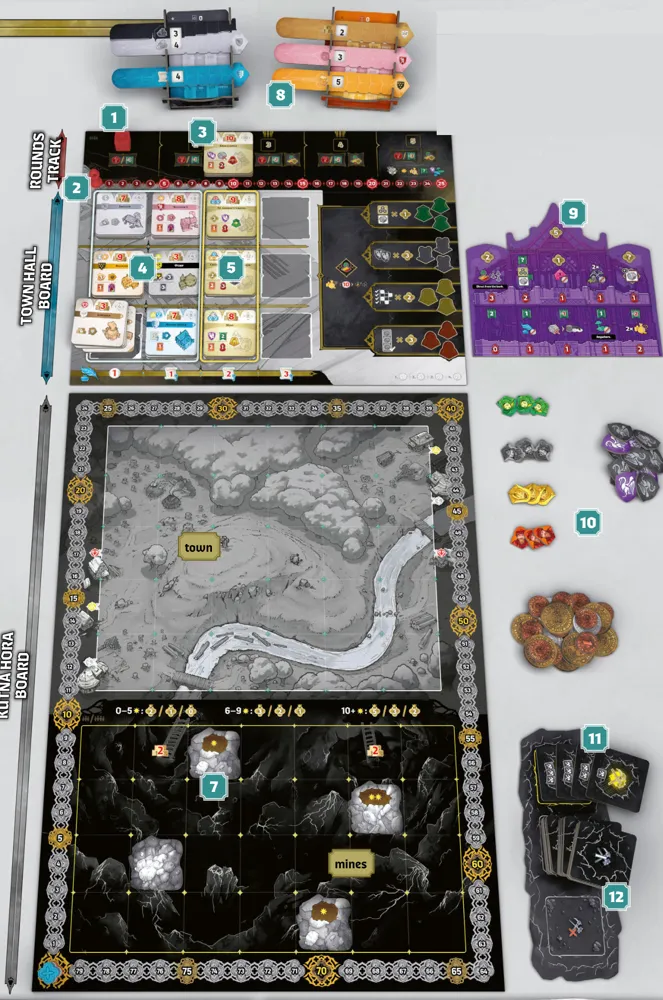
- Rounds track — rounds counter, tax track and the per-round reputation penalty
- Tax track — rises during play; everyone pays it at round end
- Red-patrician buildings — join the market mid-game
- Guild building stacks — the rights you can buy, column = price
- Public building stacks — patrician buildings anyone can build
- Mine setup card — where the rock tiles go
- Mines — the dig site under the town; stars score per row
- Card stands — the population and ore decks that set every price
- St. Barbara Cathedral — 11 bonus tiles, used in order
- Bank — coins, pelican tokens, 3 patricians of each colour
- Mining technology — how many mine tiles you draw
- Mine tile stack — tiers I, II and III
The town square above the mines is where buildings go; the score track runs round the edge. Your player board holds your houses (one row per guild), production tracks, miners, plot markers and reputation track.
A round
Each round, starting with the first player and going clockwise, everyone takes 3 turns:
| Turn | Cards you play |
|---|---|
| 1st | 2 action cards |
| 2nd | 2 action cards |
| 3rd | 1 action card (your sixth card stays unused) |
Each card shows two actions; you choose one and lose the other for this round. The actions:
 Mine,
 Rights,
 Plot,
 Building,
Income,
 St. Barbara
and the
 Joker.
At the end of the round: pay  taxes or lose reputation, resolve the
event, bring in red-patrician buildings when due, score patricians (last 3 rounds), pass the
starting player marker left and take your cards back.
How the game ends
- 4 players: after round 5. 2 or 3 players: after round 6.
- Then final scoring: city dots, mine rows, income, reputation and extras.
- Tie: most groschen left wins.
Ways to score
| Source | How and when |
|---|---|
 Building and mine effects | Points printed on a tile, scored as you build it |
| House effects | Points printed under some houses on your board, scored when you remove them by building |
| St. Barbara tiles | Tiles 6, 8, 10 and 11 give points |
 Patrician scoring | End of each of the last 3 rounds, for every patrician on the council |
 City dots | Game end: 1 per matching dot beside each of your buildings |
 Mine rows | Game end: rank by stars in each row; the board prints 1st/2nd/3rd values |
 Income | Game end: income ÷ 10, rounded down |
 Reputation | Game end: −4 to +13 by your marker’s space |
 Extras | Game end: 1 per unbuilt tile in your slots, unbuilt plot and unused pelican |
 Reputation overflow | During play: −2 per step below the bottom, +2 per step above the top |
What each resource is for
| Resource | Why you need it | How you get it | How you use it |
|---|---|---|---|
 Groschen | Pays for everything | Income action only | Wood, permits, plots, taxes, 10 for a patrician |
 Wood | Prices buildings and mines | Not a token — pay its current price in groschen | Building cost, mine cost |
 Permits | Prices rights and miners | Pay the current permit price | Rights in columns 2–4, refilling miners |
 Production | Your income per Income action | Guild buildings, mines | × current price at each Income |
| Plot markers (3) | A plot is needed to build | Plot action | Build on it, then the marker returns |
| Miners (9) | Mark your mines | 1 in your pool, the rest via permits | One per mine; the pool holds 2 |
 Pelican tokens | Fuel St. Barbara | House effects, public buildings | Flip one per St. Barbara action |
 Reputation | Cheap plots (3+), free Joker (6+), end points | Tiles, houses, St. Barbara | Lost to Joker, unpaid tax, some tiles |
| Patricians | Turn on a scoring rule for everyone | Public buildings put them in the pool | Pay 10 during Income to seat one |
Teaching tips
-
Teach the market first: build a guild building → its arm moves right → that price falls; the population and ore decks advancing make prices rise.
-
Say it twice: do not build a public building first — it gives no income.
-
Show the card pairs: picking one half burns the other for the round.
-
First game: guild setup card 1, no event cards at 3–4 players.
-
Calculate a final income of 48 to show its 4-point score; coins held do not convert the same way. Practice example.