Gameplay and Prices
Kutná Hora rounds and turns, the six double-sided action cards, how the card stands set every price, the economic-adjustment symbols and the reputation track.
Overview
Kutná Hora is played over a fixed number of rounds: 5 with 4 players, 6 with 2 or 3. There are no goods to hold: wood, permits, silver, ore, beer and food exist only as prices on two card stands and as production on your player board. You pay costs in groschen at today’s price and earn groschen from your production at today’s price.
A round
- The player holding the starting player marker takes the first turn; play goes clockwise.
- Everyone takes 3 turns: 2 cards on the first turn, 2 on the second, 1 on the third.
- When all players have played 5 of their 6 cards, the round ends.
- Everyone takes all 6 cards back and the starting player marker moves one seat left.
Your turn
Choose a card from your hand, play it face up and do one of its two actions. That card is spent until the round ends, and so is the action you did not choose. Then, on your first two turns, play a second card the same way.
Your cards are open information — anyone may look at what you still hold.
Action cards
Each player has the same 6 cards. Every action appears on two cards, except St. Barbara and the Joker, which appear once.
| Card | Top action | Bottom action |
|---|---|---|
| 1 |  Rights |  Income |
| 2 |  Plot |  Mine |
| 3 |  Building | Plot |
| 4 | Mine |  Joker |
| 5 | Income | Building |
| 6 |  St. Barbara | Rights |
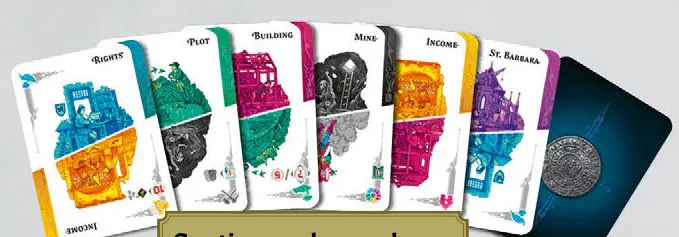
The pairs above are read from the colours of the card halves in the rulebook’s pictures; check them against your own cards. Each action is explained on The Actions.
Prices
The game has 6 commodities, each priced in groschen on a card stand:
| Stand | Commodity | Guild that produces it |
|---|---|---|
| Population (orange cards) |  Wood |  Builders |
| Population | Food |  Grocers |
| Population | Beer |  Innkeepers |
| Ore (grey cards) | Ore |  Miners (and every mine) |
| Ore | Silver |  Metallurgists |
| Ore |  Permits |  Scribes |
Each commodity has an indicator arm that starts at the far left. The visible number in the arm’s window, on the front card of its deck, is the current price.
Paying in wood and permits
When the game asks for wood or permits you pay their current price in groschen for each one.
A cost of 4 with wood priced at 3 means 12 groschen; one permit at 4 means
4 groschen.
Advancing the decks
Whenever an effect shows  or
 with a number, take that many cards
from the front of that deck, one at a time, and slide each to the back (never flip it). Every new
front card shows new prices. Any effect that raises your ore production also advances the ore
deck by the same amount.
A dynamic economy
Prices follow supply and demand:
| What happens | Effect on prices |
|---|---|
| Population deck advances (more people) | Wood, food and beer  rise |
| Ore deck advances (more ore mined) | Ore  falls; silver and permits rise |
| You build a guild building | Its commodity’s arm moves one notch right: that price falls |
| You build a silver (Metallurgists) building | Silver falls, ore rises (they share one arm) |
The Miners’ guild is the exception: its buildings raise your ore production and advance the ore deck instead of moving an arm.
Economic adjustments
Symbols on the population and ore cards:
Price just changed
 A star beside a number means that price changed with this card.
The town builds
 Demand is so high that the town builds without you. When this symbol appears,
move that commodity’s arm one notch right at once, discard the top tile of that guild’s stack on
the town hall board, move the stack to the end of its row and slide the others left. If that stack
is empty (players hold its tiles but have not built them), still move the arm.
No market
 A red X behind a price means there is no market for more of it: nobody may
build that guild’s buildings until a deck advance removes the X. Buying the rights is still
allowed.
Turn the deck over
 Halfway point: lift the whole deck out of its stand, turn it over and carry on.
The population deck runs on from 19 to 20, the ore deck from 14 to 15. A deck is never turned a
second time; if it must advance past its last card, nothing happens.
Reputation
Your reputation marker starts at 0 on your board’s track, which runs from −5 to 9.
| Your reputation | Effect during play |
|---|---|
| 3 or more | Every plot costs only 1 groschen |
| 6 or more | The Joker costs no reputation |
| At −5 and losing more |  Lose 2 points for each step you cannot take |
| At 9 and gaining more |  Gain 2 points for each step you cannot take |
At the end of the game your marker’s space scores:
| Space | −5 | −4 | −3 | −2 to 2 | 3 | 4 | 5 | 6 | 7 | 8 | 9 |
|---|---|---|---|---|---|---|---|---|---|---|---|
| Points | −4 | −2 | −1 | 0 | 1 | 2 | 4 | 6 | 8 | 10 | 13 |