The Map and Distance
Map tiles, roads and bridges, restaurant entrances, what counts as connected, and how distance and range are counted.
The map
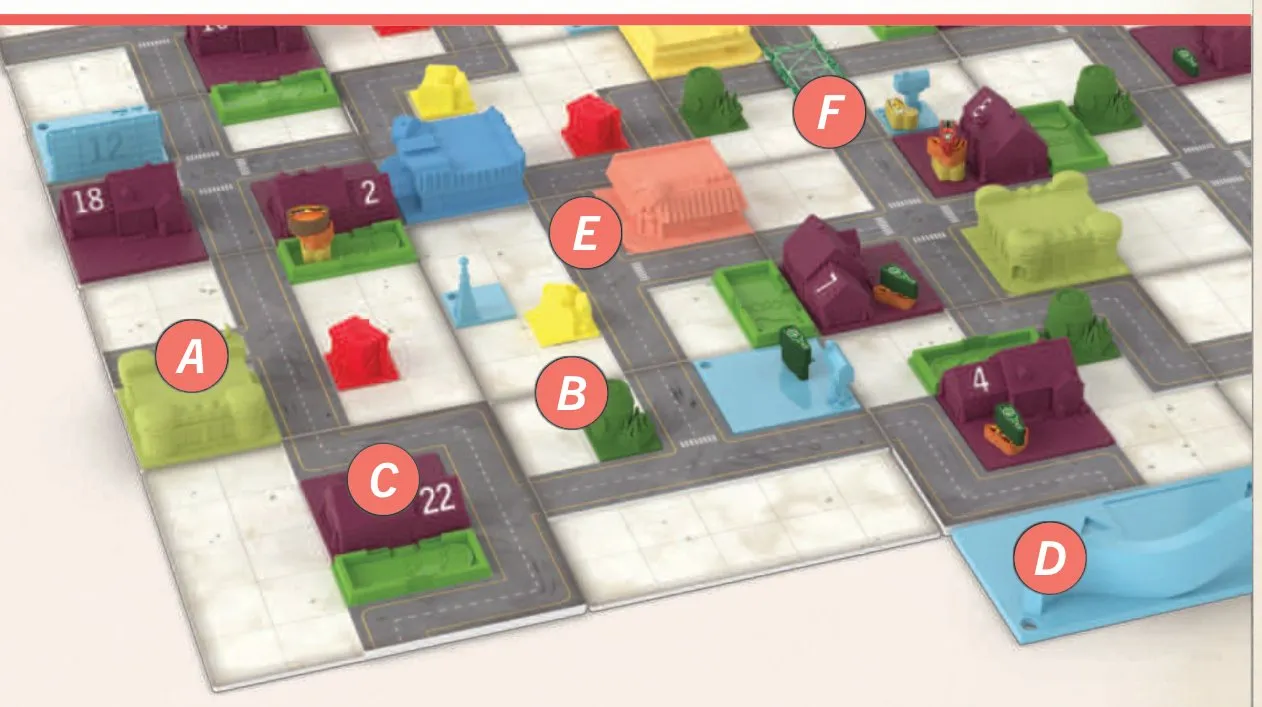
- A Restaurant: where customers buy from you.
- B Drink supplier: where your drivers collect drinks — soda, lemonade or beer.
- C House: customers live here; the food and drink counters on it are what they want (Dinnertime).
- D Marketing campaign: adds demand to nearby houses (Marketing).
- E Road: two road squares that touch across a tile border make one continuous road.
- F Bridge (overpass): two roads cross without joining.
The map is a grid of square map tiles of 5 × 5 squares. Everything else — houses, restaurants, campaigns — covers whole squares and may stretch across tiles. All 20 tiles are in Cards & Components.
Restaurants
A restaurant covers 2 × 2 squares. One corner square is its entrance corner, marked by the door. Every restaurant must be placed with that corner orthogonally next to a road (on one or both of its sides).
A restaurant connects to a road only through its entrance corner. With a drive-in (from a Local or Regional Manager) all four corners are entrances until Cleanup.
Starting restaurants
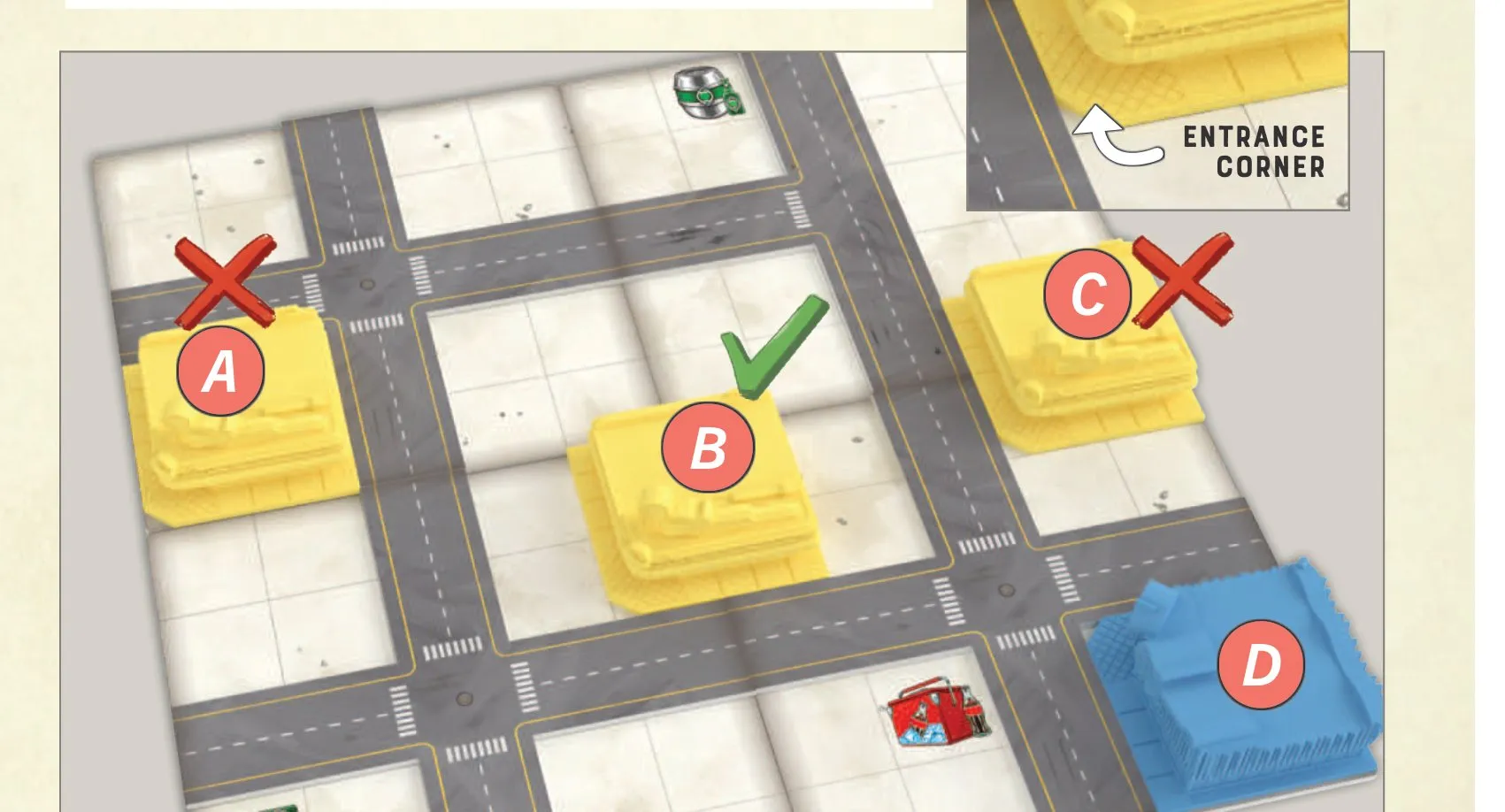
A starting restaurant:
- covers 4 empty squares (no roads, printed locations or other restaurants);
- has its entrance corner next to a road;
- may not have its entrance corner on the same map tile as another restaurant’s entrance corner. The rest of it may share a tile.
In the picture, A is illegal (entrance not on a road), C is illegal (its entrance would share D’s tile) and B is legal. The one-entrance-per-tile rule applies only at setup: later, anyone may open a restaurant right next to yours.
Connections
- Restaurants connect to a road only through the entrance corner.
- Every other location — house, supplier, campaign — connects to a road if any of its squares is orthogonally next to it. A house’s garden is part of the house.
- A location next to two separate roads connects to both.
- Two locations are connected by road if they connect to the same continuous road, at any distance.
Distance
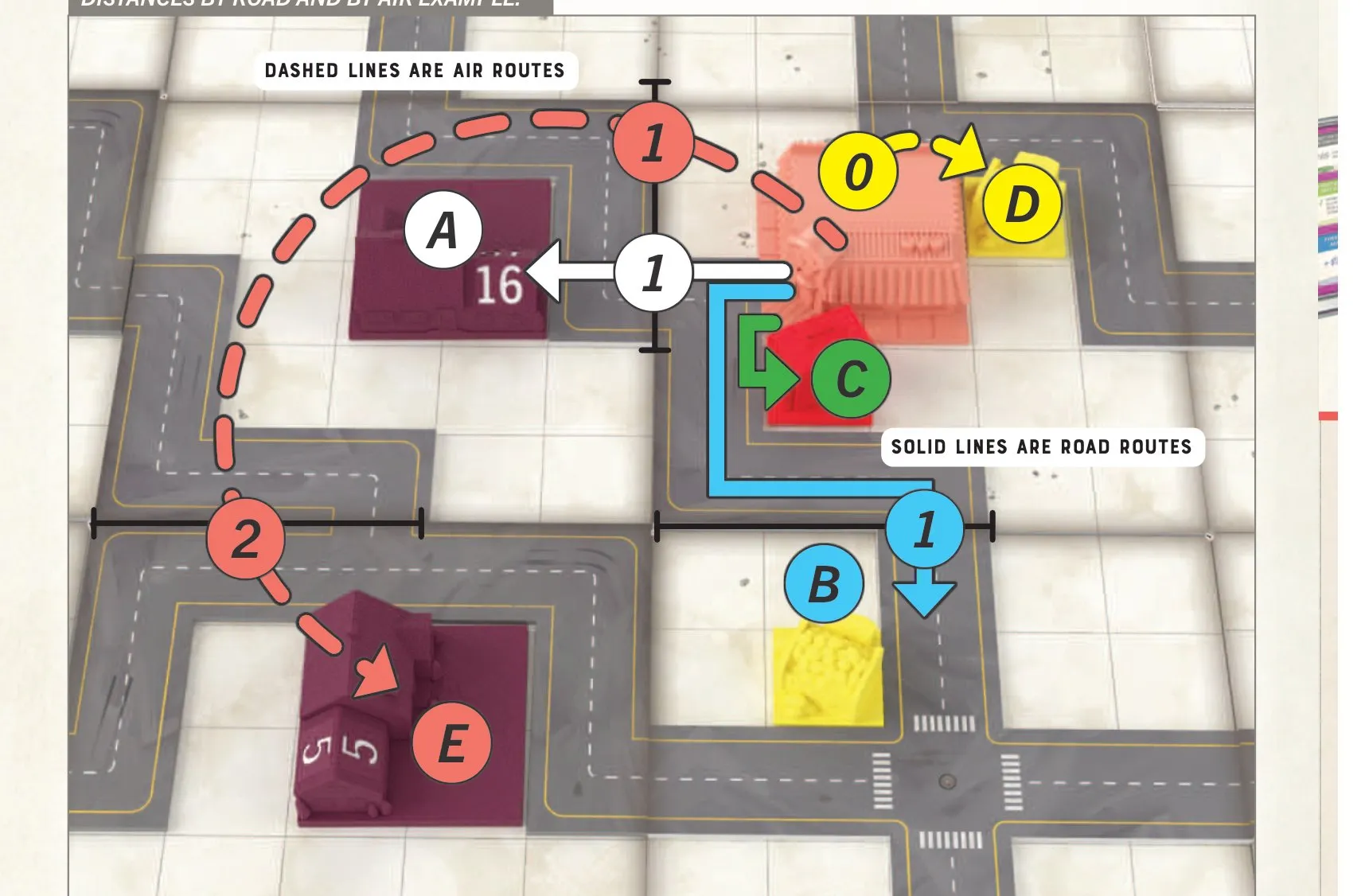
Distance is counted from the entrance corner, and only one thing counts: the number of times your route crosses into a new map tile. The number of squares doesn’t matter.
- By road: follow a road from the entrance to the target and count the tile borders you cross.
- By air: take the shortest path of orthogonally adjacent tiles, ignoring roads, and count the borders.
| From Santa Maria Pizza to | By road | By air |
|---|---|---|
| House 16 (A) | 1 | 1 |
| Lemonade (B) | 1 | 1 |
| Soda (C) | 0 | 0 |
| Lemonade (D) | impossible | 0 |
| House 5 (E) | impossible | 2 |
Range
An employee’s range (top right of the card) is the most tile borders their route may cross. Road range (the number on a highway shield) follows roads; air range (the number on a zeppelin) ignores them. ∞ means anywhere on the map.
Backtracking: a road route may go back over squares and tiles it has already used, but it may never step straight back onto the square it just came from.
If an entrance touches two separate roads, each employee who travels by road picks one of them. Two drivers may take different roads.