Departments & Donations
Carnegie Expansion #1 (Departments & Donations): A New Beginning bidding sheets, 16 new Departments, 4 New Donation tiles and three optional rules — setup changes, rules and solo compatibility.
Short tag: [D&D]
Carnegie’s first expansion holds four independent modules; add any one of them, or several, to the base game. Rules from the publisher’s expansion rulebook.
Components
| Picture | What it is |
|---|---|
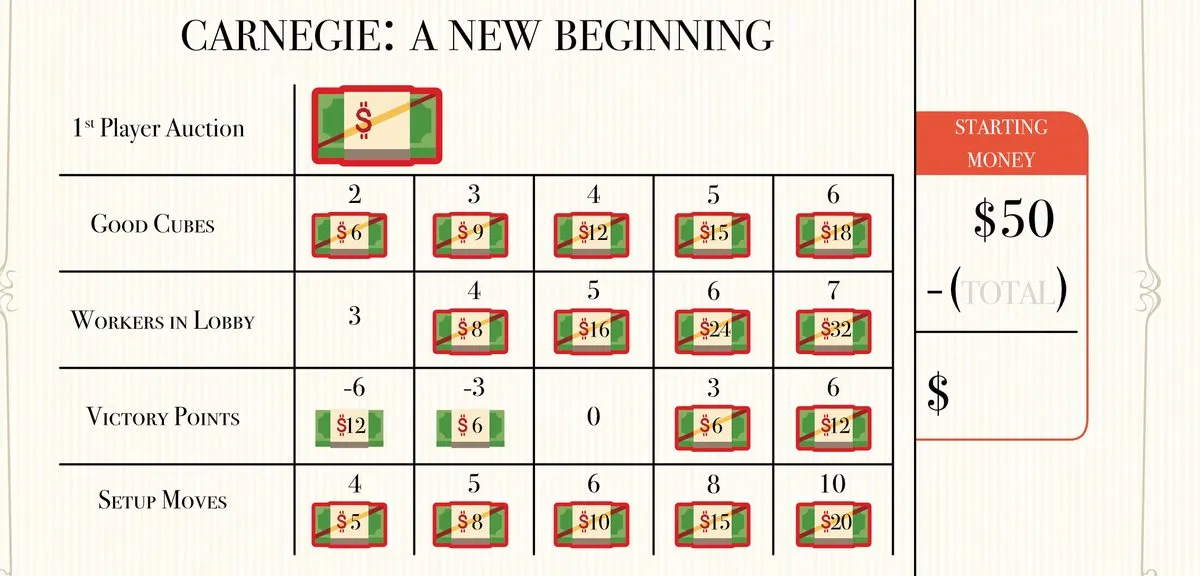 | A New Beginning — a notepad of bidding sheets. With the revised setup, resolve step 10 clockwise from the first player; negative starting VP is still subtracted from the final score (FAQ, FAQ). |
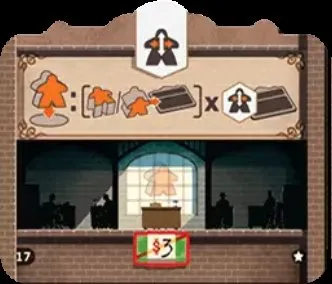 | 32 Department tiles — 2 each of 16 new Departments, numbered 17–32 and marked with a star (all faces). |
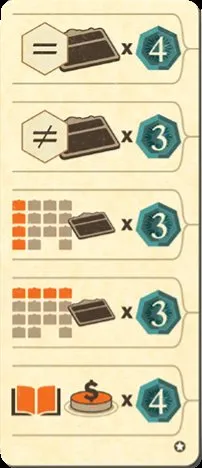 | 4 New Donation tiles (all faces, FAQ, FAQ). Each covers a printed board column, never another tile; the tile’s scoring is separate from the covered column’s donation type. |
Solo compatibility
| Module | Against Andrew |
|---|---|
| A New Beginning | Yes |
| New Departments | Yes |
| New Donations | No |
| Open Bar Setup | Yes |
| Wait Option | No |
| The Secret Donation | No |
A New Beginning
Customise your starting resources by secret bidding, for an asymmetric start.
Setup changes. Before step 6 of setup each player takes a bidding sheet and secretly chooses one option on each line, writing down its cost. The total may not exceed $50.
| Line | Choices (cost) |
|---|---|
| 1. First-player bid | Any amount |
| 2. Goods cubes | 2 ($6) · 3 ($9) · 4 ($12) · 5 ($15) · 6 ($18) |
| 3. Employees in the Lobby | 3 (free) · 4 ($8) · 5 ($16) · 6 ($24) · 7 ($32) |
| 4. Victory points | −6 (gain $12) · −3 (gain $6) · 0 · 3 ($6) · 6 ($12) |
| 5. Setup moves | 4 ($5) · 5 ($8) · 6 ($10) · 8 ($15) · 10 ($20) |
Reveal the sheets together. The highest first-player bid starts (tie: whoever spent most in total, then at random); only the winner pays the bid. Then:
- 6A — take the goods cubes of line 2 and $50 minus lines 2–5 (and minus line 1 for the first player).
- 6C — the usual 5 standing employees, plus the line 3 employees lying in your Lobby.
- 6D1 — start the score track at the line 4 value.
- Step 7 is skipped: the bid decides the first player.
- Step 11 — move your employees the number of line 5 moves instead of 6.
New Departments
Setup changes. After setup step 3 sort all 64 Department tiles into Human Resources, Management, Construction and R&D. From each type draw tiles until you have 4 different Departments, then add the second copy of each and return the rest: 32 tiles, 4 pairs per type. Then do step 4 as normal.
The 16 new Departments come in four sets (full descriptions and pictures in Cards & Components):
- Internal Specialization (17, 21, 25, 29) — Mission effects that grow with the number of Departments of the same type in your Company.
- Local Agency Networks (18, 22, 26, 30) — pick one region; gain for each project you built there.
- Improved Flexibility (19, 23, 27, 31) — ongoing effects: diagonal moves, flexible activation costs, building on any space type, cheaper transport income choices.
- Miscellaneous Achievements (20, 24, 28, 32) — final scoring bonuses, active only if an employee still stands on them at the end of the game.
New Donations
Setup changes. After setup step 10, starting with the first player and going clockwise, each player may lay one New Donation tile over any donation column printed on the board — of any type. Neutral disks on a covered column move to the same positions on the tile. Tiles may not cover other tiles.
The five conditions of each tile score at the end like normal donations (all four tiles). Each tile’s last space counts your donations in one column type (Education, Welfare, Health or Human Rights). If a tile covers another column, its conditions stay the same, while donations placed there count as the covered column type; tiles cannot cover each other (FAQ, FAQ).
Optional rules
Open Bar Setup
Just before setup step 4, take one copy of every Department — 16 base and 16 new, no duplicates — then return tiles for the player count as usual.
Wait Option
The first player — whoever holds the locomotive this round — may announce they wait: the others take their turns first and the first player goes last. Most useful on Human Resources rounds, when you can see where the others moved.
The Secret Donation
After setup each player secretly writes down one donation space: its column (1–4, left to right) and line (1–5, top to bottom). At the end, after the other donations, it scores like a donation you made. It costs nothing, doesn’t raise the price of your later donations and works even if the space is taken. Donate on that same space during the game and it scores twice.