Solo: the Id
The solo mode: the Id's components, Coffee conversions, the Compass Arrow, its State Ideas and Recall turns, Heart-Shaped Boxes, drafting, Notebook tile effects and scoring.
You play a 2-player game against the Id, an automated opponent. Learn the base game first. Setup changes are in the Setup checklist (choose Solo).
Components
| Component | What it is for |
|---|---|
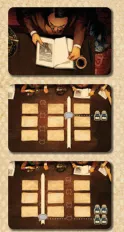 | Meeting Table cards (16) — where the Id places its Ideas; if the table stays blocked with no legal turn, you pass (FAQ). FAQ |
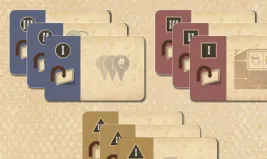 | Id Notebook tiles (9) — its engine; inactive and active sides. If its right-hand stack is empty, take the 6 VP printed there instead of a tile effect (FAQ). |
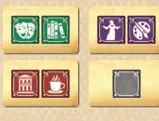 | Routine Client overlays (4) — tags that replace the effects of its Routine Clients. FAQ FAQ |
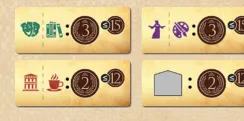 | Case-Study Client overlays (4) — scoring that replaces its Case-Study Clients’ conditions. FAQ |
 | Inkpot space overlay — covers its leftmost Inkpot space. |
 | Compass Arrow — breaks the Id’s choices. |
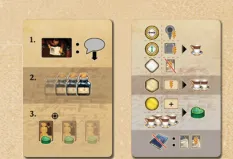 | Turn summary and conversion reference cards. |
Key concepts
The Id never uses an Insight dial. Its resource is  Coffee, which it turns into
 Heart-Shaped Boxes to treat its Clients.
Conversions
Instead of the effect shown, the Id gains:
| Effect | The Id gains |
|---|---|
| Elevate or Transfer an Insight; Generate a Minor Insight; trigger a Location effect; play a Research card it doesn’t have | 1 Coffee |
| Generate a Median Insight; trigger a standard Notebook tile | 2 Coffee |
| Generate a Major Insight; gain a Notebook tile | 1 Heart-Shaped Box |
| Fail to publish a Treatise | Draws and plays a Research card |
Whenever its Coffee reaches 4 (3 with the Strong Coffee variant) it at once pays it for a Heart-Shaped Box — mid-effect if need be. If its box track is already at 3, it scores 2 VP instead.
The Compass Arrow
 When the Id must choose among options in a row (Clients, Dreams, Treatises, goals…),
it takes the rightmost or leftmost as the arrow points, then turn the arrow around.
Other rules
- It claims every Location Goal it qualifies for during its turn (two complete columns of active tiles count).
- Research cards it gains go into a face-down hand; it plays the top one, building a row in play.
- After your first Treatise, add each new one to the left or right of your row, so the Id can cite from you with the arrow.
The Id’s turn
If it has at least two Ideas available (Bright Ideas fill in), it States Ideas; otherwise it Recalls. Then it uses its Heart-Shaped Boxes and drafts. It never takes a Treat Clients turn.
State Ideas
- Place Ideas. Reveal a Meeting Table card. The Id puts two Ideas on the target Idea space of the target column; if taken, it follows the arrow to the next empty space, looping round the column. No empty space in the column: it Recalls instead. Direction of the tails doesn’t matter — it never triggers action spaces.
- Advance the Inkpot by the Inkpot icons right of its Ideas.
- Leftmost (covered) space: move the same number again; it never triggers the Reputation track.
- Top space: trigger the unlocked column with the most active tiles (ties: the rightmost), top to bottom, plus unlocked Insight spaces.
- Lower spaces: gain 1 Coffee for the Generate, trigger the active tiles and unlocked Insight space left to right, then flip the leftmost inactive tile of the row. A third active tile in a row or column unlocks its player-color Insight into its Idea supply.
- Passing
 unlocks its leftmost Idea, or the Bright Idea on top of it.
- Any “1–4” Inkpot effect: it always moves the maximum.
Recall Ideas
It gains Coffee per different Idea space, takes its Ideas back and claims a bonus:
- A District bonus if it has a player-color Insight and the tags: the highest-value slot it qualifies for in the Districts of its Professor or Freud (ties: its Professor’s).
- Otherwise a Location bonus: the highest empty slot at its Professor’s or Freud’s Location (ties: its Professor’s).
Heart-Shaped Boxes and drafting
At the end of every turn it spends all its Heart-Shaped Boxes: on one Client, or alternating between two, starting with the one the arrow picks. When a Client reaches Catharsis, put the top overlay of the matching kind on it. It drafts Routine Clients into its Primary room and Case-Study Clients into its Secondary room, using the arrow, and takes the Manifest Dream with the most Therapy points.
Id Notebook tile effects
| Tile | The Id… |
|---|---|
| Research swap | Draws a Research card, swaps it with a face-up card (arrow), and plays it plus any cards in its hand. |
| Research and Treatise | Draws and plays a Research card, then tries to publish. |
| Publish | With an unlocked player-color Insight: publishes with its own in-play cards (fewest tags first), else citing yours only as needed; most VP wins, ties by arrow. Failing: draws and plays a Research card. |
| Professor | Moves to Freud’s Location; if already there, 1–2 Locations to where it triggers most (ties: first clockwise). 1 Coffee per effect. |
| Freud | Moves Freud 1–3 Locations to where it triggers most (ties: first clockwise). 1 Coffee per effect. |
| Location Goal | Takes a goal from an end of the row (arrow) without meeting it, gaining Reputation; none left: a Reputation point. |
| Top Notebook row | Discards the rightmost tile of the display’s top row: its banner effect, 1 Coffee, refill. |
| Bottom Notebook row | Same with the bottom row: banner effect, 2 Coffee. |
| Dream | Triggers one of its top Dreams for free (arrow if two), Therapy to that Client, discard; matching icon: a Heart-Shaped Box. |
Difficulty
Easy: top-left Id tile active, Case-Study overlays low side. Medium: whole left column active and its player-color Insight freed, low side. Hard: as Medium, high side. Strong Coffee (any level): 3 Coffee per Heart-Shaped Box.
Final Scoring
Score the Id as a player, with its overlays. Beat it to win; on a tie you need the higher Reputation.