Teach the Game
A table-ready explanation of Quacks, its nine market days and all ways to score.
How you win
“You are quack doctors mixing remedies. Draw ingredients to move farther around your pot, stop before too many cherry bombs burst, then use the rewards to improve your bag. After nine rounds, the player with the most points wins.”
The boards
The shared scoring track also tracks the nine rounds and each player’s rat-tail handicap. Each player has a spiral pot, a droplet that marks their starting point, a flask that can return a safe final white chip, a rat stone, a bag, and a score marker. Ingredient books explain the effects and prices of the recipe sets. The cauldron’s last reached space is the scoring and shopping space.
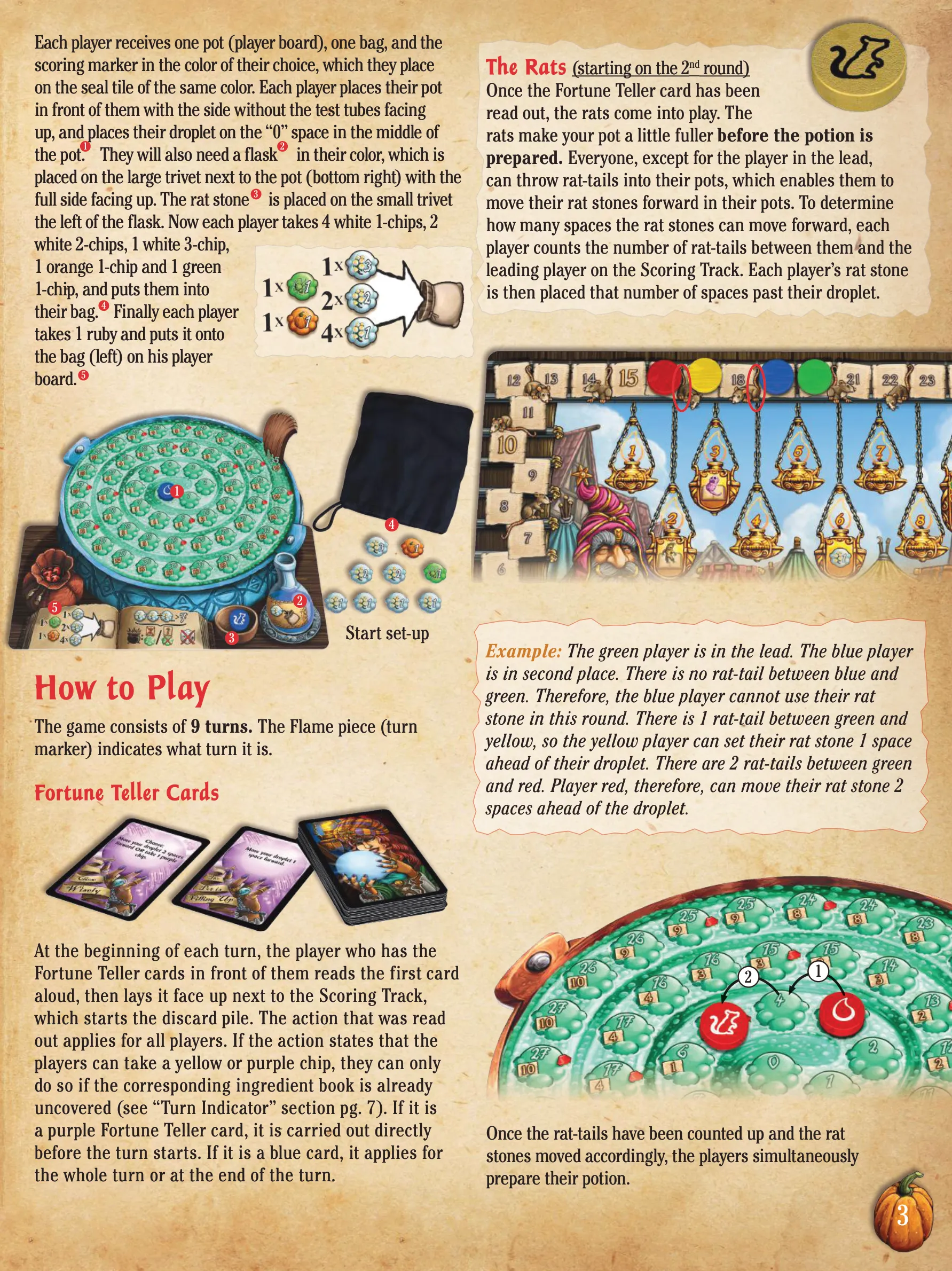
- Pot and droplet — your chips advance from the droplet or rat stone.
- Flask — once per round, return a safe last white chip.
- Rat stone — compensates players behind the leader.
- Starting bag — the exact nine initial chips.
- Ruby — begin with one; spend rubies between rounds.
A round
Reveal and resolve a Fortune Teller card for everyone. From round 2, use the rat-tail distance to move each trailing player’s rat stone beyond their droplet. Then everyone draws from their own bag at the same time (or in turn order if preferred), placing each chip according to its value. Stop voluntarily or keep risking an explosion. Blue, red and yellow effects happen as drawn; green, purple and black effects generally wait for scoring, as their books specify. Resolve scoring, then buy up to two chips of different colors and return the chips to their bags. Rubies can move droplets or refill flasks.
How the game ends
After the ninth scoring and shopping phase, spend remaining rubies or coins to buy points at the printed exchange rate. Most points wins. Tied players compare how far their pot reached in round 9; if still tied, the rules allow a shared win.
Ways to score
| Source | What scores |
|---|---|
| Scoring-space points | The printed points at the space after your final chip. Exploded pots choose these or shopping money. |
| Ingredient-book effects | Green, purple and black recipes give the particular rewards printed in the selected book. |
| Fortune Teller cards | Some award or change points for the current round; resolve their timing as printed. |
| Bonus die | The furthest non-exploded pot rolls; ties at the same scoring space also roll. The last space reached in the pot can roll if not exploded. |
| Final exchange | In round 9, spend 5 coins or 2 rubies per point, repeatable. |
What each resource is for
| Resource | Use |
|---|---|
| Ingredient chips | Build the bag and advance through the pot; white chips also create explosion risk. |
| Coins | Buy up to two different-colored ingredients each round. Unspent coins are lost. |
| Rubies | At round end, two move the droplet one space or refill the flask. They can also buy final-round points. |
| Flask | Once per round, return a last white chip that did not cause an explosion. |
| Rat stone | Gives trailing players a temporary head start based on the score-track gap. |
| Victory points | Determine the winner after nine rounds. |
Teaching tips
- Explain that all players draw from separate bags and may stop at any time after a placement.
- Only white-chip values count toward the 7 threshold; other colors do not.
- The chip that causes an explosion remains in the pot. An exploded player chooses either points or shopping money.
- Effects are timing-specific: follow each ingredient book, and do not resolve post-brewing effects during the draw.
- Use the numbered setup callouts and show the ingredient set’s book faces before players fill their bags.