Rounds, Movement and Visibility
Character selection, Manhattan terrain, the Informant and the appeal for witnesses.
This guide uses the original English2009 rules and matching component artwork. The game is a separate, complete game from Mr. Jack in London; London’s Extension does not apply here.
The board
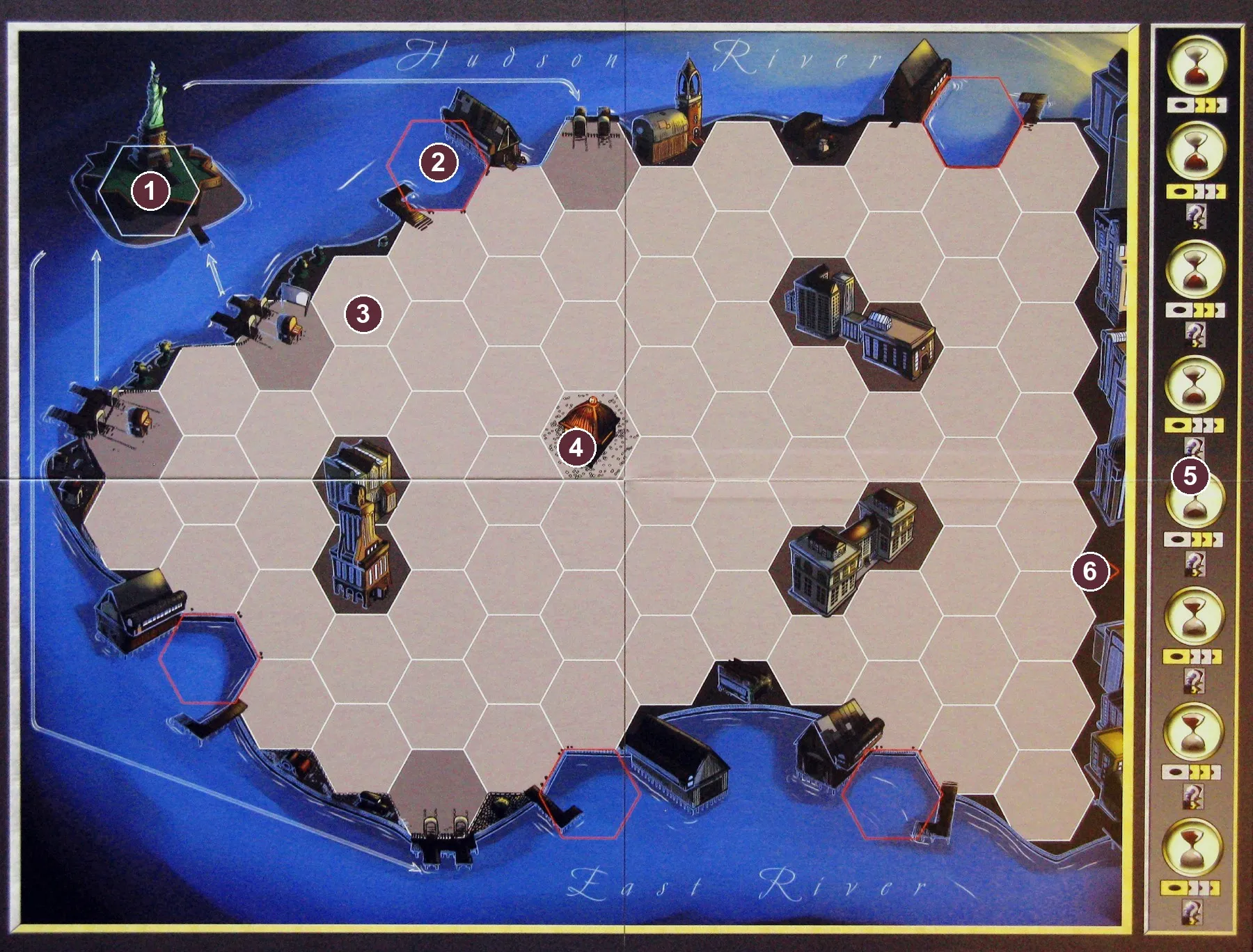
- Liberty Island — always invisible, with directed ferry routes.
- Ports — a Steamer makes a sea escape available.
- Street spaces — ordinary movement and new construction.
- Metro entrances — the printed central station and placed entrances link together.
- Round track — eight rounds; read the track from bottom to top.
- Land exit — a second way for Jack to leave Manhattan.
Activate characters
Each round uses four different Character cards. Each player controls two activations, including characters who are innocent or belong to the opponent’s plans.
| Round | Reveal | Activation order |
|---|---|---|
| Odd: 1, 3, 5, 7 | Shuffle all eight cards and reveal the first four | Detective → Jack → Jack → Detective |
| Even: 2, 4, 6, 8 | Reveal the remaining four | Jack → Detective → Detective → Jack |
Complete each character’s movement and power before the next activation. Turn its card face down afterwards. Do not reshuffle after an odd round: every character appears exactly once in each pair of rounds, and at most four times in the game.
Movement
 Each selected character moves 1–3 spaces, ending somewhere different from its starting space. Powers are described on the character page.
- Characters may pass through other characters but normally cannot finish on them. The exception is the Detective making an accusation.
- Buildings, Building sites and Gaslamps block movement. Cloud Rider has a specific exception for Buildings and Building sites.
- Investigation tiles block their two covered spaces for everybody.
- Parks, street spaces, quaysides and Metro entrances can be occupied.
- If completely trapped, a character stays put but must still carry out a mandatory power. Being unable to move does not cancel that power.
Metro entrances
From an entrance, spend one movement point to reach another entrance. This can be part of a longer move. You may use an occupied entrance if you continue through it; the normal restriction on ending on another character still applies. An Investigation tile makes a covered entrance unusable until uncovered.
For visibility, an entrance behaves like a street space, including the printed central station. It does not conceal its occupant. FAQ
Liberty Island
Follow the printed arrows: the two routes to the island and the two routes from it are directional. Crossing one arrow costs one movement point; there is no stopping point halfway along an arrow. You may continue moving after reaching the island if points remain.
Characters on Liberty Island are always invisible. Nothing may be built there and Investigation tiles cannot cover it. It is not itself an escape exit. An accusation there is legal. FAQ
Ports and the land exit
Steamers occupy the red port spaces. Jack alone may board a Steamer or leave by the land exit, and only if the Witness card currently shows Invisible. Reaching a port without a Steamer does not allow escape. Investigation tiles can block access; see the escape conditions.
Visibility
Check the character’s current position:
- A character in a Park is always invisible, even beside a Gaslamp or another character.
- Otherwise, it is visible when adjacent to a Gaslamp, or adjacent to another character who is outside a Park.
- If neither condition applies, it is invisible. The Informant is not a character for this check.
A Park blocks seeing in both directions. A lone unlit character next to somebody in a Park is still invisible. Metro entrances do not have this protection. Liberty Island is always invisible. FAQ
Appeal for witnesses
After all four activations, Jack honestly announces whether his secret character is visible or invisible. Turn the Witness card to that side.
The Detective clears all characters with the opposite status: flip those tokens to Innocent without moving them. A cleared character remains innocent for the rest of the game but is still activated normally and can affect visibility.
Leave the Witness card unchanged during the next round. It records Jack’s status at the previous appeal; moving Jack into light mid-round does not remove escape permission already earned.
The Informant
A Talkative Informant gives information when a character ends its move on his space. That character replaces him. Put the Informant Mute side up on a different empty street space, Metro entrance, quayside, Park or Liberty Island, outside an Investigation area. Then the player controlling the activation privately draws and keeps an Alibi card.
An Alibi identifies an innocent character. The Detective can rule that character out; Jack can take an Alibi too, denying that information to the Detective. Jack’s secret identity is already removed from the Alibi deck.
You may pass through the Informant without consulting him. Ending on his Talkative side requires consultation and ends movement; no movement remains afterwards. You cannot finish on his Mute side, though you may pass through it. At the start of a round, turn a Mute Informant back to Talkative. FAQ
The Informant does not make adjacent characters visible, cannot be swapped by Tumblety, and cannot be covered by an Investigation tile.
End of a round
After the appeal, advance the round marker. Refresh the Informant if Mute. After even rounds, gather and shuffle all Character cards for the next odd round. After round eight, a free Jack wins; see Game End and Scoring.