Teach the Game
A first-print teaching script for ARDEVUR: The Game of Resources.
How you win
You are a mining corporation building an operation across Africa and Europe. Explore territories, activate mines, turn their output into money, and build the infrastructure and assets that help your business grow. When the final round ends, the player with the most
Supremacy Points has Total Control.
The core loop is: gain resources from active mines, invest through a limited Development-card market, and turn your achievements into points or rewards. Balance immediate money and points against investments that make future turns more productive.
This guide follows Version 12, the September 2025 first-print rules. The designer later announced substantial revisions before the crowdfunding release; confirm the final edition and altered cards before treating this as current. See the Cards & Components gap list.
The boards
The Map Board divides the playable area into eight regions and 24 mining territories, with ports for exporting. Your Dashboard tracks your Corporation’s cards, money, structures and storage; the Character Guide summarizes its advantages and scoring. The two Market Organisers hold shared money, resources, card decks and discards. The Target Grid shows public Bronze, Silver and Gold objectives.
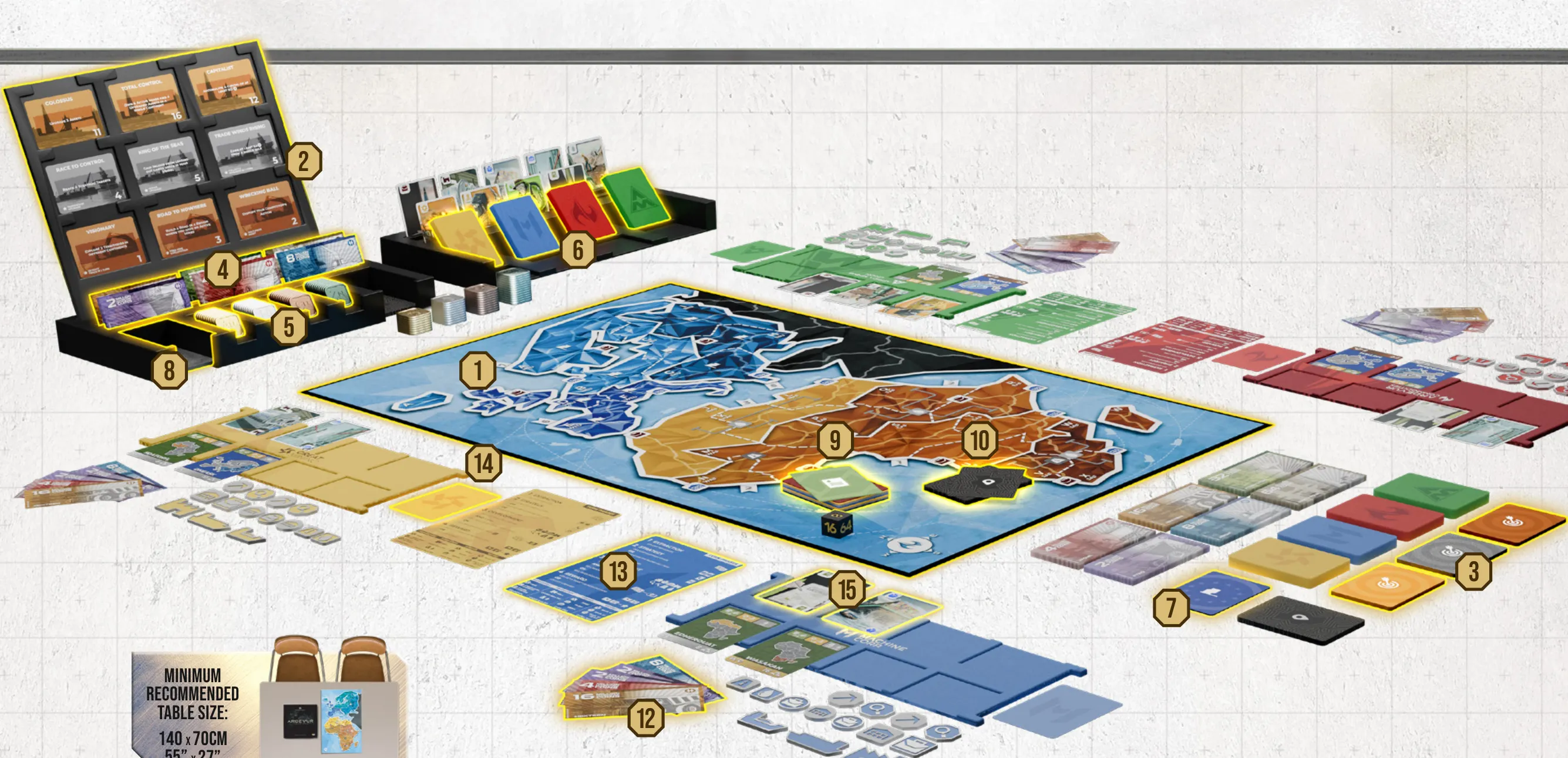
Use the setup checklist to match the printed numbers to each shared and player component.
A turn
- Extraction: collect output from eligible
 Active Mines, up to storage. Resolve surplus locally.
- Strategy: choose
 Development cards, an Action card, or a temporary
 Phone Call.
- Development: take one build or development action, or sell locally. A global export uses this phase instead of development.
- Reward: take one eligible Target or Incentive, redeem a held card, or shift a Target with Phone Call.
Players complete their whole turn before the next begins. The phase order cannot change; a skipped phase is lost. Read the detail pages for development, sales and rewards.
How the game ends
Any player may call Total Control when a Gold Target has been claimed, after all Bronze and Silver Targets are gone and no Gold can be claimed for a full round, or when a player holds at least 24 points in Targets and Incentives. Every player then receives one final turn, and Action cards stop. See Game End and Scoring.
Ways to score
| Source | Points |
|---|---|
 Strategic Targets and  Government Incentives kept | Their printed value. |
Most  Hashtag Coins | 4; tied leaders get none. |
| Most resource value | 4; tied leaders get none. |
 Regional Supremacy | The region’s printed value, if you lead its control total. |
| Each Active Mine | 4. |
Each standard  Warehouse,  Office or  Vessel | 4. |
Each upgraded Asset, including  Factory | 8. |
What each resource is for
| Piece or resource | Why it matters | How you get or use it |
|---|---|---|
| Hashtag Coins | Starting capital and payment for costs. | Start with 32 million; earn them from sales and effects. |
 Resource tokens | Mine output, sale goods and some fees. | Extract them, store them on  Territories and sell them for their nominal value. |
| Development cards | Permits for exploration, exploitation and construction. | Draft one or two from the shared market in Strategy. |
| Action cards | Corporation-specific tactical powers. | Draw one in Strategy, subject to the hand and use limits. |
| Territory cards | Permits and sites for mining. | Win two in the opening dice auction; a second auction can add more. |
| Targets and Incentives | Supremacy Points or one-time rewards. | Claim at the end of a qualifying turn; redeeming a card gives up its points. |
| Mines, Assets and Infrastructure | Produce, store, manage and move resources; add final points. | Build them with permits and money during Development. |
Teaching tips
- Explain the four turn phases first, then teach the rules for each when the first player reaches it.
- Point out the hand limit and the shared Development-card market before players make their opening choices.
- Show how each mine advances in two turns; African infrastructure and the
 Road requirement are easy to overlook.
- Agree on Standard or Fair Play before setup. Action cards change both the tone and the card objectives.