The Four Departments
Algae, Inc. department by department — Biofuel, Bioplastics, Cosmetics and Food: starting storage, machines, byproducts, upgrades and export rules from the department guides.
What every department shares
Each department has its own board, side board, tiles and contract cards, all marked on the back with its icon. The department guides show the exact setup. Common to all four:
- Income upgrades — three science tiles give +2 algae, +2 moves or +2 science on Monday. Income upgrades
- Machine capacity — three engineering tiles raise any machine to 3 (Cosmetics 4); the engineer team upgrade flips them all to 4 (Cosmetics 5). Machine upgrades
- Conveyor belt upgrade — on Machine A or B: 2 free main-belt moves in the next machine.
- Transport science tile — transport drops from €1/3/6 to €0/1/3.
- Two-player rule — the two departments must make different byproducts: Cosmetics or Biofuel together with Bioplastics or Food.
| Department | Makes | Byproduct it makes | Starting storage |
|---|---|---|---|
 Biofuel | Biofuel (one product, refined) |  biomass |  red algae, 6 |
 Bioplastics | Cups and bags |  bio-oil |  spirulina, 4 |
 Cosmetics | Hand soap, toothpaste, skin cream | biomass |  chlorella, 6 |
 Food | Burgers, drinks, wakame, nori | bio-oil |  brown algae, 6 |
Biofuel
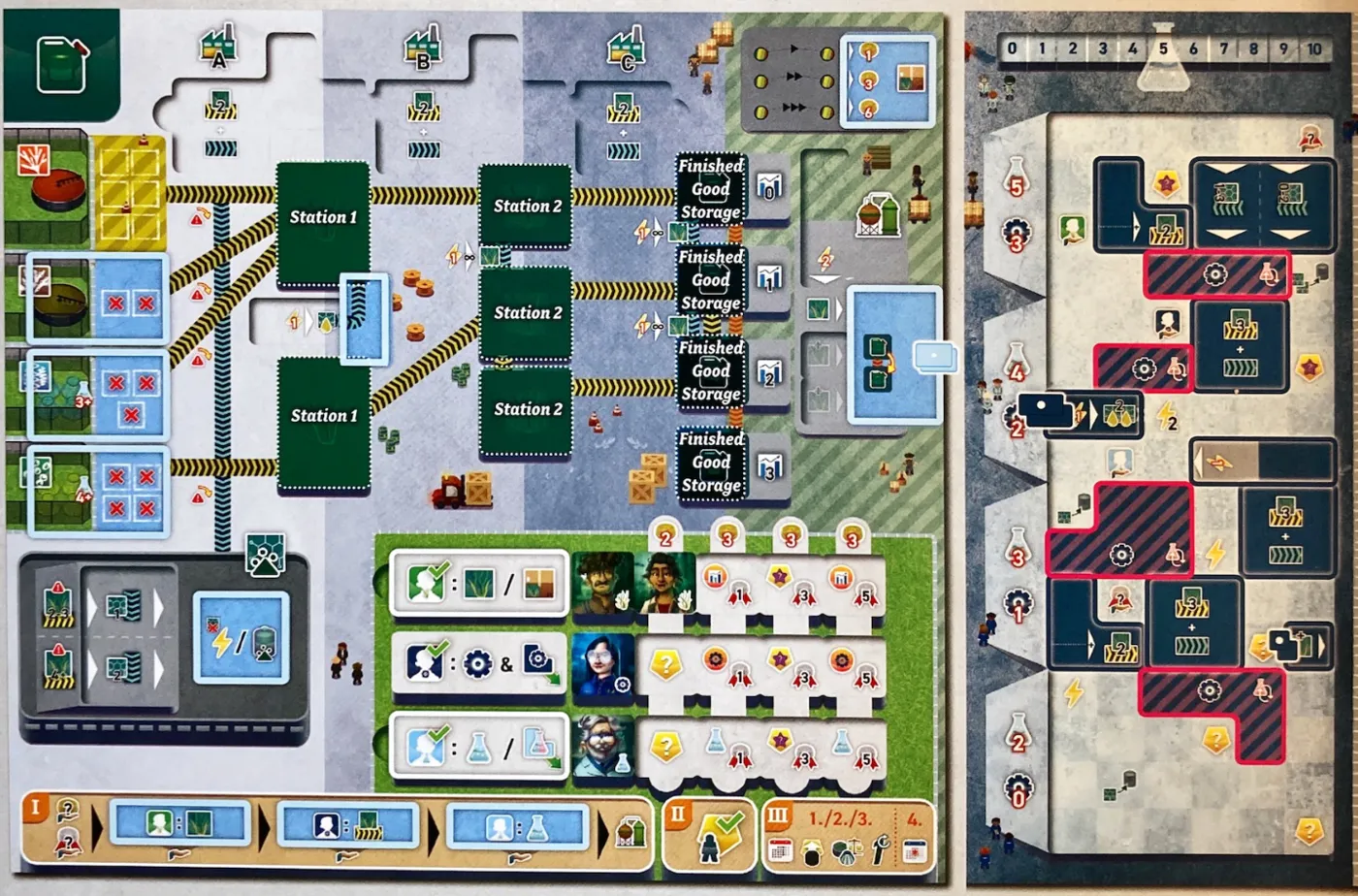
One product, biofuel, made easily but only valuable once refined — and it eats energy. Unless you use chlorella, all biofuel starts at the lowest quality.
Biofuel storage
| Storage tile | Opens storage for | Minimum cost |
|---|---|---|
| Brown algae | 2 cubes | — |
| Spirulina | 3 cubes | 3 science |
| Chlorella | 4 cubes | 4 science |
Biofuel machines
| Machine | Without upgrades | Upgrades |
|---|---|---|
 A | 2–3 cubes moved: 1 becomes biomass; 4+: 2 become biomass. | Engineering: choose 0–2 (2–3 moved) or 1–3 (4+ moved). Science: each byproduct gives 1 energy and is stored. |
 B | Pay 1 energy: add 1 bio-oil to the connected Station 1 (needs a cube in Station 1). | Engineering 1/2: 2 or 3 bio-oil for 1 energy. Science: bio-oil goes to the bottom Station 1, which makes better fuel. Science: pay 1 energy per cube to move it from the upper Station 2 to the one below, as often as you like. |
 C | Pay 1 energy per cube to move it from the upper finished good storage to the one below, as often as you like. A main belt also links the 2nd and 3rd finished good storage. | — |
Refining
At the end of each Monday Morning you may do one refining: pay 2 energy to move one finished
biofuel cube down one step along the  refining belt, to the next, more valuable
storage. This is the only way to reach the 3-value storage.
| Upgrade | Refining becomes |
|---|---|
| Engineering 1 | Costs 1 energy |
| Engineering 2 | Moves up to 2 cubes |
| Engineering 3 | Moves up to 3 cubes |
| Science 1 | Each cube may move up to 2 steps |
| Science 2 | Each cube may move up to 3 steps |
Bioplastics
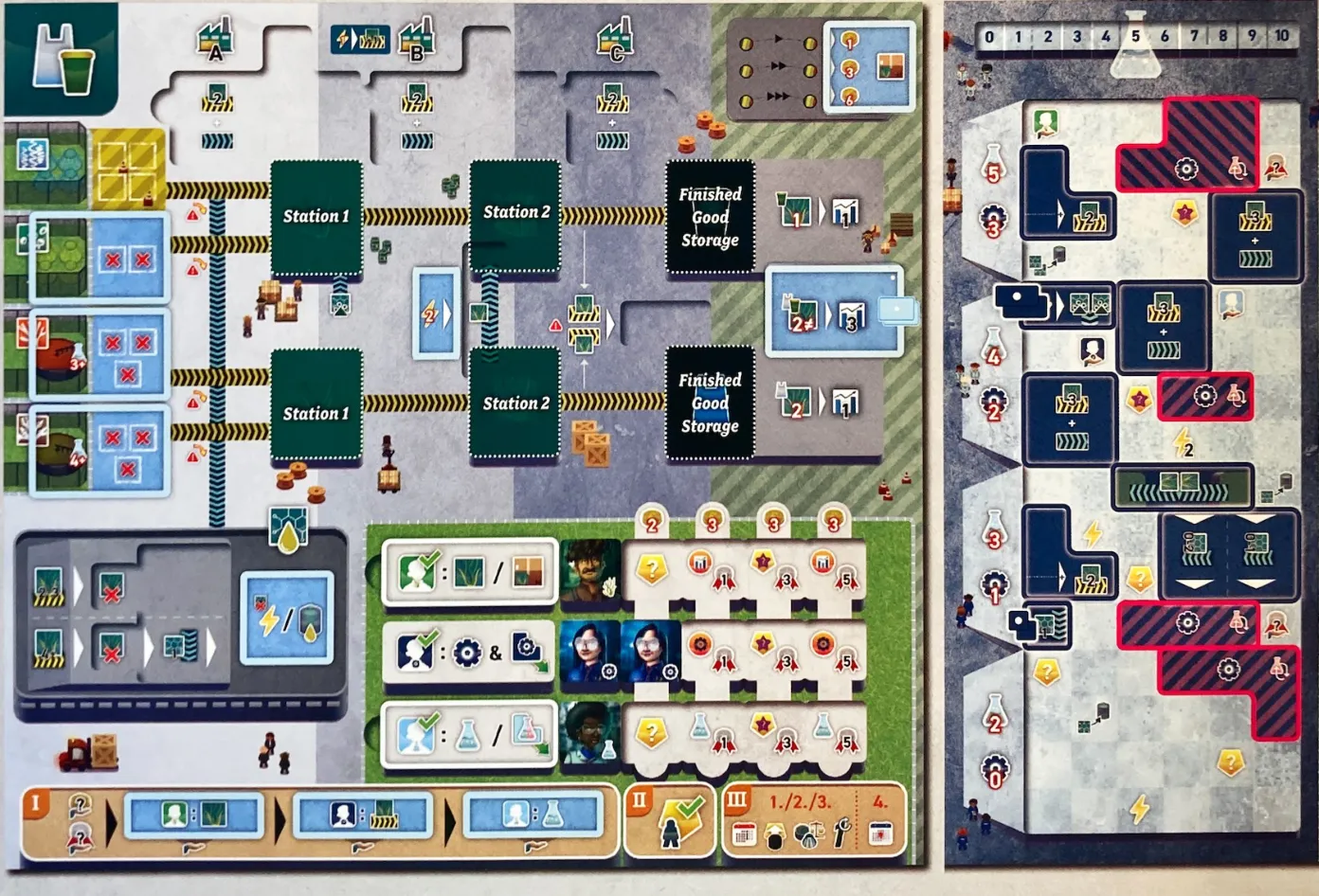
Two production lines, cups and bags. Each alone is worth little; a cup + bag pair is worth much more. Run both lines together — that is also how you use byproduct best.
Bioplastics storage
| Storage tile | Opens storage for | Minimum cost |
|---|---|---|
| Chlorella | 2 cubes | — |
| Red algae | 3 cubes | 3 science |
| Brown algae | 3 cubes | 4 science |
Bioplastics machines
| Machine | Without upgrades | Upgrades |
|---|---|---|
| A | 2–3 cubes moved: return one to the supply (not byproduct). 4: return one and convert one to bio-oil. | Engineering 1: convert to bio-oil instead of losing it. Engineering 2: may convert 1 extra (2–3 moved) or up to 2 extra (4 moved). Science: each byproduct gives 1 energy and is stored. You always lose at least one cube when moving 2 or more. |
| B | Pay 2 energy to move 1 cube between the two stations, either direction (once per activation; does not use capacity). Pay 1 energy for +1 capacity. Add 1 biomass to the connected station, even if empty (needs a cube in either Station 1). | Engineering: 2 energy moves up to 2 cubes. Science: the move costs only 1 energy. |
| C | Nothing extra. | Engineering 1/2: when cubes travel on both main belts, pay 1 energy to add 1 or 2 biomass to the bags storage. |
Bioplastics exports
Each cup on its own is worth 1 and each bag 0; every cup + bag in a city’s delivery is worth 3, rising to 4 and 5 with the two market-value science tiles.
Cosmetics
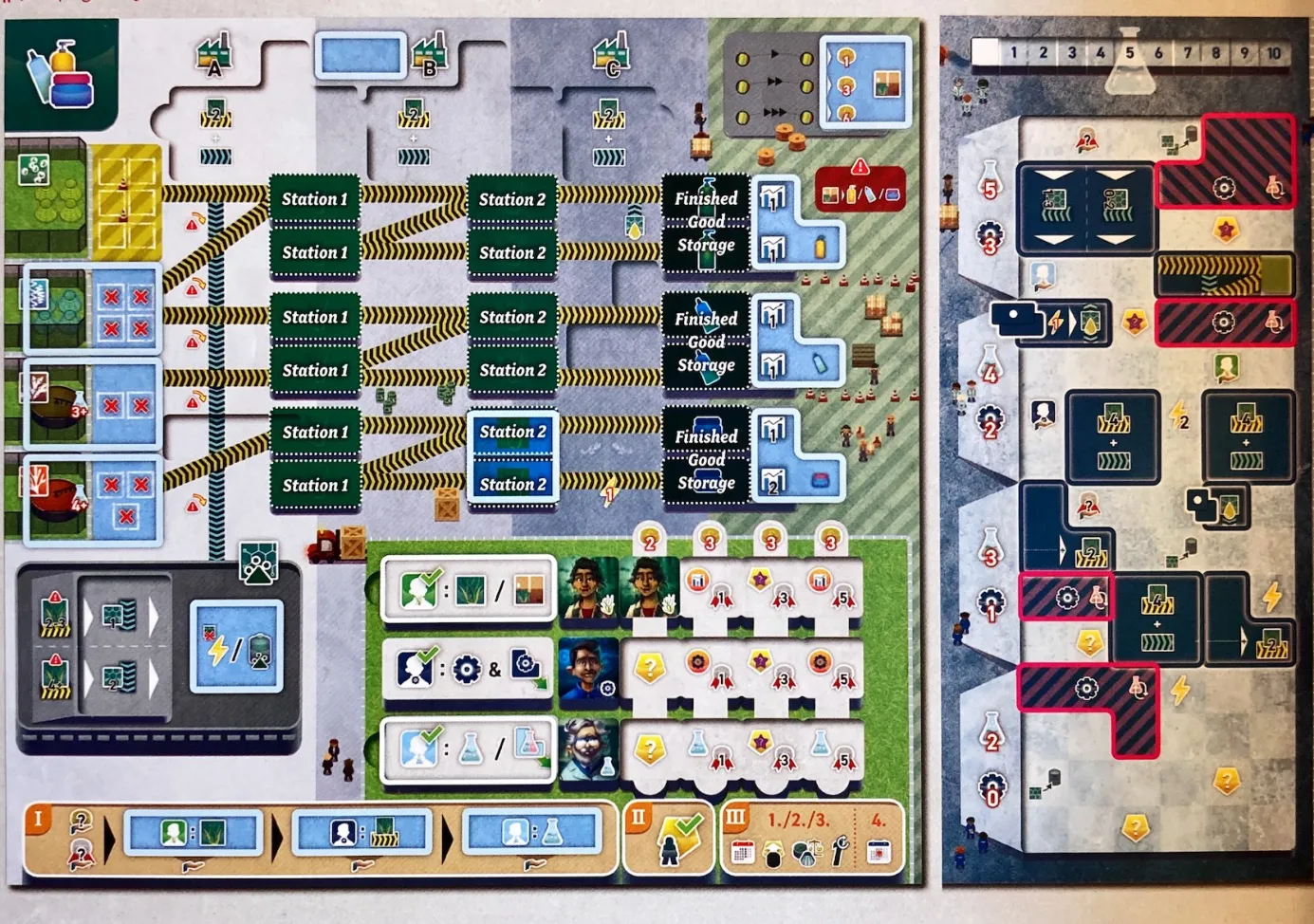
Hand soap, toothpaste and skin cream: the longer a product is processed, the more it is worth. The longest belts, but the highest capacity (4, then 5).
- Hand soap takes bio-oil easily — but only the cheapest soap. Valuable soap is processed longer, without byproduct.
- Toothpaste from brown algae is worth more than from spirulina at no extra time.
- Skin cream is worth up to 3 a jar; the best cream costs energy in the last step.
Cosmetics storage
| Storage tile | Opens storage for | Minimum cost |
|---|---|---|
| Spirulina | 4 cubes | — |
| Brown algae | 2 cubes | 3 science |
| Red algae | 3 cubes | 4 science |
Cosmetics machines
| Machine | Without upgrades | Upgrades |
|---|---|---|
| A | 2–3 moved: 1 becomes biomass; 4+: 2. | Engineering: choose 0–2 or 1–3. Science: byproduct gives energy and is stored. |
| B | Nothing extra; cubes may loop back from Station 2 to the next level of Station 1 (each step uses capacity). | Science: pay 1 energy for +1 capacity. Science: pay 1 energy to move a cube from an upper to a lower space, as often as you like, when activating B or C. |
| C | Cubes becoming hand soap may take 1 bio-oil (free of capacity). The best skin cream belt always costs 1 energy when any cube uses it — even on Monday — however many cubes move. | Engineering: add 1–2 bio-oil to toothpaste; pay 1–2 energy to add 1 bio-oil to one of the next two toothpaste belts; an extra main belt lets brown algae become skin cream. With the right tiles one cube can take 3 byproduct. |
Cosmetics exports
Each city’s delivery must be one product type only: all soap, all toothpaste or all cream. Different cities in the same action may get different products. Three market-value science tiles raise the values.
Food
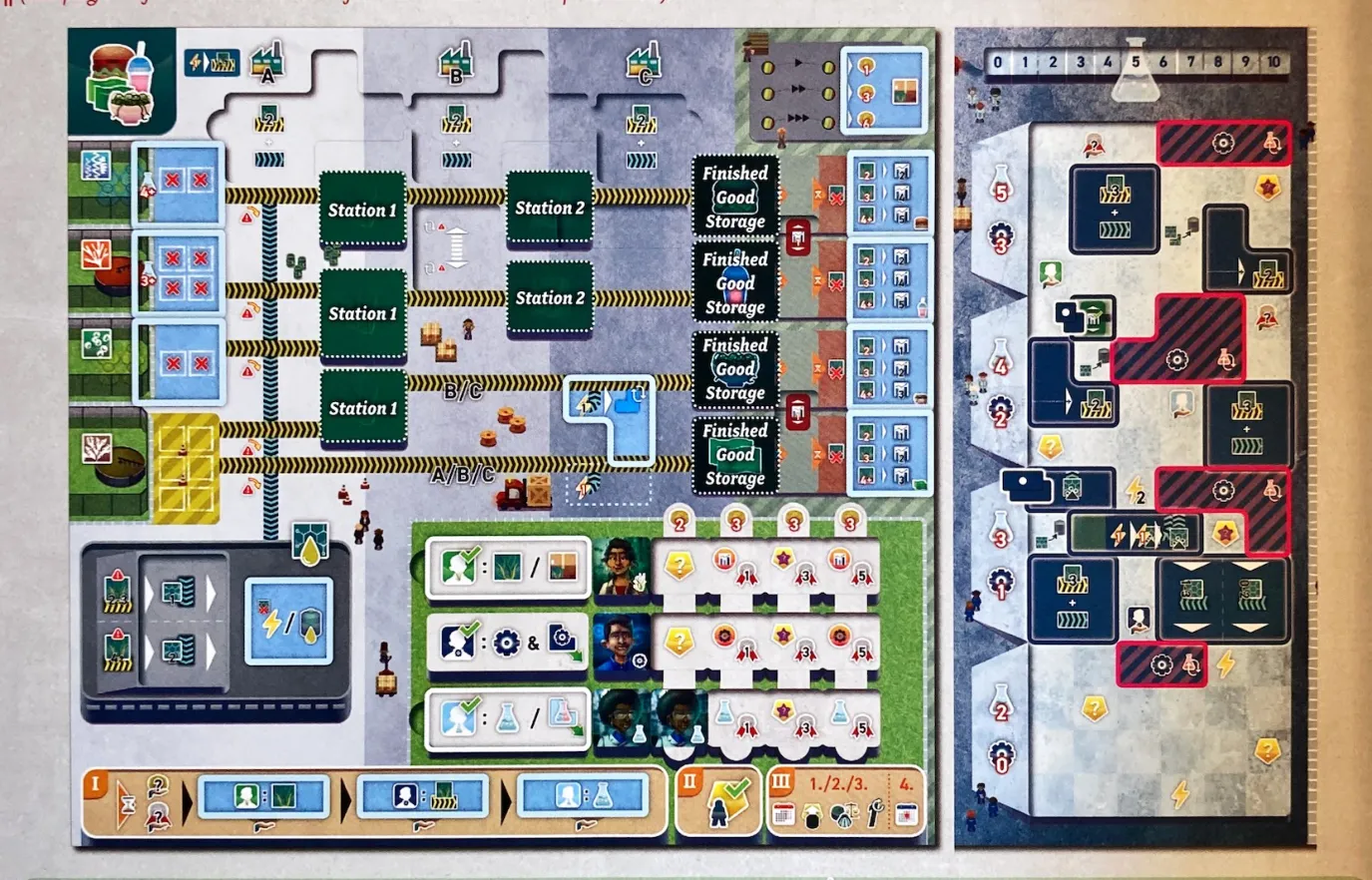
Four foods: burgers and drinks (more valuable), wakame and nori (cheaper). Each is made differently, and unsold food goes off.
- Nori is fastest: any machine activation (A, B or C) moves cubes along the nori belt, straight from storage to finished goods.
- Wakame needs Machine A first, then B or C to finish.
- Drinks and burgers go through all three machines; burgers take more byproduct.
Food storage
| Storage tile | Opens storage for | Minimum cost |
|---|---|---|
| Spirulina | 2 cubes | 4 science |
| Red algae | 4 cubes | 3 science |
| Chlorella | 2 cubes | — |
Food machines
| Machine | Without upgrades | Upgrades |
|---|---|---|
| A | 2–3 moved: 1 becomes bio-oil; 4+: 2. The same applies when B or C moves cubes on the bottom belt from storage. Pay 1 energy for +1 capacity (it counts for the byproduct total). | Engineering: choose 0–2 or 1–3. Science: byproduct gives energy and is stored. |
| B | Nothing extra. | Engineering 1 (a flip tile): when a cube travels the connected main belt, add 1 biomass to it, then slide the tile to the other belt. Engineering 2: both tiles stay, no more flipping. |
| C | Nothing extra. | Engineering: pay 1 energy to add 1 biomass to a cube becoming a burger (free of capacity). |
Wakame and nori flip tile
An L-shaped science tile starts in position A and flips between A and B after every machine activation in which a cube passes along the wakame or nori belt.
| Belt | Position A | Position B |
|---|---|---|
| Wakame (Machine B or C) | +1 energy | +2 energy |
| Nori (any machine) | −1 energy | −2 energy |
Moving on both in one activation: gain first, then pay. Removing this tile freezes the current values. It only works with a machine activation, never with Monday moves.
Degrading food
At the start of each week, before income, every unexported food cube moves one step right:
fresh food  degrades; food that had already degraded spoils and goes back to the
supply. When you export, subtract 1 market value if any degraded burger or drink is included, and
1 if any degraded nori or wakame is — then add tokens as usual. Two engineering tiles cancel these
deductions (food still spoils).
Food exports
You may mix food types for one city and add their values: 2 burgers (2) + 2 nori (1) = 3.