Teach the Game
A script to read aloud: how you win, the boards, a round, the end, every way to score and what each resource is for.
How you win
India, 1981: the licence era is ending and four industrial houses race to build the country’s new economy. Over seven rounds you win the rights to industries, build plants across the map, buy into your rivals’ companies and court the government. At the end, the house that is both the richest and the most famous is the Tycoon.
There are two scores that can win the game, and a third that only breaks the deadlock:
| Measure | What it is | How you mostly get it |
|---|---|---|
 Asset Value (wealth) | Counted only at the end | Built Industry cards, opponent shares, the Finance and Transport tracks |
 Influence (fame) | Tracked all game on the track round the map | Building, buying shares, Politics, Advertising, Policies, end-game cards |
 Favor (government backing) | Hidden tokens plus end-game sources | Politics, National Projects, Policies, your secret Corporate Agenda |
- If one player leads both Asset Value and Influence, they win outright.
- If two different players lead them, only those two compare Favor. The higher Favor wins; a tie is a shared win.
- So Favor is worthless to a player who leads neither measure — say this twice at the table.
The boards
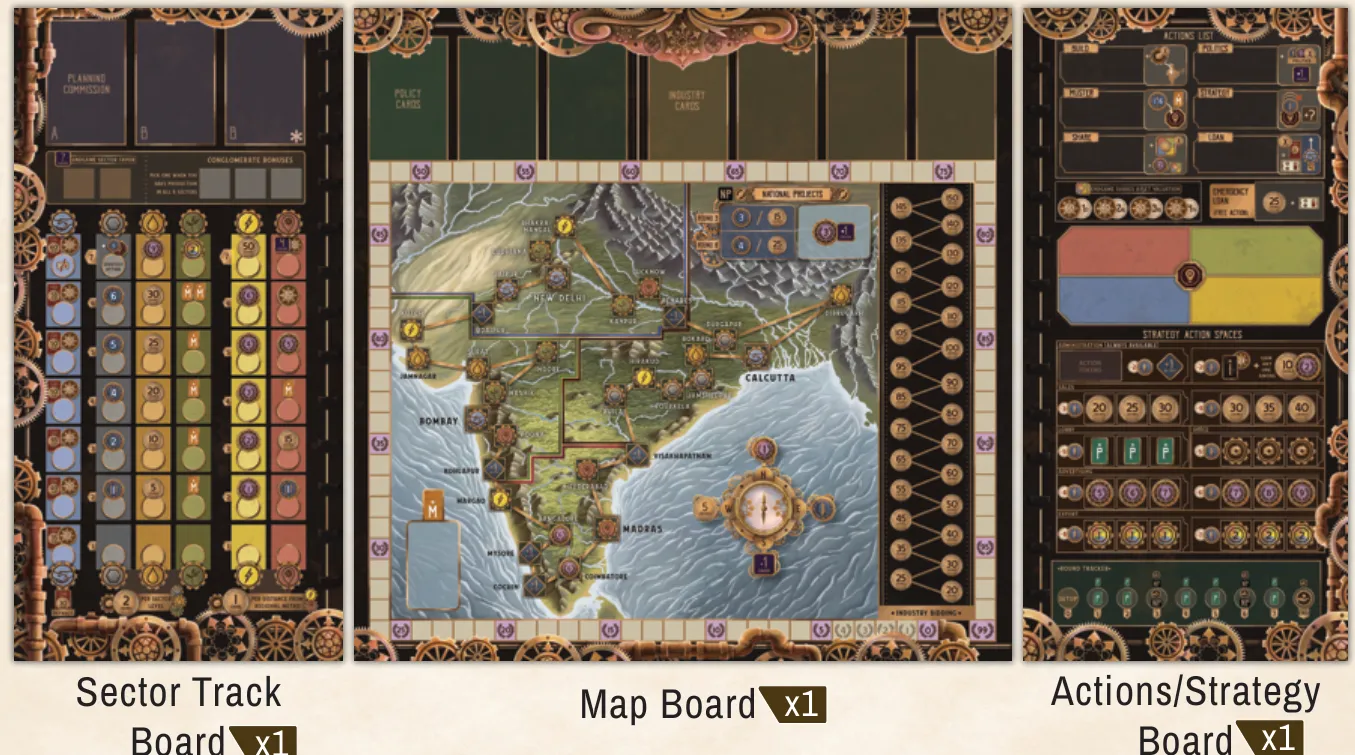
- Map board (centre). India in four regions of 8 cities each, joined by one golden road. Each region has a metro (Bombay, New Delhi, Calcutta, Madras) and a bonus on the compass; each city has a one-time bonus. The Influence track runs round the edge. The Policy and Industry decks and their open cards sit above the map. (Map and region bonuses)
- Sector Track board (left). Six production tracks —
 Finance,
 Minerals,
 Fuel,
 Agro,
 Power,
 Transport — numbered 1–7, each with its own bonuses. The highest disc on a track is that sector’s leader and is paid when others build. Above them: 3 Planning Commission cards, the 2 Endgame Sector Favor tokens and the Conglomerate Bonuses. (Sector tracks)
- Actions/Strategy board (right). The six action spaces, the Strategy spaces, the Industry bidding track and the round tracker. (Actions)
- Your area. A Player card with your 9 shares stacked 30 → 70, 8 discs, 9 plants, 2 action tokens and a screen hiding your money, Promoters, Favor and Merit cards.
A round
Seven rounds, each with four phases. Every phase is finished by everyone before the next starts.
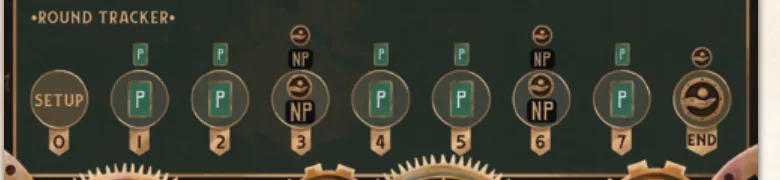
- Activate a region. The Tycoon moves the pawn to a different region. Everyone gains that region’s bonus once per plant they have there. (Phase 1)
- Round event. Rounds 1, 2, 4, 5, 7: a secret Promoter bid for one of two open Policies. Rounds 3 and 6:
 Revenue and Dividends, then
 National Projects. (Phase 2)
- Bid for Industries. An open money auction, exactly twice round the table. The top two bidders each pay and take an Industry card; everyone else gets 3 Promoters in their Strategy Pool. The top bidder is next round’s Tycoon. (Phase 3)
- Take actions. One action per turn, round the table, until everyone has used their 2 tokens (3 for the Tycoon) or passed. The six actions: Build, Share, Muster, Strategy, Politics, Loan. You can’t repeat an action in a round unless you spend a
 +1 Action token. (Phase 4)
How the game ends
After round 7 the marker reaches END: one last Revenue and Dividends, then each player may repay Promissory Notes at 50 Cr each. Score Asset Value, then Influence, and Favor only if the two leaders differ. (Endgame scoring)
Ways to score
| Source | Measure | When |
|---|---|---|
| Built Industry cards (printed Asset Value) | | End |
| Opponent shares — 60 / 40 / 20 / 10 Cr each by the owner’s Industry rank | | End |
| Finance track (20–100) and Transport track (30 at level 6, 50 at 7) | | End |
| Merit cards that give Asset Value | | End |
| Each unpaid Promissory Note | −50 and −7 | End |
| Influence track position | | All game |
| Building (Industry card), Share action (2 per opponent share held), Advertising, Politics, region and track bonuses | | When gained |
| National Projects: 3 Influence + 1 Favor per unit bought | | Rounds 3 and 6 |
| 3 Planning Commission cards | | End |
| Industrial Policies | | End |
| Favor tokens (Politics, National Projects, cards) | | Only for the two contenders |
| 2 Endgame Sector Favor tracks: 1 Favor per level | | Only for the two contenders |
| Policies (printed Favor worth) and your Corporate Agenda | | Only for the two contenders |
What each resource is for
| Resource | Why you want it | How you get it | How you use it |
|---|---|---|---|
 Money (Crores, hidden) | Industries, buildings and shares all cost money | Start 150 Cr (Tycoon 130); Revenue and Dividends; Loans; Sales; Fuel track; region West | Bid for Industries; pay sector leaders to build; buy shares; repay notes at the end |
 Promoters in hand (hidden) | Policies are bought with them | 7 minus your starting Influence; Politics; region East; Policies on offer; Minerals track | Secret Policy bids; Muster into your pool; National Projects |
 Promoters in your Strategy Pool | Strategy actions only take pool Promoters | Losing a Policy bid; not winning an Industry; Muster | Pay for Strategy spaces (2–7 each) |
 Industry cards +  plants | Asset Value, Revenue, track steps and Influence | Industry auction; Administration “buy an Industry” | Build in an empty city; a plant waits on the card until then |
 Shares | Your own: cover Strategy spaces. Opponents’: dividends and Asset Value | Share action (always the cheapest of that player) | 15 Cr dividend each in rounds 3, 6 and END; end-game value by owner’s rank |
| Influence | Half of the win, and it breaks every bidding tie | See above | Lead the track at the end |
| Favor (hidden) | Settles the game between the two leaders | Politics (+1 every time), South region, National Projects, cards | Count only if you lead one measure |
 Merit cards (hidden) | One-shot boosts | Muster (always 1); Agro track; some Policies | Play at the time printed on the card |
 Promissory Notes (public) | Fast cash | Loan action; Emergency Loan (free, up to 25 Cr) | Repay 50 Cr each at the end or lose 50 Asset Value and 7 Influence |
| +1 Action tokens | A fourth (or fifth) action, even a repeat | Administration Strategy space; Policies; Merit | Spend on your turn for any action; discard after |
Teaching tips
- Open with the win condition and its trap: Favor only matters to a player who leads Asset Value or Influence.
- Teach the sector leader idea before the Build action: whoever is highest on a track is paid when anyone builds with that sector, and pays nothing themselves.
- Point out that nobody leaves an auction empty-handed: lost Policy bids go to your own Strategy Pool, and players without an Industry get 3 Promoters there.
- Walk one Build from the rulebook example aloud: Refinery in Nashik, Minerals leader at level 3 = 6 Cr, Power 2 cities from Bombay = 2 Cr. (Worked example)
- Leave the [Headlines] module out of a first game (Headline Cards), and keep the scoring page open for the end — it has many steps.
Rehearse a Policy bid
Use the four-player example: Yellow bids zero promoters, Red two, Green one and Blue two. Green is the Tycoon. Blue beats Red because Blue is higher on their shared Influence stack. Blue pays two promoters to Green and takes a Policy, including any promoter already on it. Red’s two and Green’s one go to their own Strategy Pools; Yellow transfers nothing.
Ask everyone to point out the difference between personal supply and Strategy Pool before returning these practice pieces.