Solo and 2 Players: AIPL
The AIPL automated opponent: setup, difficulty decks, its standing rules and what it does in each phase, plus solo with two AIPL.
How the AIPL works
Tycoon is built for 3–4 players. With fewer, AIPL (“Automaton India Private Limited”, a government company) fills the table so the game always plays like a 3-player game: 1 AIPL with 2 humans, 2 AIPL in solo. The humans carry out its moves.
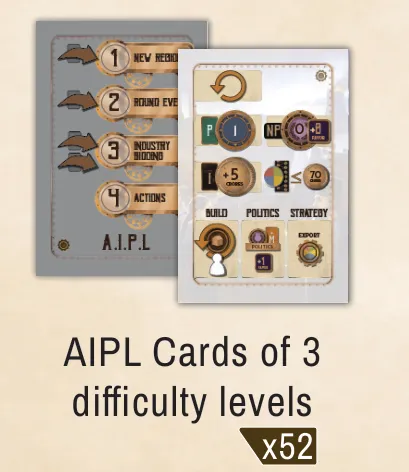
The 52 AIPL cards have 1, 2 or 3 gears on the back: 18 level-1, 18 level-2 and 16 level-3 cards. Each card has an instruction for each of phases 1–3 and a row of actions for phase 4.
Setup with AIPL
- Set up a normal 3-player game, but remove the 3 Planning Commission B cards about leftovers: Promoters in hand, Promoters in the Strategy Pool and money in hand.
- Build each AIPL’s deck from the difficulty tables; shuffle it face down by its player area.
- Give the AIPL a colour, a seat and its pieces: Player card, 8 discs, 9 plants, 9 shares (30–70).
- Start player: a human — an AIPL can’t be the first Tycoon, though it can win the role later.
- Starting Influence: in its turn it takes the highest Influence space still free, and gets no Promoters.
- Starting Policy: the one whose Politics bonus gives it the most Influence; on a tie, the leftmost.
- Corporate Agenda: one drawn at random, kept hidden.
Difficulty decks
Two players — one 36-card deck:
| AIPL level | Level 1 | Level 2 | Level 3 |
|---|---|---|---|
| Microenterprise | 18 | 18 | 0 |
| Small Business | 18 | 10 | 8 |
| Corporation | 12 | 12 | 12 |
| Industry Giant | 4 | 8 | 14 |
Solo — two separate 18-card decks, one per AIPL:
| Your level | Deck A (L1 / L2 / L3) | Deck B (L1 / L2 / L3) |
|---|---|---|
| Entrepreneur | 18 / 0 / 0 | 0 / 18 / 0 |
| Magnate | 12 / 6 / 0 | 6 / 6 / 6 |
| Tycoon | 6 / 12 / 0 | 0 / 6 / 12 |
| Balanced Twin | 6 / 6 / 6 | 6 / 6 / 6 |
| Legendary | 3 / 7 / 8 | 3 / 7 / 8 |
When a deck runs out, shuffle its face-up pile into a new deck.
AIPL rules
| Situation | The AIPL… |
|---|---|
| Money and Promoters | Has unlimited amounts, keeps none and never spends any. If it would take money from a human, that human pays the supply; if it would pay a human, the human takes it from the supply |
| Strategy Pool | Never adds or removes Promoters; can always take a Strategy space it is told to |
| Merit cards | Keeps them face down and never plays them; each is worth 10 Asset Value at the end |
| Influence and Favor | Gains them like a human |
| Choosing an Industry | Takes the highest Asset Value (leftmost on a tie); unbuilt cards go in a row to the left of its Player card, newest on the left |
| Choosing a Policy | Takes the one with the best Politics Influence (leftmost on a tie) |
| Strategy spaces | Covers the leftmost free space of the type shown, with its cheapest share, then gains the bonus if it can |
| Sector steps | Moves like a human and gains the bonuses |
| Wild sector steps | Into the leftmost of the 2 Endgame Favor sectors; if that is blocked or full, the other; if both are, it skips |
| Conglomerate bonus | The one with the most Influence |
| Choosing an opponent (Policies) | The one with most Asset Value; ties to higher Influence |
| Scoring | Like a human: Asset Value, Influence, Favor and its Agenda |
| Never | Takes Muster or Loan, or is affected by Headline cards |
Phase by phase
Whenever the AIPL must decide in phases 1–3, flip the top card of its deck face up and follow that phase’s line.
| Phase | What to do |
|---|---|
| 1. Region | Only if the AIPL is Tycoon: flip a card and move the pawn as shown (for example “next region clockwise”, or “nearest region anticlockwise with the most AIPL plants”) |
| 2. Policy bid | After the humans reveal, flip a card: the AIPL bids the Promoters shown |
| 2. Revenue | It just collects and pays (using the supply for humans) |
| 2. National Projects, round 3 | Don’t flip: draw the top card and set it aside face down |
| 2. National Projects, round 6 | Draw another card; the AIPL gains the better Influence + Favor of the two cards; discard both |
| 3. Industry bid | Flip a card on each of its bidding turns. The number is an increase over the current bid, never a total. Starting as Tycoon: lowest open Asset Value + the number. It passes if the number is 0 (unless it opens) or if the current bid is above the card’s limit. If it passes on the first lap it doesn’t bid again |
| 4. Actions | Flip nothing. It uses the actions on its current face-up card, left to right, one per turn, skipping any it can’t do, and marks them with its action tokens on the card. Once they are used or impossible, every remaining action is Politics — the only action it may repeat |
Action instructions
| Instruction | The AIPL… |
|---|---|
| Build in the metro | Builds in the active metro; if taken, in the first empty city clockwise from it |
| Build in a named region | From the active metro, follows the road anticlockwise to the first empty city in that region |
| Share of least Influence | Buys the cheapest share of the opponent lowest on Influence |
| Share of most built Industries | …of the opponent with most built Industries (tie: lower Influence) |
| Share of highest-valued share | …of the opponent whose next share costs most (tie: lower Influence) |
| Strategy: Sales | Covers the leftmost Sales space and gains nothing |
| Strategy: Lobby | Covers the leftmost Lobby space and takes a Policy by its Policy rule |
| Strategy: Office | Covers the leftmost Office space and places a plant where its Build line says |
| Strategy: Advertising | Covers the leftmost Advertising space and gains the Influence |
| Strategy: Export | Covers the leftmost Export space and takes a wild step |
| Strategy: Administration (Industry) | Takes the open Industry with the most Influence or Asset Value, as the card says, and puts a plant on it; no 10 Cr / 2 Influence bonus |
| Politics | Gains Influence and Merit cards from its Policies’ Politics bonuses, plus 1 Favor token |
Solo
Set up a 3-player game with two AIPL, A and B, each with its own 18-card deck from the solo table. Run both by the same rules. Each AIPL is an opponent of the other as well as of you, for shares, Policies and every “opponent” choice.