Teach the Game
A table-side script for teaching Panamax: goal, board, a turn, the end, scoring and what everything is for
This guide follows the original 2014 English (USA) rulebook by MESAboardgames and Stronghold Games, the only edition of Panamax published so far.
How you win
A century after it opened, the Panama Canal is still the shortcut between two oceans. Each of you runs a shipping company in the Colón Free Trade Zone: you take cargo contracts from China, Europe and both US coasts, load the cargo onto ships and push them through the locks. Three rounds, about two hours. But the company is not you — the winner is the player with the biggest personal fortune, not the richest company.
- What you need: personal money at the end — cash, shares sold at the final price, your best two Financial Advisor bonuses and any Managing Director Awards.
- How you get it: your company earns money by shipping cargo (Ship arrival); a healthy company pays you dividends on its shares and pushes its share price up (Shares and dividends). Ships that reach the ocean also pay you bonus cards or cash, and moving warships pays you directly.
- The trap: company money left at the end is worth nothing, and a company that cannot pay its fees or dividends costs you dearly.
The boards
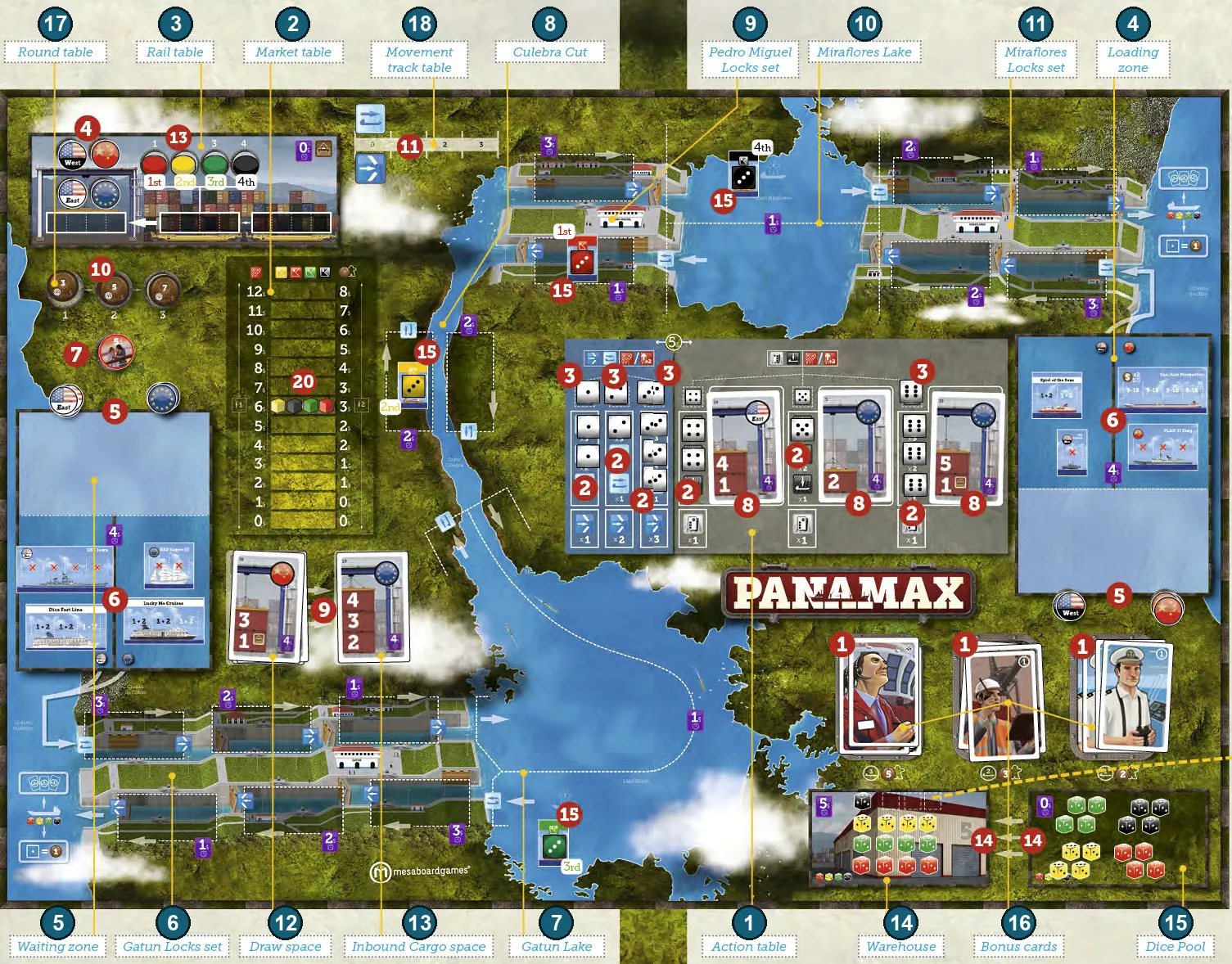
- Action table — the white dice you draft: blue side moves ships, grey side takes contracts and loads cargo
- Market table — each company’s share price (left) and the dividend it pays per share (right)
- Rail table — cargo by train; at round end it sets turn order and hands out flags
- Loading zones — one per nation, two on each ocean; ships here take cargo from that nation’s contracts
- Waiting zones — empty ships that reached an ocean wait here for a new load
- Gatun Locks — the Atlantic locks; locks and the Culebra Cut hold at most 4 ship slots
- Gatun Lake — a lake: no size limit, groups may split here
- Culebra Cut — the narrow channel between the lakes, treated like a lock
- Pedro Miguel Locks — the first Pacific lock
- Miraflores Lake — the second lake
- Miraflores Locks — the last locks before the Pacific
- Draw space — the face-up Contract deck
- Inbound Cargo space — the next contract, which refills the Action table
- Warehouse — your unused cargo dice; each one costs $5 at round end
- Dice Pool — dice back from delivered cargo, free to store
- Bonus cards — Financial Advisor, Stevedore and Captain piles
- Round table — the three Managing Director Awards ($3, $5, $7)
- Movement track — markers to count the lock and waterway moves you still owe
Your Clipboard holds everything your company owns — its money, unbuilt ships, flags and Passenger tokens. Everything outside the Clipboard is yours (The Clipboard).
A turn
The game lasts 3 rounds. A round is a series of turns in Rail-table order until every white die is gone: 4 turns each with 3–4 players, 6 with 2.
- Take one die from the Action table — always the lowest one in a column.
- Blue side (1–3): Movement —
 lock moves equal to the column, plus
 waterway moves for each empty space left above.
- Grey side (4–6): Contract / Load Cargo — take the contract above the column if you like, then load as many dice as the row you uncovered (1–3).
- An Executive die (top row, only when its column is empty) does its side’s action at full strength, or instead a Market action: buy one
 share, or raise your own stock by $2.
- Blue side (1–3): Movement —
- Before or after your die, you may play a Captain or Stevedore card earned on an earlier turn, build ships (company pays $5 / $7) and pay $5 to move a die to the other side of the table.
- Complete contracts earn flags (
 ); each flag fills a Clipboard space and may trigger a free action.
How the game ends
After the third round’s end-of-round steps (rail, cargo fees, dividends, Managing Director Award), everyone scores: personal money + best 2 Financial Advisor cards + Managing Director Awards + all shares sold at their final price − $15 per Bailout. Company money is ignored. Most money wins; a tie goes to the player earlier in the final turn order.
Ways to score
| Source | How and when | Who gets it |
|---|---|---|
| Dividends | End of each round: the company pays the dividend next to its cube for every share players hold | You (for each share of any company) |
| Selling shares | Game end: every share you hold sells at the company’s price on the Market table | You |
| Ship bonus cash | A ship you own leaves the canal: 1-slot $2, 2-slot $3, 3-slot $5 (or take the card) | You |
| Moving a Military ship | $1 per flag you hold of its nation, up to $3, once per turn (and once per Captain card or free move) | You |
 Managing Director Award | End of each round: $3 / $5 / $7 to the player whose company has the highest stock and paid dividends | You, at game end |
| Financial Advisor cards | Game end: your best 2 (see Cards & Components) | You |
| Cargo delivered | $1 per pip of the company’s dice on a ship that leaves the canal (one die doubled on San Juan Prospector) | Company |
 Passengers | A Cruise ship leaves the canal: each die takes the top Passenger token; its value goes to the company | Company |
| Share bought by a player | The buyer’s money goes into that company | Company |
| Cargo fees (loss) | End of each round: zone fee per die in the canal and Loading zones, $4 per die on an incomplete contract, $5 per die in the Warehouse | Company (you cover shortfalls) |
| Missed dividends (loss) | A company that cannot pay every share pays none and its stock drops $2 | Shareholders |
 Bailout (loss) | You get $10 to cover fees, and pay back $15 at game end | You |
What each resource is for
| Resource | Why you need it | How you get it | How you use it |
|---|---|---|---|
| White Action dice | Your one action per turn | Rolled onto the Action table each round | Movement (1–3), Contract/Load (4–6), Executive → Market |
| Cargo dice (your colour) | They are your cargo, and your income when they arrive | 9 per company; 5 in the Warehouse, 4 in the Dice Pool | Set to a contract’s values, loaded onto ships or the Rail table |
| Contract cards | They tell you which cargo to ship and where | Taken with a Contract/Load die | Load their dice; finish one to earn its nation’s flag |
| Ships | Cargo only reaches the ocean on a ship | 1-slot and 2-slot ready at start; build the others for $5 / $7 | Load to their minimum, then move through the locks |
| Flags | Free actions, Military-ship pay and some advisor goals | Completing national contracts; the Rail table at round end | Fill your Clipboard rows left to right |
| Passenger tokens | Permanent benefits and company cash | Dice on a Cruise ship that leaves the canal | Place on a Passenger benefit space |
| Company money | Builds ships, pays fees and dividends | Deliveries, passengers, shares players buy | Spend it — what is left at the end is worthless |
| Personal money | It is your score | Dividends, ship bonuses, Military ships, final share sale | Buy shares, cover company shortfalls |
| Shares | Dividends each round and their price at the end | Market action (Executive die or free action) | Hold them; raising your stock raises their value |
| Captain / Stevedore cards | Extra moves / an extra load or lower fees | Your 1-slot / 2-slot ship leaves the canal | Play on a later turn, then they return under their pile |
Teaching tips
-
Say “company money is not your money” three times; then show the Clipboard: on it = company, off it = you.
-
Teach a Movement die with a real column: lock moves = column number, waterway moves = empty spaces left above.
-
Play the setup contracts openly so everyone sees loading, the one-die-per-ship limit and ship minimums before turn 1.
-
Point at the Warehouse: every die still there costs $5 at the end of the round.
-
Demonstrate two Load actions onto two ships; loading twice onto one ship needs a Stevedore or Clipboard exception. Practice example.