Starting a Game
What the Panamax setup prepares and why: the board, each company, setup contracts, the advanced bid and the 2–3 player changes
The setup checklist walks through every step with the rulebook’s numbered markers. This page explains what the setup is for.
Shared board
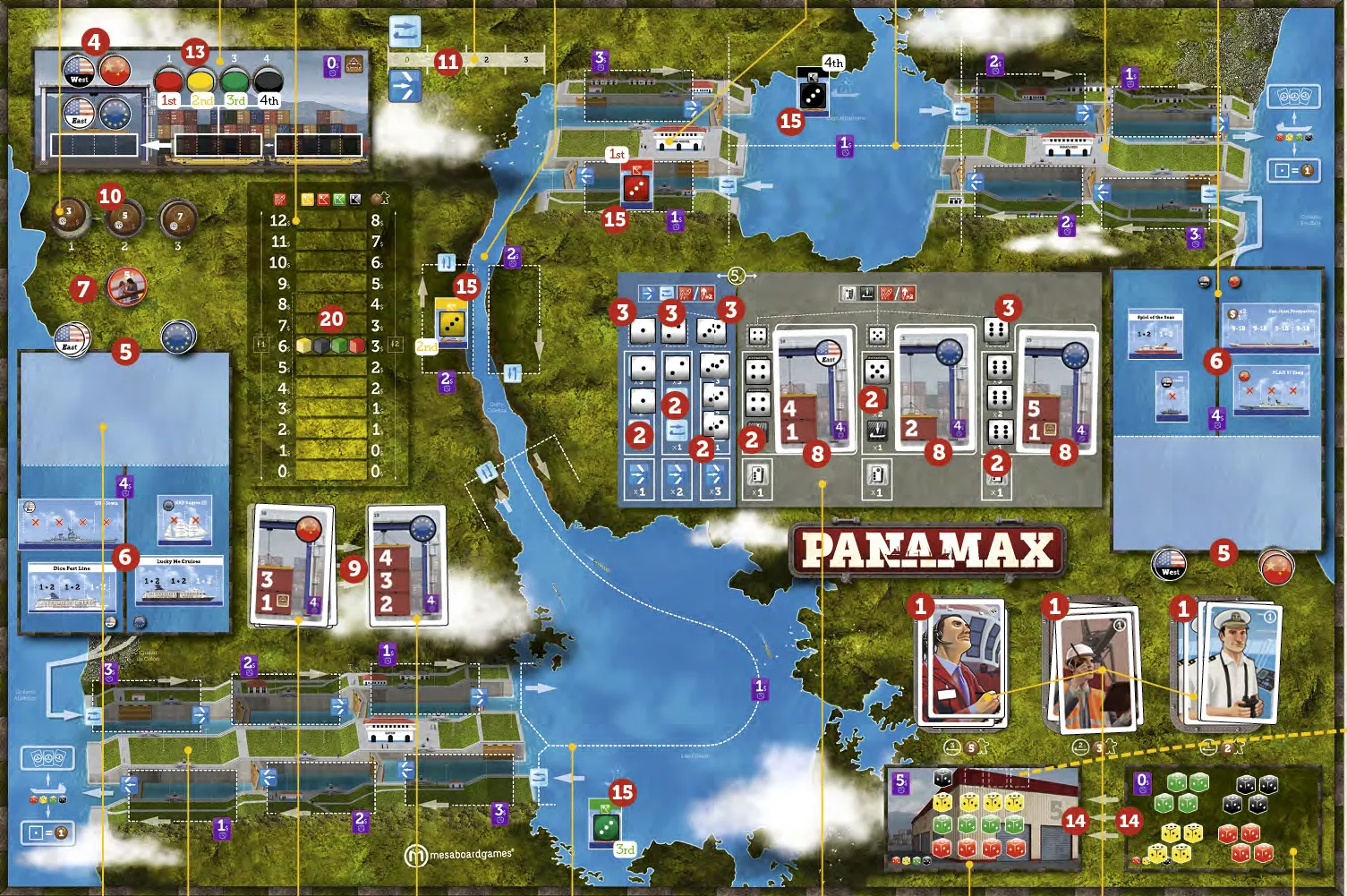
- Bonus cards (1). Captain and Stevedore cards are stacked face down in number order, card 1 on top: the early cards are the strongest (Cards & Components). Financial Advisor cards are shuffled.
- Action table (2, 3). The white dice are rolled and sorted by value into the columns, highest row first. A full column passes its extra dice to the next column on the left with room, and the die takes that column’s value; leftover 1s pass to the right instead. The last dice rolled are the Executive dice: a 1–3 goes on its pip space over the blue side, a 4–6 over the grey side. If either side ends up with too few dice (4 or fewer with 4 players, 3 or fewer with 2–3), re-roll everything — this mulligan applies every round.
- Flags (4, 5). One flag of each nation sits on the Rail table, ready to be won at round end. The other flags wait beside the Waiting zones until contracts are completed.
- Unique ships (6). Military ships, Cruise ships and the San Juan Prospector start in the national Loading zones (Unique ships).
- Passengers (7) are stacked 5, 4, 4, 3, 3, 2, 2, 1 — the first Cruise passengers pay best.
- Contracts (8, 9). Three contracts lie above the Contract columns; the next one waits on the Inbound Cargo space.
- Awards and markers (10, 11). The Managing Director Awards ($3, $5, $7) go on the Round table; the movement markers start at 0.
Each player
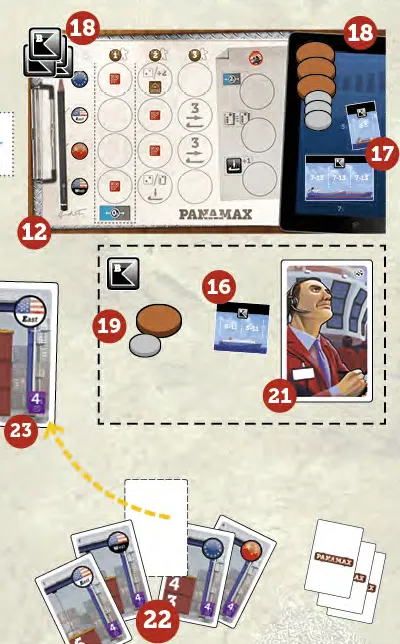
- Company and order (12, 13). Turn order is random for round 1; your disc sits on the Rail table above the 2nd wagon.
- Dice (14). Each company has 9 dice: 4 start in the Dice Pool, 5 in the Warehouse. Dice in the Warehouse cost $5 each at the end of every round, so getting them onto ships matters from turn 1.
- Ships (15–17). Everyone starts with a 1-slot ship already in the canal carrying a 3 — later players start closer to the end, which makes up for their turn position. The 2-slot ship is built and free to place. The 3-slot ship and the second 1-slot ship are still on the Clipboard and cost $7 and $5 to build.
- Money and shares (18–20). The company holds 4 of its 5 shares for sale and $18; you hold 1 share and $6. Every company’s stock starts at $6.
- Financial Advisors (21). Two cards each: keep one, pass one left, then keep one of the two you hold as a secret goal. The other goes back into the deck, which a 3-slot ship lets you search later.
Startup contracts
- Draw one Setup Contract card (white backs) per player, plus one (22). The rulebook also calls them “Startup” contracts — a typo: they are the 8 Setup Contract cards (BGG thread).
- In reverse turn order, take one, set dice from your Warehouse to its values and load them at once onto ships in the matching Loading zone (23), one die per ship, as many as the card has. Build ships if you need them.
- An emptied card earns its nation’s flag, with any free action, and returns to the box with the unused cards. An unfinished one stays by your Clipboard and counts toward your two incomplete contracts.
Advanced setup
For players who know the game. Instead of the fixed $18 and $6:
- Everyone takes $24 and bids in secret, in a closed fist, $12, $15, $18, $21 or $24.
- The bid is the company’s starting money; the rest is your personal money.
- The company’s stock starts at one third of its bid: $4 to $8.
Shares are dealt as usual. The bid replaces only the money and stock-price steps; turn order is still drawn at random first (BGG thread).
Two and three players
| Players | Action dice | Executive dice | Turns each per round | Mulligan if a side has |
|---|---|---|---|---|
| 4 | 12 | 4 | 4 | 4 or fewer dice |
| 3 | 9 | 3 | 4 | 3 or fewer dice |
| 2 | 10 | 2 | 6 | 3 or fewer dice |
With 2 players, the San Juan Prospector and Spiel of the Seas stay in the box, and the two remaining Cruise ships start one in each Waiting zone instead of a Loading zone.
Solo setup
[PanaBot] The solo variant plays on the two-player numbers against an automated company. Its setup changes are on the PanaBot page.