Teach the Game
A script to teach Maestro at the table — how you win, the boards, a round and a turn, the end, every way to score and what each resource is for.
How you win
“Florence, early 1500s. Leonardo da Vinci’s workshop against Michelangelo’s — one or two of us on each side. We create Artworks, carry them to the Galleries of northern Italy, sway the Collectors who decide which regions are in fashion and win the favour of patrons. Four rounds, about two hours. The Workshop with the most victory points wins.”
You score mostly in two ways:
- Galleries, every round — hold the most Artworks in a region with a Gallery and your Artwork becomes its Centerpiece. In each Exhibition phase every Gallery pays its Centerpiece owner; Popular Galleries pay double, and the Collectors decide which colours pay most.
- The end of the game — your Workshop board (da Vinci’s Inventions, Michelangelo’s cleared Sistine Chapel) and the Patroness cards you won.
The loop: play a card to one of four Actions — its Effort powers the action, its Publicity fights for that Action’s patron card — then use your Workshop with the Resources your partner passed you.
The boards
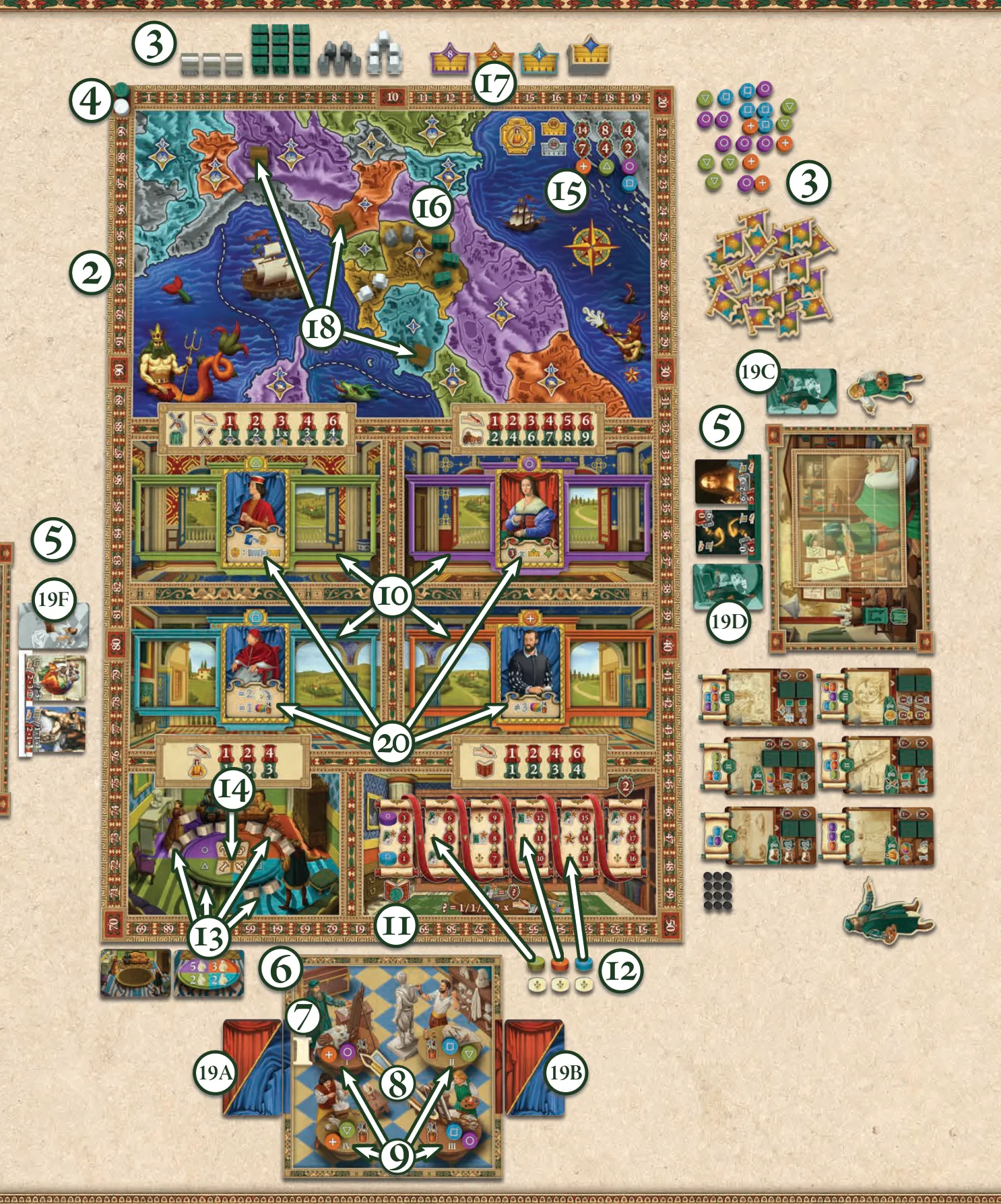
- Map of Italy (top) — numbered regions in four colours, Florence (where new Artwork arrives) and gray regions you may only cross. Gallery tokens show where art is exhibited this round.
- Four Action spaces (middle) — Move, Create, Influence and Study. Each Workshop plays its cards on its own side; each space holds a patron card for the round.
- Collector Lodge (bottom left) — four coloured areas. The colour with the most Collectors makes its regions score most.
- Study track (bottom right) — six tiers of rewards: Resources, card upgrades, Workshop upgrades.
- Sideboard — the four Characters (Leonardo, Michelangelo and their Assistants) around the Tools tile, which points at whoever acts next. Each Character’s Resources sit in its section.
- Workshop boards — da Vinci’s grid for Resource patterns with six Blueprint cards beside it; Michelangelo’s ceiling of 20 Sistine Chapel tiles.
A round
Four rounds of five phases. Details.
-
Planning — only a Workshop with two players: plan together. After this, no more talk.
-
Preparation — draw 5 cards, discard 2, keep 3. Alone you do this twice and set the first 3 aside.
-
Action — 12 turns, alternating Workshops. On your turn:
- Main Action: play a card to Move, Create, Influence or Study; its Effort gives Action Points (table). You may add a Publicity token.
- Workshop Action: da Vinci places all his Resources on the Workshop board and may build an Invention; Michelangelo pays Resources to resolve and clear a Sistine Chapel tile.
- Turn the Tools tile to the next Character.
In rounds 1 and 2 the first 4 turns are Gossip turns: each Character plays a card face down, only for its Publicity.
-
Exhibition — Galleries score; then each Action’s patron card goes to the Workshop with more Publicity there. Details.
-
Cleanup — scored Galleries lose an Artwork, Popular Galleries become Secondary, three new Popular Galleries appear, new patron cards are dealt.
How the game ends
- Trigger: after the Exhibition phase of round 4 (skip that Cleanup).
- Final scoring: your Workshop board — Michelangelo 2 VP per removed Sistine Chapel tile and 2 VP per empty row; da Vinci the VP beside each Invention he built — then your Patroness cards. Details.
- Ties: most Popular Gallery tiles, then farther on the Study track, then the marker underneath.
Ways to score
| Source | How and when |
|---|---|
| Popular Gallery | Exhibition, each round: 14 / 8 / 4 VP to the Centerpiece, by the colour’s rank in the Collector Lodge — and you keep its Popular Gallery tile |
| Secondary Gallery | Exhibition, rounds 2–4: 7 / 4 / 2 VP by the colour’s rank |
| Card upgrades | When you upgrade: the old card’s Effort (from your hand) or Publicity (from the board), doubled in rounds 3–4 |
| Sistine Chapel (Michelangelo) | End: 2 VP per removed tile, 2 VP per empty row |
| Inventions (da Vinci) | End: the VP printed beside each Invention marker you took |
| Patroness cards | End: each scores its condition — regions, upgrades, Effort, Publicity, Study tiers, Resources… |
| Event module | Rounds 3–4: extra VP for majorities and other feats |
What each resource is for
| Resource | Why you need it | How you get it | How you use it |
|---|---|---|---|
| Cards | Every action | 3 a round from your deck (Preparation) | Effort → Action Points; Publicity → patron cards; plus a special effect |
    Resources | Power your Workshop | Influence (the area a Collector leaves), Study, Gallery presence without majority, cards | da Vinci: patterns for Inventions. Michelangelo: Sistine Chapel tiles, or +1 Effort each on a matching Action |
   Artwork | Majorities and Centerpieces | Create (always +1 to your supply first) | Create puts them in Florence or your Centerpiece regions; Move carries them out |
| Collectors | Decide which colours score most | Already in the Lodge | Influence moves and lays them down |
 Publicity tokens | Win patron cards | Lose a Publicity contest, Benefactor cards | Add one to a card you play: +2 on a matching Action, +1 otherwise |
| Benefactor cards | One-time boosts | Win Publicity at an Action | Use before or after your Main Action, or at the start of the Exhibition |
| Patroness cards | End-game VP | Win Publicity at an Action | Scored at the end |
Teaching tips
-
Teach the asymmetry early: da Vinci builds a slow engine of Inventions, Michelangelo gets quick, punchy Sistine Chapel effects.
-
Stress the Resource hand-off: what you gain goes to your partner (or your other Character), not to you.
-
Walk through one Exhibition with the Collector Lodge in view — the colour order is the heart of the scoring.
-
First game in teams: consider the Communication variant; it is slower but friendlier.
-
Rehearse one face-down Gossip card with no actions, then a normal Create: gain an Artwork to your supply before placing it in Florence. Practice example.