Teach the Game
A script to teach John Company at the table — how you win, the board, a turn's nine phases, how the game ends, every way to score and what money and promises are for.
How you win
“London, 1710. We are rival families sending our sons and daughters into the East India Company. They run its offices, trade and fight in India, then come home rich to buy estates, seats in Parliament and titles. The Company is a shared machine none of us owns — we profit from it, and we may let it fail. Five turns in the 1710 scenario. The family with the most victory points wins.”
You score mostly in three ways:
- Retirements — every London Season, family members coming home from offices buy
prizes: estates, seats and titles worth
 points.
- Power — at the end, the families with the most
 power (enterprises, Company
shares, passed laws, trophies, blackmail) take a power award.
- Company shares — each one scores if the Company survives, and costs you if it fails.
The heart of the game: almost everything is a deal. Offices are handed out by other players, money flows through them, and any promise can be made — only promise cards are binding.
The board
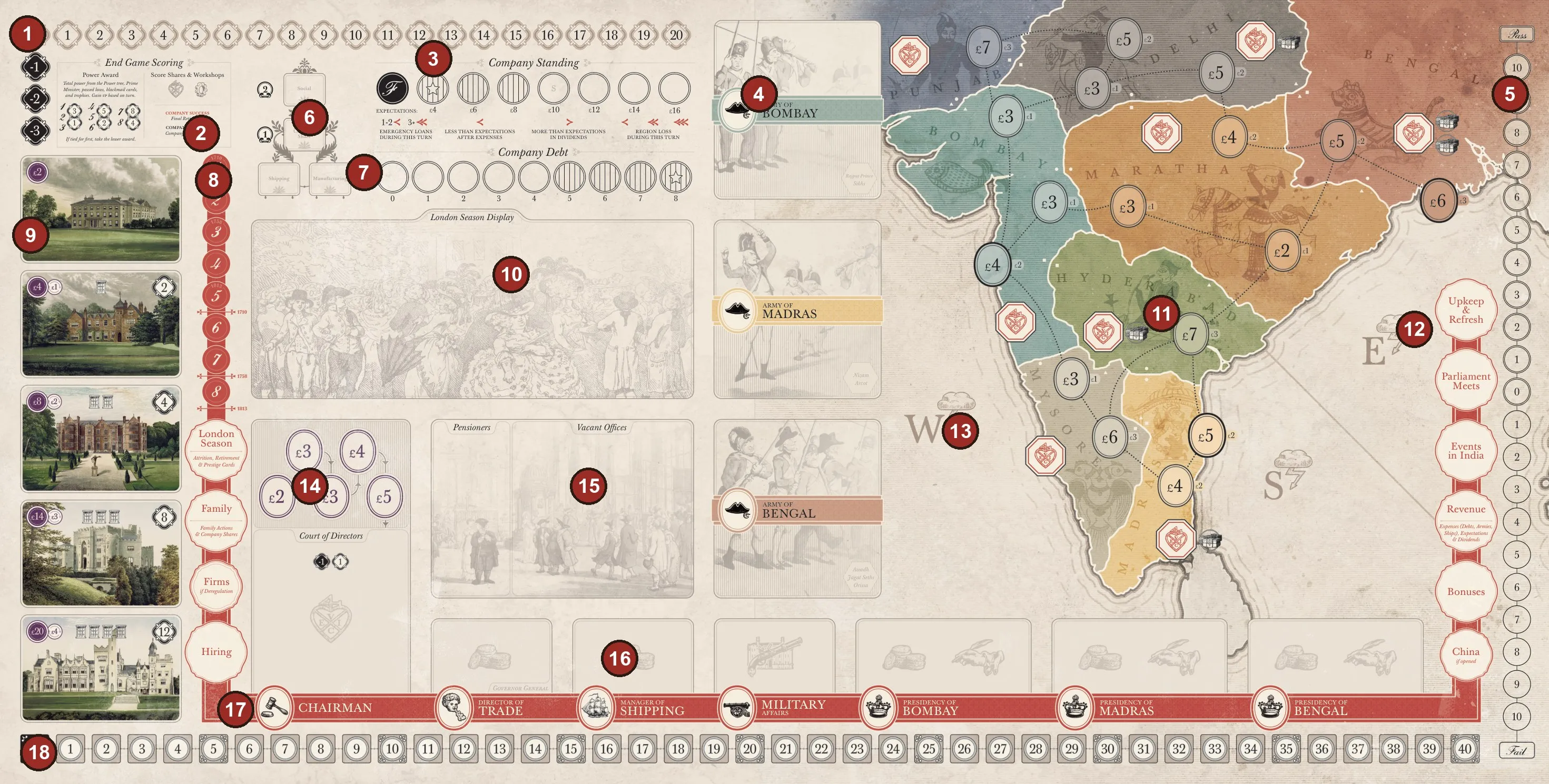
- Map of India — eight regions, each with orders to fill and a strength made of tower levels. Empires form and fall; the Elephant shows where trouble comes next. Three sea zones, one per Presidency, carry the ships.
- The Company ribbon — the offices in the order they act: Chairman, Director of Trade, Manager of Shipping, Military Affairs, then Bombay, Madras and Bengal, each with its treasury and Army.
- Company tracks — Balance, Debt and Standing. Standing at the leftmost space and the Company fails.
- London — the prizes, the London Season Display, the Power track and the Votes track.
- Your family board — your supply, treasury and enterprises.
The full legend is on How to Play.
A turn
Nine phases. Details.
- London Season — roll attrition for officers, retire pensioners to prizes, take prestige or blackmail cards. Details.
- Family — two actions each: enlist a writer or officer, buy an enterprise, seek a Company share. Details.
- Hiring — the Chairman is elected by shares, then each office hires the next. Nepotism costs Standing. Details.
- Company Operations — offices in order spend the Company’s money: Chairman, Director of Trade, Manager of Shipping, Military Affairs, then each Presidency trades, fights and governs. Details.
- Bonuses — £1 per fitted shipyard and per workshop.
- Revenue — expenses, expectations and dividends move Standing. Details.
- Events in India — storms at sea, then event tiles: turmoil, crises, invasions, peace. Details.
- Parliament — the Prime Minister picks a law and everyone votes with cash. Details.
- Upkeep and Refresh — pay upkeep on prizes, reset the board.
How the game ends
After the scenario’s last turn — or at once if the Company fails. Then Final Scoring: the power award, Company shares (plus or minus), and either a last retirement or a Company failure card blaming somebody.
Ways to score
| Source | When | How |
|---|---|---|
| Prizes | Each London Season | Retire a pensioner and pay the prize’s cost. |
| Prestige cards and spouses | When taken | Printed points. |
| Power award | Final Scoring | Most and second-most power. |
| Company shares | Final Scoring | Court value each if the Company survived; minus that if it failed. |
| Workshops | Final Scoring | 1 each, only if the Company failed. |
| Final retirement | Final Scoring | Only if the Company survived. |
What each resource is for
- Your family treasury — buy enterprises and shares, retire to prizes, pay upkeep and taxes, vote in Parliament, and sweeten deals. You can’t move it into the Company’s boxes yourself.
- Company money — sits in office boxes and is spent only by whoever holds that office. Presidents and Commanders turn it into trade income and loot; much of that goes to the families.
- Promise cards — the only binding deals: five per family, given away and called in later.
- Ships, writers and officers — your stake in India: a fitted ship earns its shipyard bonus, writers on filled orders pay you, officers win trophies and loot.
Teaching tips
- Set up 1710 and teach with the board in front of you; the first turn teaches the rest.
- Say early that the Company can fail, and that failure isn’t the end of everyone’s hopes.
- Encourage open negotiation from the first Hiring phase.
- With one or two players, teach the Crown after the base turn.