Family and Hiring
Phases II and III of John Company: the six family actions and the opportunity marker, new Company shares, and how every office is hired — Chairman election, nepotism and promotions.
Family actions
Starting with the Chairman and going clockwise, each player takes one family action and puts their glass opportunity marker on it. If your marker was already on the action you choose, you take that action twice. (At the start of the game the marker is on no action.)
- Out of family members? If an action needs a piece and you have none, take one back from any of
your prizes and lose that prize’s
 points.
- Extra actions. Some passed laws give everyone one extra action after the main one. Only the most recently passed one counts; it is never doubled and doesn’t move your marker.
- No action. If you have no pieces, no prizes and no money, you can’t act: put your opportunity marker in your supply.
Enlist Writer
Put a family member in one of the three Writers boxes as a  writer. If 4 or more
offices are vacant, you may enlist one extra writer, once this turn — so up to three with a doubled
action.
Enlist Officer
Put a family member in the Officers-in-Training box as an  officer in
training. Military Affairs sends them to an Army later in the
turn.
Purchase Luxury
Pay £4 and take a luxury: +2 while you own it, one  window, a
 social enterprise.
Purchase Shipyard
Pay £2 and take a shipyard; its ship sits on it, unfitted. Once the ship is fitted it pays a
£1 bonus each turn. One  vote. A
 shipping enterprise.
Purchase Workshop
Pay £5 and take a workshop: a £1 bonus each turn, two votes, and 1
if the Company fails. A  manufacturing enterprise.
Seek Share
Put a family member on an empty space of the Stock Exchange above the Court of Directors and pay its price (£2, £3, £3, £4 or £5). It may become a share at the end of the phase.
New Company shares
After everyone has acted, for each point of Company Debt: move the rightmost family member on
the Stock Exchange into the Court of Directors, where it becomes a  Company
share, and lower the Debt by one. Repeat while there is both Debt and someone waiting.
If people are still waiting but there is no Debt, slide them as far right as possible, keeping their order. They wait for a later turn.
A Company share pays dividends, helps elect the Chairman and scores at the end if the Company survives — or costs points if it fails.
Hiring
Fill every vacant office, in ascending order of the number on the back of its card. The back also says who hires and who may be chosen. The new officeholder moves onto the office and takes its card.
| No. | Office | Hired by | From |
|---|---|---|---|
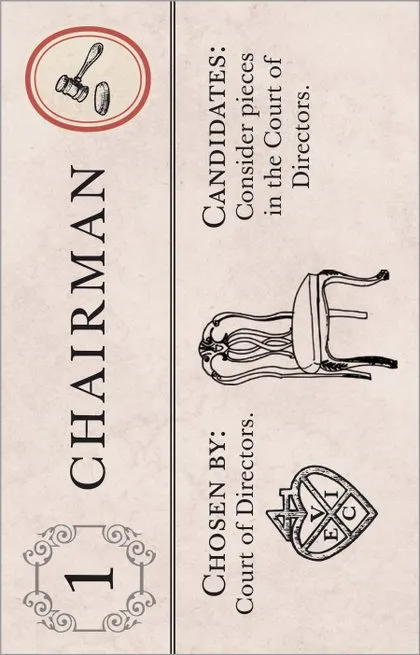
| 1 | Chairman | election in the Court | players with a Company share |
| 2 | Director of Trade | Chairman | any officeholder except the Chairman and Governors; if all are vacant, any writer |
| 3 | Manager of Shipping | Chairman | any writer |
| 4 | Military Affairs | Chairman | any Commander; else any officer; else anyone in Officers-in-Training |
| 5–7 | President of Bombay, Madras, Bengal | Director of Trade | a writer or Governor of that Presidency |
| 8 | Superintendent of Trade in China | Chairman | any writer |
| 9–16 | Governors | their President | a writer or officer in that region’s Presidency |
A Commander is not an officeholder and not an officer, so can’t become Director of Trade or a Governor.
Nepotism
You may hire your own family member only with the spoken consent of every other player who has a candidate for that office. This doesn’t apply to the Chairman election. A “My consent for nepotism” promise card lets you skip its guarantor.
Promotions
When someone already holding an office is hired into another, their old card goes face down among
the vacant offices (in number order, so it is filled later this phase) and any  fatigue
moves to the new card.
If an office has no possible candidate, or the office that hires it is vacant, it stays vacant all turn and does nothing — not even hire.
Chairman election
Any player with a Company share may stand. The former Chairman announces how many shares are a majority (more than half). Players campaign and bargain; the moment someone has the support of a majority of shares, they are Chairman.
The new Chairman takes the Chairman marker and moves one of their shares onto the Chairman space. It still counts as a share (for votes in the Court and for dividends) but can’t be traded or invested in a firm.
If nobody reaches a majority, the former Chairman picks any player with a share — themselves included. If the Court is empty, the former Chairman stays on with a piece from their supply (or from a prize); if that’s impossible, there is no Chairman.
Who hires whom
The Chairman hires the central offices; the Director of Trade hires the Presidents; each President hires their Governors. Governors and the Superintendent of Trade in China only exist once created in play. If Parliament passes the Governor General law, Governors disappear and the Governor General takes the Director of Trade’s place.