How to Play
The core of John Company: what you are trying to do, the board and its numbered parts, the map of India, empires and the Elephant, negotiation and promise cards, and the nine phases of a turn.
The goal
You lead a British family in the eighteenth century. The East India Company is not yours: everyone
shares it, holds its offices, and uses it to make money. That money matters only because your
family members later retire from the Company and buy estates — the prizes on the left of the
board — which give  victory points. Spouses, luxuries, shares and the end-game
power award add more.
The family with the most victory points at the end wins, whether the Company survives or not. If it fails, shares cost points instead of giving them — see Company failure.
Scenarios
| Scenario | Turns | For |
|---|---|---|
| 1710 Early Company | 1 to 5 | Your first game. |
| 1758 Company Under Siege | 3 to 7 | After a couple of 1710 games. The monopoly can be voted away (Vote to Deregulate). |
| 1813 Post Monopoly | 5 to 8 | The most advanced. Starts deregulated, with private firms; best with 5–6 players. |
| Long 1710 | 1 to 8 | The full history, about twice as long. Starts like 1710, with the Vote to Deregulate available. |
Each scenario card lists where the Standing and Debt markers start, the cash in each Company treasury, the laws already passed, the starting regiments and Company ships. Its back shows the starting map of India.
The board
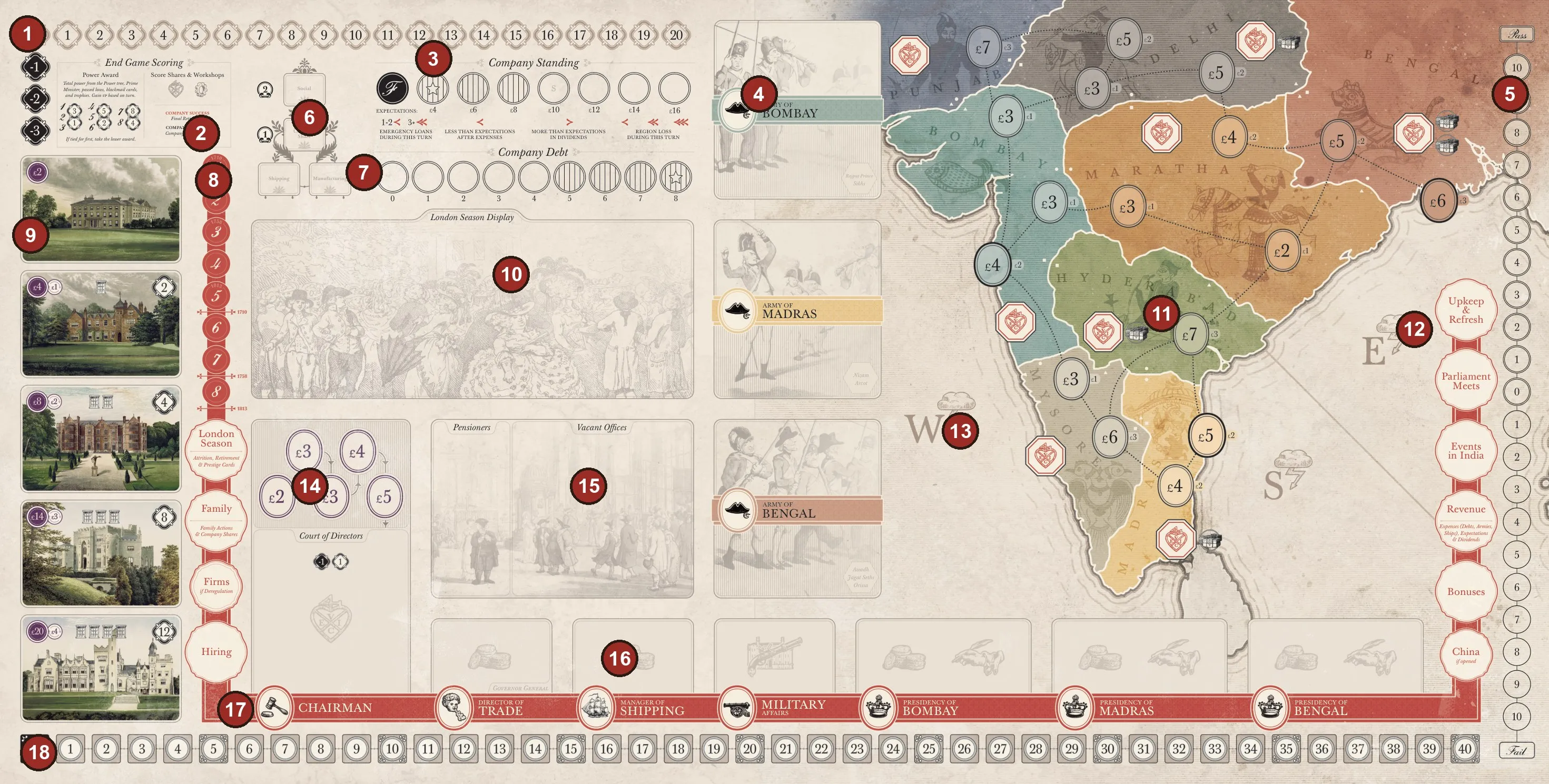
- Victory point track — 0 to 20, then keep going round.
- End game scoring — the power award table by final turn, and the share and workshop reminders.
- Company Standing — the expectations the Company must meet (£4 to £16); the leftmost space means Company failure.
- Armies — one per Presidency: Commander slot, officers and regiments, and the local alliances listed in the box.
- Votes track — support for the law, from Pass to Fail.
- Power track — the power of
 social,
 Company share,
 shipping and
 manufacturing at the end.
- Company Debt — 0 to 8.
- Turn track — turns 1 to 8, with each scenario’s start and end marked.
- Prizes — the five estates your retired family members buy.
- London Season Display — three prestige or blackmail cards.
- Map of India — eight regions with their orders.
- Phase ribbon — the phases of a turn, read along the board’s edge.
- Sea zones — West, South and East Indian Ocean, one per Presidency.
- Stock Exchange and Court of Directors — bought shares wait above; Company shares sit in the Court.
- Pensioners and Vacant Offices — retiring family members and empty offices.
- Office treasuries and Writers boxes — the cash each office may spend, and each Presidency’s writers.
- Company ribbon — the offices in the order they act: Chairman, Director of Trade, Manager of Shipping, Military Affairs, then the three Presidencies.
- Company Balance — the Company’s money, 0 to 40, before the Chairman shares it out.
Your pieces
Each family has 18 family members, a victory point marker, 5 promise cards, a glass opportunity marker and a family board (plus 2 firm cubes and 4 firm strategy cards for Deregulation). Family members mark almost everything you own:
 Writers — in a Presidency’s Writers box; they become traders and office candidates.
 Officers-in-Training,
 officers and
 Commanders — in the Armies.
- Officeholders — on an office space, with the office card in front of you.
- Company shares — in the Court of Directors.
- Retired family members — on a prize.
Money
Cash always sits somewhere, and where it sits decides who may spend it. Your family treasury pays for family actions, retirements, upkeep, taxes and deals. Cash in an office treasury can only be spent by that office. The Company Balance is shared out by the Chairman each turn.
Some offices pay their holder a bonus when they act; the board shows these in boxes. Everything is public except face-down blackmail cards.
Map of India
Eight regions: Punjab, Delhi, Bengal, Bombay, Maratha, Hyderabad, Mysore and Madras.
- Strength — the number of tower levels in the region (the dome on top does not count). It is the region’s attack and defence.
- Orders — the numbered circles, linked by dotted lines. The big number is the order’s value
when the Company fills it (the small number is for firms).
- Home ports have a thick black outline: Bombay, Madras and Bengal each have one, and trade starts there.
- A closed order is covered by a token and can’t be filled.
- Sovereign or dominated — a region with a large flag, or a dome and no flag, is sovereign and tries to invade its neighbours. A region with a small flag (or no dome) is dominated and tries to rebel.
- Company-controlled regions have a Governor overlay and no tower; their strength comes from their Army.
- Loot tokens sit in each region until the Company conquers it.
- Unrest cubes in a Company-controlled region make attacks there stronger.
Empires
A region that conquers another forms an empire, or grows its own. The capital carries a flag with a star, each dominated region a small flag of the same colour. Empires add up the strength of all their regions when they attack and defend. An empire cut back to its capital alone loses its flag and is no longer an empire.
The Elephant
The Elephant always shows the next looming crisis in India:
- On a border — the region behind its tail is about to invade the one it faces.
- Inside a region, or facing the region that dominates it — that region is about to rebel.
It moves in Events in India.
Negotiation
Almost everything is negotiable, at any time. You may give or trade:
- enterprises (shipyards, workshops, luxuries, enterprise prestige cards);
- face-down blackmail cards (others may peek before buying);
- cash from your family treasury;
- Company shares (the new owner swaps the piece for one of their own; never the Chairman’s share);
- promise cards.
You can’t trade officeholders, writers, officers, family members on prizes, spouses, passed laws, played blackmail cards, the Prime Minister dial or trophies. A deal that transfers something now is binding; any promise about the future is not. Something you transfer can’t be used twice in the same step: a workshop sold after it paid its bonus doesn’t pay again.
Promise cards
Each family has five promise cards, guaranteed by that family:
| Promise | You can call it in to… |
|---|---|
| Take £2 or less from me | take up to £2 from the guarantor’s treasury |
| Take my officeholder’s bonus | take a bonus the guarantor’s office earns |
| Take my London Season card | take the card the guarantor picks in the London Season |
| My consent for nepotism | ignore the guarantor when you need consent for nepotism |
| Vote with my enterprises | use the guarantor’s enterprises to vote |
Call one in and the guarantor must keep it if they can; if several are called at once and they can’t keep all of them, they choose. Promise cards can be passed on to a third player or handed back. They can’t be called in once Final Scoring starts. Each card’s back explains its use.
Sequence of play
Every turn has nine phases, shown on the board’s phase ribbon:
- The London Season — officeholders may retire, buy estates and compete for prestige cards (skipped on the first turn).
- Family — one family action each; then new Company shares.
- Firms — only with Deregulation.
- Hiring — every vacant office is filled.
- Company Operation — each office acts, left to right along the red ribbon.
- Bonuses — shipyards and workshops pay.
- Revenue — the Company pays expenses, may pay dividends, and its Standing moves.
- Events in India — storms at sea, then events in India.
- Parliament Meets — one law is voted on.
- Upkeep and Refresh — pay for your estates and reset for the next turn.
The game ends after the scenario’s last turn, or at once if the Company fails — Game End.